In the Journals

New Virtual Issue of Cultural Anthropology on “Security”

Once I get done with these midterm exams, I’ve been itching to get another edition of Anthropoliteia In the News out, but this is too exciting to wait: one of our fellow anthropoliteians, Michelle Stewart, has co-edited a special online virtual issue of Cultural Anthropology on the topic of “Security”.

Check it out at: http://culanth.org/?q=node/258

Continue reading

Standard
In the Journals

As part of the continuing project to think through policing in the financial crisis, i thought it would be helpful to highlight the current issue of Anthropology News, which gives examples of anthropological takes on the same issue in other domains

October AN Addresses the Economic Crisis

AN cover, October 2009 Full-text October 2009 In Focus commentaries will be available here through October 31, and subsequently through AnthroSource. Share your comments on these articles through the AAA blog. Read more about accessing Anthropology News electronically on our archives page. See the AN homepage for information on opportunities to contribute to AN.

via October AN Addresses the Economic Crisis.

October AN Addresses the Economic Crisis

Aside
Book Reviews

Of Police, Provinces, and Professionalization

Came across this today via H-Net Reviews:

Zhiqiu Lin. Policing the Wild North-West: A Sociological Study of the Provinvial Police in Alberta and Saskatchewan, 1905-1932. Calgary: University of Calgary Press, 2006. 210 pp. $34.95 (paper), ISBN 978-1-55238-171-7.

Reviewed by Joel Kropf (Carleton University)

Published on H-Canada (September, 2009)

Commissioned by Stephanie Bangarth

For the most part, it’s a thoroughly well-written review on what seems like a responsible piece of scholarship.  In other words, I can’t see why it might be interesting at all (maybe Michelle, our resident Canada expert, can help me see more of what’s at stake here?).

One thing that did pop out at me, though, was this:

…he intends the term “professionalization” to evoke “rationalization” and Max Weber’s ideas concerning the latter.  “Calculable and predictable rules and procedures” have tended more and more to infuse organizations and enterprises in many nineteenth- and twentieth-century societies, and this holds true, Lin believes, in the case of policing in Western Canada (p. 203n7).  By no means does Lin claim that the patterns and approaches emerging among Canadian police during the period of his study always possessed a more professionalized flavor than their previous practices had.  Sometimes the provincial police went with the less professionalized alternative from among the options that they might potentially have pursued.  On the whole, however, the police found it attractive to incorporate new doses of professionalism into their patterns of work.  After all, citizens who noted a police force’s proclivity for professionalized dealings became less likely to worry that they might suffer from prejudiced actions or capricious responses on the part of officers.  And this, in turn, tended to reduce the chances that police would find their efforts impeded by distrust or recalcitrance on the part of the people among whom they worked.

There’s something that seems a bit off there; i’m still trying to put my finger on exactly what it is.  It’s in the reading of Weber, for one (I love Max, but whatever… I can let that slide), but also in the portrait it offers of Canadians as fundamentally rational actors in search of a government worthy of them.  Maybe that’s more accurate than I think, but something smells off there, to me…  to be continued after some reflection.

Standard
Dispatches

Policing after the “financial crisis”

So I did a little bit of “exploratory ethnography” here in my new home of Worcester, MA by going to a Public Safety Commission Meeting.  There’s plenty that could be said about it, even though it lasted all of ten minutes (has anybody else gone to these kinds of meetings?  Have you noticed how existentially absurd they are?  They don’t really do anything like that in France), but one thing in particular stuck out… It seems that the City of Worcester will need to lay off 24 officers by the end of September due to the city’s $1,300,000 (i like to leave in zeros) deficit.  this is on top of the fact that they apparently graduated 32 new recruits in February and promptly proceeded to lay them off at the end of the month.

To me, that sounds like a lot.  To put that in context, according to the WPD’s 2008 Annual report they had 381 budgeted police personnel, which amounted to $38,969,002 in Salary, Overtime and Holiday/Extras.  So these cuts would mean anywhere from about a 6% (just subtracting the 24 officers from last year’s corps) to a 17% (adding together the 24, plus the 32 recruits, plus the 9 scheduled retirees) cut in the workforce and the $1.2 million would be about 3% of the money budgeted for salary. Now, that doesn’t sound like that much, but I have no idea to be honest.  I really have only a general sense of what these kinds of cuts will mean–if they mean anything new at all.

Which got me wondering: does anyone know of any good work and/or reporting being done on the effects of the financial crisis on the practices of policing in American (or other) cities?  If not, shouldn’t we be a part of that?  What kinds of questions can we fruitfully ask about the situation?

Here’s the outline of one: if nothing else, what we’ve learned from the literature on neoliberalism is that it doesn’t make much sense to call it a “retreat of the state”–everyone from Loic Wacquant to Nikolas Rose & co. to the Cheney/Bush homeland security apparatus has shown us that.  Even though that’s very much how the present crisis is being framed (“lack of government funds” etc.), the same truth still seems to hold–wither the stimulus money, for example?

How else to make sense of  “financial crisis'” affect on municipal policing?

Further Reading

Wacquant, L. (2008). The Body, the Ghetto and the Penal State Qualitative Sociology, 32 (1), 101-129 DOI: 10.1007/s11133-008-9112-2

Wacquant, L. (2001). The Penalisation of Poverty and the rise of Neo-Liberalism European Journal on Criminal Policy and Research, 9 (4), 401-412 DOI: 10.1023/A:1013147404519

Rose, N., O’Malley, P., & Valverde, M. (2006). Governmentality Annual Review of Law and Social Science, 2 (1), 83-104 DOI: 10.1146/annurev.lawsocsci.2.081805.105900

Standard
Announcements, Conferences

UC BERKELEY CONFERENCE: Queering Race, Policing Bodies: Militarization & Resistance | Center For Race Gender | CRG

Queering Race, Policing Bodies: Militarization & Resistance

Presenter:

“Documents and Disguises: Transgender Politics, Travel, and U.S. State Surveillance,” Toby Beauchamp, UC Davis

Presenter2:

“The Face of Gays in the Military: Neoliberalism, Multiculturalism, and the ‘Right to Fight,'” Liz Montegary, UC Davis

Date:

Thursday, September 10, 2009 – 4:00pm – 5:30pm

Location:

691 Barrows Hall

via Queering Race, Policing Bodies: Militarization & Resistance | Center For Race Gender | CRG.

(poster after the break)

Continue reading

Standard
Blotter

Anthropoliteia In the News 9/8/09

If you’ve  been so caught up in the story of the East Bay kidnapping uncovered by UC Berkeley police (for a cogent analysis, and some myth-busting regarding what parole can accomplish, see Jonathan Simon’s post over at Prawfsblog) that you haven’t had time for anything else, here’s another edition of Anthropoliteia In the News:

«Ceux qui sont fatigués, au revoir!»

Nicolas Sarkozy recently surprised a meeting of the departmental Cheifs of the Police Nationale and Gendarmerie, who thought they were merely meeting with Minister of the Interior Brice Hotrefeux, with an unannounced visit.  The reason for the suprise visit was the recent less-than-spectacular crime statistics, particularly in Loire.   These stats have been a bragging point for sarkozy over the last seven years.  The answer, according to sarkozy?  More work.  “Those of you who are tired, au revoir!”

But don’t be impolite about it.  The President of the Republic also reminded police officers to “respect the basic rules of courtesy” when dealing with youth, and not to immediately revert to using the (impolite and overly-familiar) “tu” form of address.

However…

Several French police unions have denounced as “overly aggressive” and “lying accusations” a televised report, and interview of Interior Minister Hortefeux, by M6 television reporter Mélissa Theuriau.

During a televised interview of Minister Hortefeux, Theuriau presented footage of a group of police officers forcing youth to the ground and suggested that such images “ridicule the police code of conduct.”

For his part Hortefeux suggested that the “presumption of innocence applies to police officers as well.”

In the space of security, police are the opposite of culture?

Or is the metric at play here that of “sublty” ?

Simon Reid-Henry has an interesting review of the new edited volume by geographers Alan Ingram and Klaus Dodds, Spaces of Security and Insecurity: Geographies of the War on Terror in Times Higher Education:
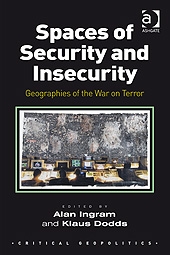
spacesofsecurityWhile some states are being broken up into ever less state-like parts, making intervention an easier task, others are busy hardening their borders through the securitisation of immigration and asylum legislation. This geographical unevenness in the manner and extent to which security is pursued through territorial proxy is sustained by cultural processes that normalise some definitions of security as they disavow others. This book is especially welcome for the way it picks apart this process. In doing so, it shows that if security has become perhaps the dominant paradigm of the War on Terror in Western states, it is based not only upon expanded police powers and identity cards but also on a raft of more subtle cultural practices that respond to and inform actual political events.

Police cars are not green

Over at Cop in the Hood, Peter Moskos doesn’t lament Ford’s decision to stop manufacturing Crown Vic’s, the industry-standard in American cop cars,  by 2011.   The whole affair does lead Moskos to inquire into the cost of operating such cars, and suggest that more green alternatives could be incentivized by offering cops who choose to patrol on foot $20-50 more per shift.

Mass Incarceration News

  • The California state Assembly watered down a bill intended to ease the state’s budget crisis by redusing the prison population. The stripped-down version of the bill will reduce the prison population by 17,000 inmates by next June instead of 27,000.  The saving will go from an estimated $300 million this year instead of the estimated $520 million.
  • Additionally, Jonathan Simon wonders whether more federal stimulus money for police officers will mean more people incarcerated (despite the state’s stated goal).  Simon’s answer? “Of course the law professor’s answer is “it depends.”  It depends on how those police officers view their job.”
  • Despite this, Simon suggests (or perhaps “hopes”) that mass incarceration might be the “new SUV,” meaning that it’s cultural profile could be in the process of “flipping”
  • Which is good news, because Chino prison just had one of the state’s biggest race riots in years.
  • Peter Moskos offers some pretty, if not exactly novel, graphs from the Justice Policy Institute of skyrocketing U.S. incarceration rates

[Insert requisite taser post]

Radley Balko at Reason Magazine offers an indictment of cop-based reality shows, especially TLC’s new Police Women of Broward County:

The most obvious criticism of these shows is their exploitation and general tackiness. Police work is reduced to clownish pranks, adrenalin-inducing raids, and telegenic lady cops edited to invoke S&M fantasies for the shlubs watching at home. No one expects much dignity from cable networks, but you’d think, for example, that the Broward County Sheriff’s Department might object to the sexualization of its female officers, or to a national ad campaign insinuating that they’re sporting itchy Taser fingers….

Cop reality shows glamorize all the wrong aspects of police work. Their trailers depict lots of gun pointing, door-busting, perp-chasing, and handcuffing. Forget the baton-twirling Officer Friendly. To the extent that the shows aid in the recruiting of new police officers, they’re almost certainly pulling people attracted to the wrong parts of the job.

One of the tag lines for TLC’s new show is “There’s always a good time to use a Taser.”

This Week in Anthropoliteia History

25 years ago this week Alec Jeffreys discovered DNA fingerprinting

The South Pacific, Water… and police

In writing an expose about Fiji bottled water for Mother Jones magazine, Anna Lenzer runs in to some trouble with the police

Moments later, a pair of police officers walked in. They headed for a woman at another terminal; I turned to my screen to compose a note about how cops were even showing up in the Internet cafés. Then I saw them coming toward me. “We’re going to take you in for questioning about the emails you’ve been writing,” they said.

What followed, in a windowless room at the main police station, felt like a bad cop movie. “Who are you really?” the bespectacled inspector wearing a khaki uniform and a smug grin asked me over and over, as if my passport, press credentials, and stacks of notes about Fiji Water weren’t sufficient clues to my identity. (My iPod, he surmised tensely, was “good for transmitting information.”) I asked him to call my editors, even a UN official who could vouch for me. “Shut up!” he snapped. He rifled through my bags, read my notebooks and emails. “I’d hate to see a young lady like you go into a jail full of men,” he averred, smiling grimly. “You know what happened to women during the 2000 coup, don’t you?”

Are police human?

I understand that edited pieces, such as special issues of journals, by their very nature can’t be exhaustive in their scope.  However, Daedalus‘s special issue “on being human,” an off-shoot of the National Humanities Center’s project of the same name, offers nothing coming close to a discussion of anthropoliteia, let alone any full-on consideration of police.

There would seem some work for us to do here: to include discussion of policing into STS-dominated discussions of “the human”.  How has the chasm between Aristotle (“man as that human animal with the additional capacity for politics”), or even Montesquieu, and the present moment opened up so wide as to make discussions of the human without politics seem plausible?

Foucault Lectures now on you iPod

Certainly one of the culprits people might point to for that transition is Michel Foucault and his discussion of biopower (“For millennia, man remained what he was for Aristotle: a living animal with the additional capacity for political existence; modern man is an animal whose politics places his existence as a living being in question”).

I don’t necessarily buy that though.  Luckily we can go to the audio to try to resolve it…  Mp3 versions of Foucault’s famous lectures, some of them in English, have been made available via UC Berkeley’s Media Resources Center.  These include such anthropolitiea-related classics as “Sécurité, territoire, population” and “Il faut défendre la société”.

Citations Mentioned

Rose, H., & Rose, S. (2009). The changing face of human nature Daedalus, 138 (3), 7-20 DOI: 10.1162/daed.2009.138.3.7
Gazzaniga, M. (2009). Humans: the party animal Daedalus, 138 (3), 21-34 DOI: 10.1162/daed.2009.138.3.21
Pippin, R. (2009). Natural & normative Daedalus, 138 (3), 35-43 DOI: 10.1162/daed.2009.138.3.35
Hacking, I. (2009). Humans, aliens & autism Daedalus, 138 (3), 44-59 DOI: 10.1162/daed.2009.138.3.44
Darwin, C. (2009). Comparison of the Mental Powers of Man and the Lower Animals–continued Daedalus, 138 (3), 60-67 DOI: 10.1162/daed.2009.138.3.60
Ritvo, H. (2009). Humans & humanists Daedalus, 138 (3), 68-78 DOI: 10.1162/daed.2009.138.3.68
Harpham, G. (2009). How do we know what we are? The science of language & human self-understanding Daedalus, 138 (3), 79-91 DOI: 10.1162/daed.2009.138.3.79
Appiah, K. (2009). Experimental moral psychology Daedalus, 138 (3), 92-102 DOI: 10.1162/daed.2009.138.3.92
Standard
In the Journals

Just a FYI to keep us up to date on anthropoliteia “out of place” (i.e. where you normally wouldn’t expect it):

Special Issue: Crime and Madness in Modern Germany

September 2009, Volume 39, No. 3

Guest editors: Ofer Ashkenazi, Udi E. Greenberg, and Jonathan Lewy

Journal of European Studies — Table of Contents (September 2009, 39 [3]).

I’m particularly excited to look at Udi E. Greenberg’s article on Carl Schmitt vs. Walter Benjamin…

Continue reading

Special issue of the Journal of European Studies: Crime and Madness in Modern Germany

Aside
Blotter

Tasers, tasers and more tasers: this time at an Oakland A’s game

It’s becoming clear that “the taser” will have to be one of the things we think through…  Another incident, this time right here in the East Bay:

According to Oakland Police spokesman Jeff Thomason, the unidentified man was allegedly drunk and yelling profanities, prompting A’s security to ask the cops to have him removed. Police say he appeared to be intoxicated, refused to leave and took a swipe at one of the cops. “Given his size and his condition the officer thought it appropriate to taser him,” Thomason said. The tased fan was hospitalized and held on a “5150” crazy hold.

via Matier And Ross : Taserball.

What’s more, the tasing officer has himself been the object of much scrutiny over the last several months, including some of the corollary incidents that occurred in the wake of the Oscar Grant shooting.

Now, I don’t think it’s very helpful if this blog serves just to document the many tasing incidents that occur–as our own socdeputy points out, by many important measures the use of these non-lethal implements is rather paltry.  On the other hand, and I think Brian would agree with me here as well, the fact that these incidents captures the public imagination is inself something that we probably need to reflect on.

Now, some of you may have read an article that I’ve been preparing (and finally submitted!) which argues that paying attention to the figure of the taser in the French banlieue riots of 2005 and 2007 offers insights into the very form of political action at stake in France today.  I call this emergent space, briefly, the “problem of a post-social police”– a pervasive set of open questions (ethical, social, political, technical) that are being negotiated around the goals, orientations and forms of legitimacy associated with the police once one of its founding objects, The Social, has lost its sway.

Now, from that perspective, one of the interesting aspects of the video (which can be seen below, after the break) is the way that, even as the incident is unfolding, there is a high degree of quite public negotiation of the scene: you can hear people off-camera debating the police action (“i can’t believe you guys tased him!”  “He was being belligerent!”); some people move away, while one man tried to move forward, causing a minor incident of its own; and, if I’m not mistaken, you can see some uncertainty among the police themselves as to how to move forward–after the man is (literally) done thumbing his nose at the cops, he appears to actually be putting out his hands to be cuffed.  One of the officers in physical contact with the man actually jumps back, apparently surprised by the second “tase”.  To add to everything a foul ball happens to be hit right into the middle of the fracas.

At the very least, I would hope that an anthropology of policing would be able to account for the complex levels at which incidents like this occur…

Continue reading

Standard