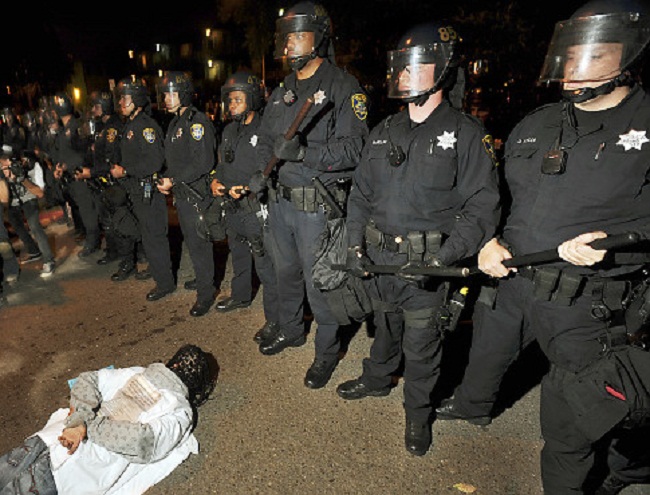
Oakland protest against murder of Oscar Grant. Image courtesy of Voice of Detroit
The editors of Anthropoliteia would like to welcome Brad Erickson with the latest entry in our developing Forum #Ferguson & Elsewhere
The police killing of an unarmed, 18-year old African American, Michael Brown, and the hyper-militarized response to public protest in Ferguson, Missouri, has prompted wide-ranging national discourse following several threads. The first, exemplified by the #BlackTwitter phenomenon, emphasizes the pattern of extrajudicial killings of black people by police, security guards and self-appointed vigilantes as the continuing exercise of racial domination in the United States. The second is the attempt to cast Michael Brown and other black victims as threatening criminals in order to justify their killings and deny the salience of racism. A third major theme is the militarization of police, a growing trend since the introduction of SWAT teams in the 1970s, now pushed into high gear through the federal distribution of idle war materiel including armored vehicles, grenade launchers, and machine guns. This militarization is often linked to a decline in civil liberties and violations of due process. Some commentators locate these trends in the contexts of the rise of a surveillance state, the crisis of inequality and the demise of democracy orchestrated by wealthy elites.
I would like to reflect on these trends via the perspectives of people deeply impacted by them. In 2013, I carried out an evaluation of Oakland’s community policing program, and also tracked the effectiveness of family support services in Oakland’s lowest performing middle schools. For the first project I interviewed Oakland police personnel including captains, sergeants, lieutenants, problem solving officers (PSOs—assigned to work with specific neighborhoods), and crime reduction team officers (CRTs—largely focused on gang activity). For the second project, I observed and interviewed parents and children, teachers, principals, school counselors, and a variety of school-based service providers including nurses, counselors, mental health professionals, legal advisors, food bank and community gardens personnel, and Teach for America volunteers.

 Anthropoliteia