#Ferguson & Elsewhere, Pedagogy

Anthropoliteia reacts to #Ferguson

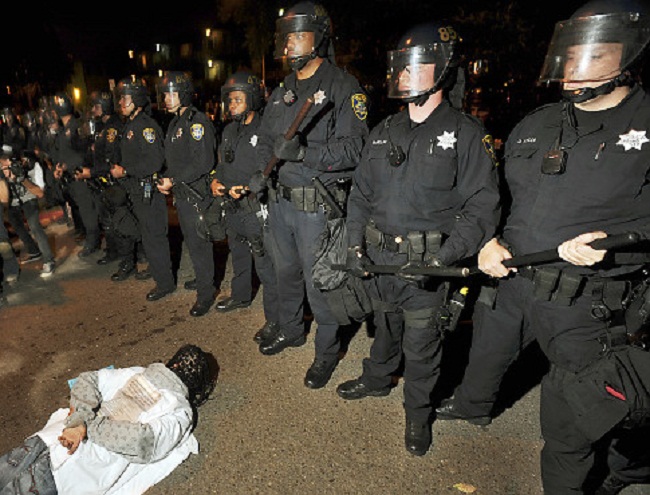
It’s hard to know what exactly to say, to think, to feel or how to react at a time like this; even as a scholar of police.  Which is not to say that everything in the case is terribly ambiguous.  Quite the opposite: another young black man has been the victim of a deadly and unaccountable state violence in front of our very eyes.  I suppose the disorientation lay in how to move forward, and for that I have no strong answers.

Embed from Getty Images

Having said that, several of us at Anthropolitiea have been active on Twitter, I imagine in an effort to make sense of exactly that existential question. This is not dissimilar to my own reaction during and after the Trayvon Martin/George Zimmerman affair.  Below are some of our thoughts, as we form them:

Continue reading

Standard
DragNet

DragNet September 8 – 21, 2014

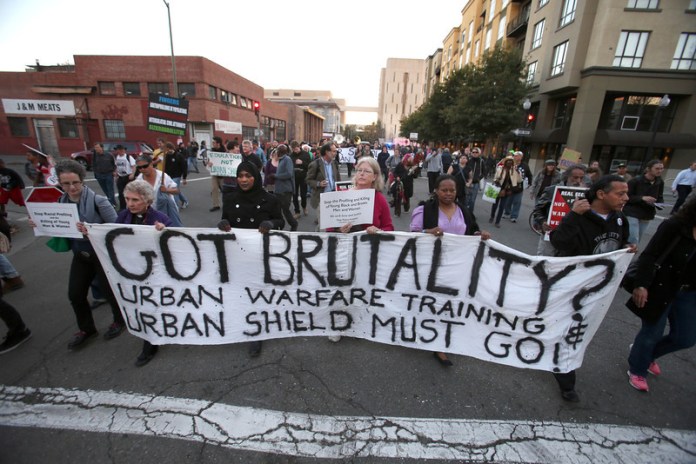
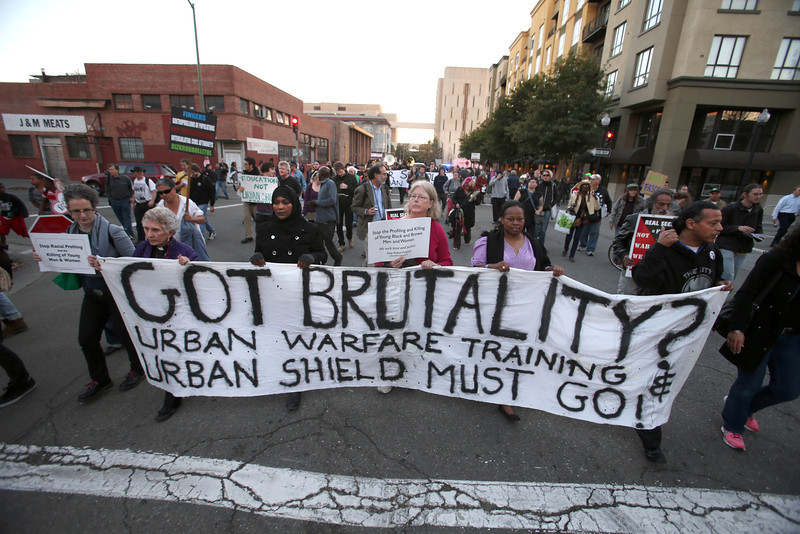
...just wait 'til you see the T-Shirts that were on sale at this year's Urban Shield event.

…just wait ’til you see the T-Shirts that were on sale at this year’s Urban Shield event.

“The claim that outside agitators had been the riot’s ringleaders…reiterated that black people were incapable of acting as political subjects in the defense of their humanity and rights as citizens,” writes Steven Gregory, professor of Anthropology and African American studies at Columbia University. Although applicable to the more recent Ferguson protests, Gregory’s words reference a series of similar events that occurred in 1930s Harlem. His recollection of several white-black, citizen-police fatalities exposes the need for not only institutional -but cultural- change.

Speaking of which, hopefully some of you were able to attend UC Berkeley’s forum, Black lives matter: police violence, prisons and freedom visions” on September 19th. The event featured speakers such as CeCe McDonald, Julia Chinyere Oparah and Ashon Crawley.

What can anthropology contribute to discussions of race, state-condoned brutality and violence? Pem Davidson Buck reflects on this and other questions in her post for Anthropology News, The Violence of the Status Quo.

My award for most disturbing topic of the month goes to Shane Bauer’s coverage of the 2014 Urban Shield event that was held in Oakland, California. Every year members of police and SWAT teams attend the tradeshow, where the latest tactical gadgets (including things like armored vehicles, blindness inducing flashlights and canine mounted cameras) are unveiled. Wait ‘til you see pics of the T Shirts that were on sale at the event…

Coming in at a close second on the creepiness scale is Jaeah Lee’s post, “So Basically Everyone Killed by a Cop is a Criminal, According to the FBI” And yes, it truly is as bad as it sounds. The fact that the FBI –among other things- allows jurisdiction-by-jurisdiction variation in the definition of “felon” is among Lee’s most worrisome findings.

NPR’s Gregory Warner featured an opposing view of police brutality this month. A Kenyan officer charged with the fatal shooting of two men inspired a local protest…in his favor. Find out why this instance of police brutality was “warranted” in the minds of citizens in his jurisdiction.

Police brutality often brings images of Ferguson, militarization and white-black violence to mind. But what about the seldom-mentioned tactic of police seizure of funds from people not charged with a crime (and without a warrant)? An engaging three-part expose about the questionable search and seizure practice is featured in The Washington Post.

Phew, that was a lot of bad news. Now onto the good- the Anthropology of the Good to be precise. In the words of Professor Joel Robbins, “Consensus about what constitutes good and how we separate this from bad is hard to pin down.” Cheer yourself up by reading about Robbins’ research at the University of Cambridge as well as why an Anthropology of the Good is a necessary complement to the already prevalent Anthropology of Suffering.

Also bound to make you happy is AllegraLab’s call for editorial assistants! Find out if you qualify, then send an email to their team at stuff@allegralaboratory.net before September 30th.


Did I miss something? No worries- it does happen on occasion. If you have any suggestions for DragNet, or if you want to call attention to a specific blog or article, send an email to anthropoliteia@gmail.com with the words “DragNet” in the subject header and I’ll get on it!
Standard
DragNet

DragNet August 1 – 24, 2014

Whether you rely on Twitter, Facebook, Washington Post or Reddit for updates, chances are your August feed has been dominated by discussions surrounding the death of Michael Brown.

Whether you rely on Twitter, Facebook, Washington Post or Reddit for updates, chances are your August feed has been dominated by discussions surrounding the death of Michael Brown.

Whether you rely on Twitter, Facebook, Washington Post or Reddit for updates, chances are your August feed has been dominated by discussions surrounding the death of Michael Brown. Matt Thompson of Savage Minds touched upon the conflicting coverage of recent events in Ferguson (as well as the implications highlighted by news entities like The Washington Post and New York Times) in his entry, “What is a rioter?” Likewise, the short (and terrifyingly poignant) comic featured in Medium’s August 14th post expands upon the reality of modern police militarization. Among other problems, it emphasizes the role of basic training (or lack thereof) in the police use of military-issued equipment.

If militarization is of particular interest, be sure to check out Taylor Wofford’s piece in Newsweek. Although many associate the growing police use of military grade gear and weaponry with Ferguson protests, Wofford details how departments have been “silently preparing officers for battle” as far back as the early ‘90s.

The Economist’s post Cops or Soldiers? is also relevant to concerns about police militarization. More intriguing is the fact that the article was originally featured back in March (preceding the events in Ferguson). Although SWAT teams are implied as representing an important tool of departments, when and where such teams should be deployed remain key (unanswered) questions.

Of course, Anthropoliteia staff have not been silent bystanders to Ferguson discussions. Meg Stalcup offered insight about the series of events, providing the seldom-addressed topic of officer perceptions. Although the dynamic of officer-civilian relations remains mostly hostile, Stalcup posits that with officer’s “under threat perception, it’s not surprising, although unprofessional and deplorable, that officers menace the protestors they are supposed to protect.” Lastly, don’t miss Anthropoliteia’s second Ferguson post Blue on black violence and original crime: view from Oakland, California. Our developing forum featured Brad Erickson on August 21st. In his post, Erickson uses his own experiences researching the people and police of Oakland, CA to comment on the racial and militaristic implications of Michael Brown’s shooting.

Standard
#Ferguson & Elsewhere, Commentary & Forums

Blue on black violence and original crime: a view from Oakland, California

Oakland protest against murder of Oscar Grant. Image courtesy of Voice of Detroit


The editors of Anthropoliteia would like to welcome Brad Erickson with the latest entry in our developing Forum #Ferguson & Elsewhere

 The police killing of an unarmed, 18-year old African American, Michael Brown, and the hyper-militarized response to public protest in Ferguson, Missouri, has prompted wide-ranging national discourse following several threads. The first, exemplified by the #BlackTwitter phenomenon, emphasizes the pattern of extrajudicial killings of black people by police, security guards and self-appointed vigilantes as the continuing exercise of racial domination in the United States. The second is the attempt to cast Michael Brown and other black victims as threatening criminals in order to justify their killings and deny the salience of racism. A third major theme is the militarization of police, a growing trend since the introduction of SWAT teams in the 1970s, now pushed into high gear through the federal distribution of idle war materiel including armored vehicles, grenade launchers, and machine guns. This militarization is often linked to a decline in civil liberties and violations of due process. Some commentators locate these trends in the contexts of the rise of a surveillance state, the crisis of inequality and the demise of democracy orchestrated by wealthy elites.

I would like to reflect on these trends via the perspectives of people deeply impacted by them. In 2013, I carried out an evaluation of Oakland’s community policing program, and also tracked the effectiveness of family support services in Oakland’s lowest performing middle schools. For the first project I interviewed Oakland police personnel including captains, sergeants, lieutenants, problem solving officers (PSOs—assigned to work with specific neighborhoods), and crime reduction team officers (CRTs—largely focused on gang activity). For the second project, I observed and interviewed parents and children, teachers, principals, school counselors, and a variety of school-based service providers including nurses, counselors, mental health professionals, legal advisors, food bank and community gardens personnel, and Teach for America volunteers.

Continue reading

Standard
#Ferguson & Elsewhere, Commentary & Forums

Notes on Ferguson: Some factors in the policing of protests

 
Ferguson Missouri protests

Ferguson, MO – Protests Day 4 –August 14th 2014
By Loavesofbread (Own work) [CC-BY-SA-4.0 ] via Wikimedia Commons

A friend sent me an article which quoted a police officer in Ferguson, MO snarling to a crowd, “Bring it. You fucking animals, bring it.” She asked for my thoughts. I’d seen the article earlier, part of the news reporting and blogosphere discussion of people of color killed by on-duty officers and the accompanying demonstrations against police violence. I think that coverage has correctly pointed to 1) entrenched racism, such that black faces are reflexively perceived as suspicious and dangerous, 2) and militarization of the police. But even with these explanations there seems to remain something incomprehensible, and I think that comes from just how differently the police tend to understand what they do.

Continue reading

Standard