Blotter

In The News: Police-Community Relations

TORONTO – A Toronto police officer recently apologized for suggesting that women could prevent sexual assault by not dressing “like sluts” during a campus safety information session at York University last month.  Toronto police spokesman, Mark Pugash, stated that the officer’s remarks were “diametrically opposed to the way in which [they] train [their] people, the way in which [they] train [their] investigators and the way in which [they] write about sexual assault.”  Although the officer has been disciplined, many -including  Mila Guidorizzi, part of York University’s Sexual Assault Survivors’ Support Line- believe that this cannot make up for the damage that may have been caused by the Toronto officer’s insinuation that women are to blame for sexual assault as it may decrease the likelihood that survivors of sexual assault will report their assaults or seek counseling.  Others, such as the vice-president of campaigns and advocacy for the York Federation of Students Darshika Selvasivam, believes the Toronto police’s procedures for handling sexual assault cases should be evaluated by a third party as current police training  “clearly isn’t sufficient enough because this officer clearly felt comfortable (making the comments) despite the training that he had received.”  Toronto police asserted that they have worked with a number of outside organizations to create an adequate training program for sexual assault investigators and maintains that the officer in question does not represent the force.

SAN JOSE – Facing increasing numbers of racial profiling and other bias allegations, the San Jose police department has broadened its definition of profiling to include “any biased behavior at any time during an encounter with the public.” Prior to the change, San Jose’s Police Duty Manual stated that an officer must not “initiate a contact solely” based on factors including race, color, nationality and gender,” however, it is difficult to prove biased policing has taken place under this definition as officers could argue the person in question was stopped for a valid reason such as a broken taillight of failing to signal.  While the new definition does not directly address this issue, the city’s independent police auditor believes the change is a “huge” move in the right direction, noting past attempts to get the previous police chief to address issues of biased policing.  It is hoped that the new definition with help rebuild the “strained” relationship between San Jose’s minority communities and the police.  This is just one change in a series of alterations to the department’s operation.  Last year, the new police chief stopped his officers from impounding the cars of unlicensed drivers who were picked up for minor traffic violations, a practice many believed to target undocumented Latino immigrants.

Standard
Blotter

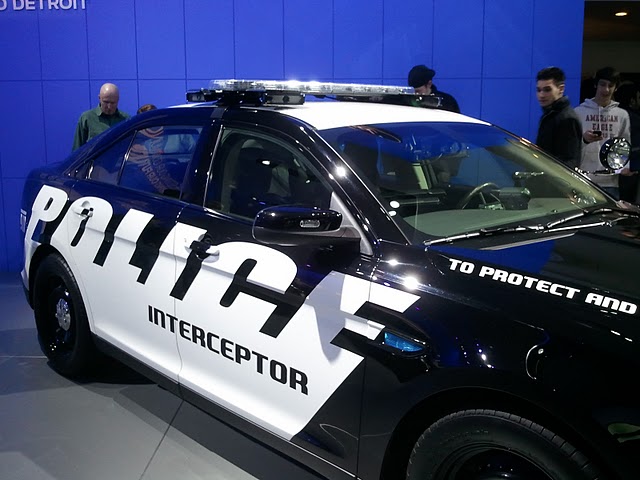
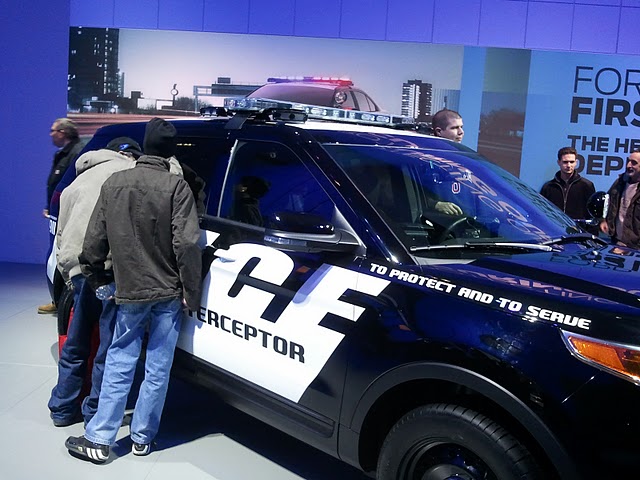
This past weekend I visited Detroit’s 2011 North American International Auto Show, where Ford used the opportunity to show off its new police Interceptors (check out Ford’s site complete with siren loading graphic and nationwide tour dates).  Seductively displayed in front of a slogan proclaiming, “Protecting Our Community. Securing Our Future,” and the message, “Ford salutes first responders. The heroes you depend on depend on Ford,” the cars were hard to miss.  There was something rather striking about the Interceptors -fierce yet sleek- that seemed to draw a continuous crowd of all ages.

The name alone is alluring: Interceptor.  It rolls off the tongue and brings forth images of blockbuster car chases complete with explosions and gritty, attractive male leads like Jason Statham or Daniel Craig.  As I stood listening to the soft “ooohs” and “ahhhhs” of passersby and watched dozens of people whip out their cameraphones (yours truly included), I asked myself who Ford was trying to sell the Interceptor to -the police or us?  Moreover, what was Ford really selling -the car itself, an “ideal” representation of the police, a car-chase fantasy, their own “Ford-tough” image, or all of the above?

Ford Interceptor Attracts Attention at the Detroit Auto Show…

Aside
Dossiers

Police and the Social Network – Rights at Stake?

You may want to think twice before accepting that new friend request from your favorite social networking site.  Why is that you may ask?  As social networks have experienced exponential membership growth rates over the last decade or so, the police, too, have taken notice.  More recently this has translated into law enforcement authorities employing social media sites such as Facebook, Myspace, and Twitter to combat and deter crime arguing that if average people are using these sites to find long lost friends or create new bonds there is no reason why police should not use these networks in their efforts to prevent crime.

Of the many advantages -from a police perspective- of using the social network as another tool to combat crime is that it allows officers to conduct online investigations of its users with near-anonymity.   With the click of a mouse and a few registration steps, police detectives are setting up fake profiles to ‘friend’ suspects under investigation and gain intelligence information.  Up to this point, criminal gangs have been their main focus.

For example, in the state of Florida, police report that gang members are using these sites to brag about their involvement in criminal activity[1].  Members often post photos of themselves in gang colors along with gang related hand gestures.  Some even use these sites as a way to communicate threats about future criminal activity against other rival gangs.

Florida police have recognized these shenanigans and have used the fist of law to combat such unruly behavior.  In October of 2008, the sunshine state passed statue 874.11, which makes it a 3rd degree felony for anyone posting electronic communications that “furthers the interest of a criminal gang,”[2] The charge carries a sentence of up to 5 years.  What’s more, successful conviction of a felony charge such as this may result in the defendant’s loss of his or her right to vote[3].

You may be asking yourself what exactly does “furthering the interest of a criminal gang,” mean?  Unfortunately there is no exact definition, which means that the individual police officer conducting the investigation is given total discretion in deciding who is allegedly violating the law; this should not be taken lightly and should be seen as very frightening.  Essentially, this means that anything you post online -be it a comical statement or picture that is not intended to represent anything criminal, such as a cartoon or hand gesture- can easily be misinterpreted as criminal gang activity.  One could argue that this is yet another example of our 1st Amendment rights (freedom of expression) being tossed out the front door. Currently, Florida is the only state with such a law on the books, however, numerous states are in the process of creating similar initiatives.

Lack of clarity in the law and the deceitful process used by police to intrude members’ profiles is causing a ruckus amongst digital rights advocacy groups, such as the Electronic Frontier’s Foundation (EFF)[4]. This civil liberties group, based in San Francisco, argues that deceptive police tactics like creating fake profiles to gain access to individual’s profiles -especially those set to private- is a blatant violation of people’s right to privacy.   Shawn Moyer -a spokesperson from the digital rights advocacy group Fishnet Enterprise- declared that such intrusion is not only wrong, but also unethical, noting that police pretending to be someone else are actually in violation of Facebook’s terms of service policy against willful impersonation of another individual.[5] Despite this rule, however, police continue to employ this tactic without any legal ramifications because there are no state or federal laws governing when and how police may conduct their online investigations on social networking sites.

In order to gain some sort of clarity on these issues the two digital rights advocacy groups filed a Freedom of Information action suit against the Dept. of Justice.  In a whopping 33-page response, the DOJ expressed their interest in -and implied their support for- police using the social network as an investigative tool and stated that all investigations are legal, as long as they are accompanied by a valid search warrant.[6] The DOJ did, however, remain silent on the issue of police violating social networks’ terms of service agreements. Although the DOJ did provide some answers to these fundamental questions of right to privacy online, their response seems to be mediocre at best.

Therefore, until both transparency and clarity are provided within the laws of online investigations, you may want to take some time to see who is really behind that new friend request.  Also, if there was ever a time to re-examine your profile you may want to do that now -you wouldn’t want an image or a comment you posted last week (or last year for that matter) to be misinterpreted as criminal.  Remember, there is a disclaimer on all major social networking sites that states that all posted information is public information[7] [8] [9].And if you didn’t know, now you know.

[1] Florida Police and Teen Gangs

[2] Fla. Stat. 874.11

[3] Specific case law – State of Florida v. Figueroa-Santiago

[4] EFF official website

[5] Privacy Concerns Raised by Undercover Police Tactics

[6] DOJ Report

[7] Facebook Disclaimer

[8] MySpace Disclaimer

[9]Twitter Disclaimer

Standard
Announcements

Introducing: Guest Contributor Seyed Mirmajlessi

I’m thrilled to be able to introduce a new guest contributor, Seyed Mirmajlessi.  Seyed graduated from Eastern Michigan University in 2010 with a B.S. in Criminology and Criminal Justice and is currently undertaking the M.A. program at EMU in Criminology.  His specific interest include: police-public relations, privatization of prisons, and the extensive impact technology has brought into our current criminal justice system.  We can look forward to posts from Seyed that explore the use of social technologies by police forces.

Welcome to our anthropolitical forum, Seyed!

Standard
Blotter

In the News: Police and Technology

Perhaps this past holiday season you got an iPad, a Blackberry Torch, the new iPod Touch with the built-in camera to keep you in constant face-to-face contact with your old roommate from college, your spouse, or whomever.  Even if you didn’t, you probably spent a significant amount of time staying in touch with the world through various forms of technology and social networking.  While this seems to have become the norm, might the ever-expanding world of technology and communication be encroaching upon our civil liberties…?

This week it was revealed that police forces in England and Wales have gathered data on millions of people who have called to report possible crimes or pass on information, recording names, addresses and contact details, and in some cases asking for the callers’ date of birth and ethnicity.  Critics like Daniel Hamilton of the pressure group Big Brother Watch forewarn that this sort of police data collection could lead to a “Big Brother” state and argue that data could easily be accessed via freedom of information requests; 13 police forces have already complied with such requests.  “For the police to log this kind of information isn’t just wrong -it’s dangerous,” he urged, noting that “the public must be confident that, when they report a crime, they do so in the comfort of anonymity and without risk of their details being stored on a central police database which can be accessed by thousands of people.”  While senior officers admitted details could potentially be used in future investigations, they maintain that databases like these are necessary to “fight crime, protect vulnerable people and ensure concerns were dealt with appropriately”.

If that doesn’t bring you to pause, how about hidden camera police interrogations?  Sometime next month the New York Police Department will begin tests of its new plan to videotape interrogations of people suspected of felony assault. The pilot program will run in two precincts: The 67th Precinct in Brooklyn and the 48th Precinct in the Bronx.  One squad will run tests with the camera in plain view, while the other squad will use a camera that “will not be obvious,” to those being interrogated in order to examine how cameras impact interrogations.  Interestingly, the police will only be required to disclose the presence of the camera if someone under questioning directly asks about it.

Finally on a more collaborative note, some police departments have found ways to work with the public via social media networks to combat crime.  With car thefts are on the rise in Seattle, the Seattle Police Department has resorted to a new tactic for recovering stolen cars: Twitter.  The new plan involves tweeting the details -including color, year, make, model, body style, and license plate- of stolen cars and asks Twitter followers who come across the stolen rides to call 911 and provide their locations.  Seattle PD also emphasized that citizens should not confront individuals occupying stolen cars.

Standard
Dossiers

Wikileaks Crib Sheet, Part 2

Source: a place, person, or thing from which something comes or can be obtained

Bradley Manning is the 23-year-old intelligence analyst who has been charged with “transferring classified data onto his personal computer and adding unauthorized software to a classified computer system,” and “communicating, transmitting and delivering national defense information to an unauthorized source,” i.e. he is allegedly the person who supplied Wikileaks with its most spectacular coups of disclosure: the Afghanistan and Iraq War logs, comprised of over 391,000 reports which cover the wars from 2004 to 2009, the video of the 2007 Apache helicopter attack released with the title Collateral Murder in April of 2010, and the 251,287 United States embassy cables, which they began releasing in November 2010.

Manning entered the Army in October 2007, and was an Army intelligence analyst in Iraq when he allegedly took the documents, passed them to Wikileaks, and confessed his actions to former hacker Adrian Lamo. A few details about the interaction between Manning and Lamo can be found in a June Washington Post article. Many more details are in what is nonetheless an extremely edited copy of their chats, available online at Wired.com. Wired’s introduction is vague enough to give the impression that Lamo edited the logs before providing them, although they don’t actually say that, and do say that they removed very personal statements by Manning or what might be sensitive military secrets. According to Glenn Greenwald in Salon, the editing was done by the magazine, and further:

Lamo told me that Manning first sent him a series of encrypted emails which Lamo was unable to decrypt because Manning “encrypted it to an outdated PGP key of mine” [PGP is an encryption program].  After receiving this first set of emails, Lamo says he replied — despite not knowing who these emails were from or what they were about — by inviting the emailer to chat with him on AOL IM, and provided his screen name to do so.  Lamo says that Manning thereafter sent him additional emails encrypted to his current PGP key, but that Lamo never bothered to decrypt them.  Instead, Lamo claims he turned over all those Manning emails to the FBI without ever reading a single one of them.  Thus, the actual initial communications between Manning and Lamo — what preceded and led to their chat — are completely unknown.  Lamo refuses to release the emails or chats other than the small chat snippets published by Wired.

What Greenwald goes on to explain is presumably why he thinks it is significant:

Indeed, Lamo told me (though it doesn’t appear in the chat logs published by Wired) that he told Manning early on that he was a journalist and thus could offer him confidentiality for everything they discussed under California’s shield law.  Lamo also said he told Manning that he was an ordained minister and could treat Manning’s talk as a confession, which would then compel Lamo under the law to keep their discussions confidential (early on in their chats, Manning said:  “I can’t believe what I’m confessing to you”).  In sum, Lamo explicitly led Manning to believe he could trust him and that their discussions would be confidential — perhaps legally required to be kept confidential — only to then report everything Manning said to the Government.

Maybe that the kind of information that would help in a civilian defense of Manning; it seems unlikely to help in a court martial. But the result of the editing is a nearly one-sided conversation, which does not allow what Greenwald alleges about Lamo’s promises of the anonymity to come through at all. What does come through is Manning’s altruism and hopes for changing the world, “i want people to see the truth… regardless of who they are… because without information, you cannot make informed decisions as a public”. Neither factor makes what he did less illegal, and as an enlisted member of the armed forces, he is subject to different laws than civilians, as his defense attorney explains at least in relation to his detention:

PFC Bradley Manning, unlike his civilian counterpart, is afforded no civil remedy for illegal restraint under either the Federal Civil Rights Act or the Federal Tort Claims Act. Similarly, the protection from cruel and unusual punishment under the Eighth Amendment and Article 55 of the Uniform Code of Military Justice (UCMJ) does not generally apply prior to a court-martial.

But Manning’s motivations are still important in as much they were clearly not for profit, nor to harm the United States, although he was despairing of the US-backed Iraqi government, and the actions of the US government in Iraq.

The exchange between Manning and Lamo took place between 21 May, 2010, and 26 May, when Manning was arrested.

(02:35:46 PM) Manning: was watching 15 detainees taken by the Iraqi Federal Police… for printing “anti-Iraqi literature”… the iraqi federal police wouldn’t cooperate with US forces, so i was instructed to investigate the matter, find out who the “bad guys” were, and how significant this was for the FPs… it turned out, they had printed a scholarly critique against PM Maliki… i had an interpreter read it for me… and when i found out that it was a benign political critique titled “Where did the money go?” and following the corruption trail within the PM’s cabinet… i immediately took that information and *ran* to the officer to explain what was going on… he didn’t want to hear any of it… he told me to shut up and explain how we could assist the FPs in finding *MORE* detainees…
(02:36:27 PM) Manning: everything started slipping after that… i saw things differently

(02:37:37 PM) Manning: i had always questioned the things worked, and investigated to find the truth… but that was a point where i was a *part* of something… i was actively involved in something that i was completely against…

On a later date:

02:22:47 PM) Manning: i mean what if i were someone more malicious
(02:23:25 PM) Manning: i could’ve sold to russia or china, and made bank?
(02:23:36 PM) Lamo: why didn’t you?
(02:23:58 PM) Manning: because it’s public data
(02:24:15 PM) Lamo: i mean, the cables
(02:24:46 PM) Manning: it belongs in the public domain
(02:25:15 PM) Manning: information should be free
(02:25:39 PM) Manning: it belongs in the public domain
(02:26:18 PM) Manning: because another state would just take advantage of the information… try and get some edge
(02:26:55 PM) Manning: if its out in the open… it should be a public good
(02:27:04 PM) Manning: *do the
(02:27:23 PM) Manning: rather than some slimy intel collector

One of the reasons Spc Manning’s story and situation have received much less international attention than Assange’s is because he is being held at Quantico. He’s in solitary confinement, according to Salon and the New York Times, or being held in a cell with others, according to the Guardian, but either way can’t be reached for comment, photographed, lauded or attacked.

Wikileaks and Assange in his role as its leader, are in many ways new and do not fit into familiar categories of journalism. Prosecution of Assange or his organization is likely to break new legal ground, even if old laws, such as the Espionage Act, are used. But Spc Manning is “the source”; he is charged with well-defined crimes, which I suspect have been successfully prosecuted in the past (feel free to post), and for which he can be imprisoned up to 52 years.

This configuration misses a key point though, in that the actions Manning is accused of resulted in the dissemination of a vastly greater quantity of information than leak laws were created to punish. What this means is that the type of act Manning is accused of is familiar, but the specific act, if it includes any one of the data dumps published by Wikileaks, is unprecedented in scale. This quantitative difference becomes qualitative.

At very least, it seems unlikely that the military wouldn’t take this opportunity to revise the punishments associated with “transferring classified data” and “communicating, transmitting and delivering national defense information to an unauthorized source” when those actions can occur several orders of magnitude up from what they have been in the past, although it should not be possible for this to be retroactively applied to Manning. Presumably  the military will also take the opportunity to redesign its information systems network, since the SIPRNet and  JWICS components of that system are what Manning is alleged to have accessed. What they should do is reconceptualize how information is defined, in order to then rethink how to link and store it, since the system which allowed such such a massive quantity of significant information to change “locations” (siprnet to the internet) and status (from secret to public) seems pretty clearly to not to understand digital data.

That’s all for now on sources.

Standard
Dossiers

A Wikileaks Crib Sheet, Part 1

I think what is happening with Wikileaks is an event, maybe the first one since 9/11. The organization has been around for about four years, this is far from its first significant release, and further, something that could be called a hacktivist subculture has been in existence for probably twenty years already; but if events are ruptures, they are ruptures of what was already existing anyway. One way or another things snowballed for Wikileaks so I am going to write a couple of posts that offer my potted analysis of how: a Wikileaks crib sheet. I needed a way to organize the pieces for myself, so, if you’ve lost track of all the threads, or don’t have time to read them exhaustively (I didn’t really either, but now it’s done), this is for you. A lot of interesting things have been written about Wikileaks, some of which I’m going to summarize. Rather less interesting and generally less accurate things have been written about the charges brought against Wikileaks’ frontman Julian Assange, international warrants and policing, and since I know relatively more about those things, I want to do an analysis of that as well.

A brief summary of what has happened might seem unnecessary except that I just watched a video in which Lula (the president of Brazil) seemed to be under the impression that the charges against Assange had to do with making public the diplomatic cables rather than sexual misconduct.

There’s a difference between not knowing what the charges are for so assuming that Assange is being held because his organization released secret cables, and knowing that the allegations against him concern sexual misconduct but believing those to be trumped up. I think that there are probably a very large number of people around the world who haven’t paid enough attention to think anything more than the first (and it is what they expect from the US anyway), and so their position doesn’t have anything to do with how seriously they take rape charges. As a point of fact though, it is important to note that it is unclear what a person associated with Wikileaks could be charged with in relation to the release of secret information, and Assange is actually being detained on four allegations of sexual misconduct and a European Arrest Warrant issued in order to question him about those charges. But this is getting ahead of myself.

In 2010, Wikileaks describes itself as a non-profit media organization. I actually like the term “media insurgency” (from this June New Yorker piece, because “rising in active revolt” against the status quo of  excessive secrecy and repression of information in both governments and the mainstream media seems apt. I also like the term because it has resonance with the “talibanization” of information in a “flat world” or as Geert Lovink and Patrice Riemens more eloquently put it in their Twelve theses on WikiLeaks “Despite being a puny non-state and non-corporate actor, in its fight against the US government WikiLeaks does not believe it is punching above its weight – and is starting to behave accordingly. One might call this the ‘Talibanization’ stage of the postmodern ‘Flat World’ theory, where scales, times and places are declared largely irrelevant”. What Wikileaks is legally defined as is much more important than what I happen to like though, since its status as a media organization (or not) will determine what protections it has and what charges can be brought against it. This exchange at a press briefing by Department of State Assistant Secretary Philip J. Crowley on 2 December 2010 was meant to lay the ground for the US government position that Wikileaks shouldn’t get first amendment protections:

QUESTION: Some of the governments that have been mentioned in these cables are heavily censoring press in terms of releasing some of this information. How do you feel about that? (Laughter.)
MR. CROWLEY: The official position of the United States Government and the State Department has not changed. We value a vibrant, active, aggressive media. It is important to the development of civil society in this country and around the world. Our views have not changed, even if occasionally there are activities which we think are unhelpful and potentially harmful.
QUESTION: Do you know if the State Department regards WikiLeaks as a media organization?
MR. CROWLEY: No. We do not.
QUESTION: And why not?
MR. CROWLEY: WikiLeaks is not a media organization. That is our view.

Wikileaks traces the principles on which its work is based (on its site, which I can’t reliably link to because it keeps getting shut down), “freedom of speech and media publishing, the improvement of our common historical record and the support of the rights of all people to create new history” not of course to the US constitution and its amendments, but to the 1948 Universal Declaration of Human Rights, in particular, Article 19.

I think that Wikileaks problematizes both our conceptions of media and information, but more about that later. Since officially launched in 2006 (according to Wikipedia) or 2007 (according to its site), the organization has posted a staggering number of leaked documents. Until recently, everyone’s favorite leak, for which it won the 2009 Amnesty International human rights reporting award (New Media) was the 2008 publication of “Kenya: The Cry of Blood – Extrajudicial Killings and Disappearances”, a report by the Kenya National Commission on Human Rights about police killings in Kenya. According to the Wikileaks website, the leak “swung the vote by 10%. This led to changes in the constitution and the establishment of a more open government”. Since the beginning of 2010, Wikileaks has made four major releases, possibly all from the same leak, of information from various branches of the US government: on 5 April 2010 a video of US soldiers in an Apache helicopter shooting people in an Iraqi suburb of New Baghdad; on 25 July 2010 the “Afghanistan War logs” and on 22 October 2010 the “Iraq War Logs”, both compilations of documents detailing the war and occupation of those countries by the United States military; and beginning on 28 November 2010, what will eventually be a quarter million diplomatic cables from US Embassies around the world.

Below are some pieces I’ve found useful. Next post, I’ll write about the charges against Julian Assange, the role of Interpol, European Arrest Warrants, and extradition, among other things.

Best pieces on Wikileaks
Twelve theses on WikiLeaks
Wikileaks, Now

Best pieces on Assange
Julian Assange and the Computer Conspiracy; “To destroy this invisible government”
What is Julian Assange Up To?

In Julian Assange’s own words
Interview on the Colbert Report
His blog on the wayback machine
Opinion piece posted 8 December 2010 in an Australian paper, before turning himself in the UK Don’t shoot messenger for revealing uncomfortable truths

Standard
Announcements, Call for papers

Call for chapter proposals – Police and Protesters: Motives and Responses

Call for chapter proposals – Police and Protesters: Motives and Responses

Location: Australia
Publication Date: 2011-02-01
Date Submitted: 2010-11-22
Announcement ID: 180858
Proposals are currently being sought for an international collection of scholarly papers on the motives and responses of police and protesters in occurrences of social action. The proposed collection will contain a collection of personal accounts, analyses of historical and/or current events, and other experiences in order to evaluate the motives, procedures/practices and outcomes in such situations from both the perspectives of protesters and police. In terms of ‘motives’, submissions should primarily consider what motivates people to use different forms of social action as a means to achieve their goals, not necessarily what issues (eg: climate change, war) motivates them to take such action in the first place (however, these other factors may still be addressed in the paper). Original contributions from any discipline are welcome.In the twenty-first century protesters and protest groups are well organised and prepared for confrontations. Yet there is only a relatively small body of academic work on protests from either the perspective of protesters or law enforcement agencies. This collection seeks to extend upon this literature. Our objectives are to document through a series of case studies of different situations what motivates people to undertake different forms of social action, what outcomes they seek to achieve in protests, and how they seek to achieve these outcomes. Examples of topics of interest include:

• Humour and social action;
• Popular (mass) social action;
• Transport blockades;
• Non-violent action;
• Music and social action;
• Destruction of property;
• Media and social action;

Please submit a 1-2 page proposal by 1 February, 2011.

Authors should also attach a brief (one-page maximum) biographical summary. Please direct all inquiries and proposals via email to Dr. Nathan Wise, Dr. Alyce McGovern and Dr. Jenny Wise at ppmrproject@gmail.com

Title: Police and Protesters: Motives and Responses

Editors: Dr. Nathan Wise, Dr. Alyce McGovern, Dr. Jenny Wise


Dr. Nathan Wise
School of Humanities
University of New England
NSW 2351
Australia

Email: ppmrproject@gmail.com

Standard
Blotter

In the News – A Close Up

Student-Police Relations in UK Riots

While it looks as though the future holds budget cuts galore for numerous countries across the globe, Britain appears to be taking the lead with massive cuts to law enforcement and education.  Perhaps more interesting than the cuts -which are neither surprising nor innovative or unique -has been the public’s reaction to them and the police response it has elicited.

Evoking memories of 1960’s student movements, British youth have taken to the streets on several occasions to protest education cuts that will make university education too costly for many to attend.  Over the past three days three mass student protests have taken place in Brighton, Birmingham, Bristol, Manchester, Newcastle, Oxford and London.  Yet as students continue arguing for their right to education and peaceful protest (check out a video from the UK’s Guardian) -like student protesters of the 1960’s -they have been met with hundreds of police officers with riot shields, batons, dogs, armoured horses and meat wagons.  As Laurie Penny of the New Statesman comments in her article on the recent Whitehall police kettle, “these young people joined the protest to defend their right to learn, but in the kettle they are quickly coming to realise that their civil liberties are of less consequence to this government than they had ever imagined.”

As the student protests continue to build momentum and power, some police departments have started reaching out to protesters.  Just this morning, Bristol police have asked the protesters to speak with them before carrying out any additional actions.  Chief Inspector Mark Jackson stated that it was in the interests of protesters and police to come together and “have a clear plan of what the demonstration can achieve, and how we can work together to negotiate the safest way of doing this.”  He also insisted that “the police are not trying to stop young people from staging legitimate protests. But we must insist that those protests are peaceful, lawful and safe.”

Coincidentally, a 40th anniversary edition of The Politics of Protest has just been published, exploding onto the scene with an interesting American Society of Criminology Annual Meeting panel this past November. The author, Jerome Skolnick, as well as some of the project’s original collaborators, including Anthony Platt, were present.

Standard
Blotter

“The crisis in Rio and the media pastiche”

Brazilian anthropologist Luiz Eduardo Soares, who served as the Coordinator of Public Safety for Rio de Janeiro and the Brazilian Secretary of Public Security, among other posts, and has held several academic positions, at private and public universities in Rio, São Paulo and in the U.S., has written an excellent piece, The crisis in Rio and the media pastiche, on the violence in the city of Rio that has made front page news around the world. I met Soares in the spring of 2005 when he agreed to come to Berkeley for a conference I co-organized on violence and the Americas.

The last month and a half in Rio have been particularly bloody, as both the traffickers and government have made shows of force. The most recent events (roughly following this summary in the newspaper the Jornal do Brasil) began on the evening of Sunday, November 21st, when six men armed with machine guns set three vehicles on fire on a major highway called the Linha Vermelha, and while escaping attacked the car of an air force commander. On Tuesday, all of Rio’s active police, along with officers from federal highway patrol were put to the streets to deal with further attacks. Throughout the rest of the week, in which 181 vehicles were burned, the Navy, Army and Federal Police joined forces with Rio’s police in attempting to control the situation, which, it should be noted, was not spread throughout the city but concentrated in specific neighborhoods.

Last Thursday, 200 officers belonging to an elite police force known as Bope (Batalhão de Operações Especiais) entered a favela called Vila Cruzeiro, which is part of bairro da Penha (where for a brief period of time I taught English). Some of the drug traffickers there escaped to another favela, Morro do Alemão. On Sunday morning, a week after this particular episode began (although it is misleading to speak of such events as isolated, even as a shorthand), the forces took control of the morro and the whole Complexo do Alemão, more or less without resistance from the traffickers, according to reports. All of this received dramatic coverage by the Brazilian press. Since at least some of the major traffickers are now making their way through the forested areas of the city to Rocinha, another major favela, the police campaign and accompanying violence will presumably continue.

At least 39 people died in this time period. The initial violence by the gangs was widely reported to be a response to the installation of new community policing units called UPPs in but some sources have said, to the contrary, that rather it was due to a standstill between police and bandits who were in negotiations to update their agreed upon index of bribes.

UPP stands for Unidade de Polícia Pacificadora, in English Pacifying Police Unit, a program that at least in theory aims to impede the “parallel power” of the drug traffickers by actually providing state services in long neglected areas while also addressing crime. (Here’s a NYTimes article; Ben could undoubtedly say a lot more though) They are the current incarnation of a program Soares tried to implement when he was the Public Safety Coordinator in 1999.

Most of the international media, such as the New York Times, has been positively euphoric over the turn of events: “In a quick and decisive military sweep, Brazilian security forces seized control of this city’s most notorious slum on Sunday, claiming victory in a weeklong battle against drug gangs that has claimed dozens of lives”; this echoes the reporting in the mainstream Brazilian media.

The traffic the TV shows. The traffic the TV does NOT show

Soares, who was in much demand by the media for comments on the events, instead wrote a piece for his blog. Some of the points he made are these:

The media always repeats the same cycle of rabid attention to crises, paired with a complete lack of investment in reflection and consistent, solid information in the off period. They repeat the same wrong questions (a) what can be done right now to contain the violence? (b) what can the police do to definitively conquer the drug trade? (c) Why doesn’t the government call in the army? (d) will Rio’s image be sullied internationally? (e) Will we succeed in having a great World Cup and Olympics?

de André Dahmer http://www.malvados.com.br Rough translation: 1) guy: I wrote a piece on Facebook defending the death of the trafficker. 2) guy: Or you think a bandit would grant quarter to someone? He’d kill him right away. 3) guy: I am a good citizen, you have to put bullets in them. Dog: one more good citizen who thinks like a bandit

He then proceeds to respond to these questions. There is nothing, he says, that can be done immediately to resolve the situation of insecurity. “If we want to in fact solve a serious problem, it is not possible to continue to treat the patient only when he is in ICU, stricken with a deadly illness, in the acute stage…Therefore the first step to avoid repeating the situation is to change the question… : what can be done to improve public security, in Rio and in Brazil, to avoid the everyday violence, as well as its intensification, expressed in successive crises?” Those who say that the situation requires immediate response take exactly the position that has impeded consistent advances in public security; long term solutions are necessary. “The best response to the emergency is to begin to move in the direction of rebuilding the conditions that generated the emergency situation.”

The police, Soares writes next, must stop joining the traffickers: they must stop selling them arms, and they must not form militias that take criminal profits. In other words, “the polarity referred to in the question (police versus traffickers) hides the real problem: there is is no polarity.” What must happen is in fact a separation of the bandit from the police, a differentiation between crime and police. There are, he emphasizes, honest police whom he considers the first victims of their institution’s degradation, because the “rotten band of police” who act in militias, embarrass, humiliate and threaten them.

Soares makes several other useful comments, pointing out, for example, that trafficking as it is currently conducted, by gangs that are expensive to arm and have high mortality, is going to change to a delivery model; I’ll leave it at this for now though.

He ends with an incensed description of the media coverage. The nightly news in Brazil, watched by nearly everyone, is called the Journal Nacional. Soares writes that the news on “Thursday, 25 November, defined the chaos in Rio de Janeiro, splattering scenes of war and death, panic and desperation, as a day of historic victory: the day the police occupied Vila Cruzeiro. Either I suffered a sudden mental blackout and became an obdurate and incorrigible idiot, or the editors of the nightly news felt themselves authorized to treat millions of viewers as obdurate and incorrigible idiots.”

Here’s another useful analysis of the media and what has been happening in Rio (in Portuguese)
Standard