For those of you keeping track, I’ve added the syllabus for the class I’m teaching this semester at Eastern Michigan University entitled “Police, Society”. It’s my own attempt at a spin on a traditional “Police and Society” course. As always, it’s a work in progress, so commentary is both welcome and solicited. You can check it out over in the resources section.
Recent Magazine Articles on Incarceration
Ran across this recent piece and thought I’d post it.
Prison Without Walls appears in this month’s Atlantic. It is written by Graeme Wood and discusses the use of home monitoring/electronic ankle monitors. Of note I think is the discussion including some that “correct” elements of the text. A few months back the Economist also ran some work on prisons (Joys of Overcrowding)which also generated a few interesting comments.
I find these types of pieces (and the online comments) useful teaching tools. Are there other recent pieces that are on people’s radar?
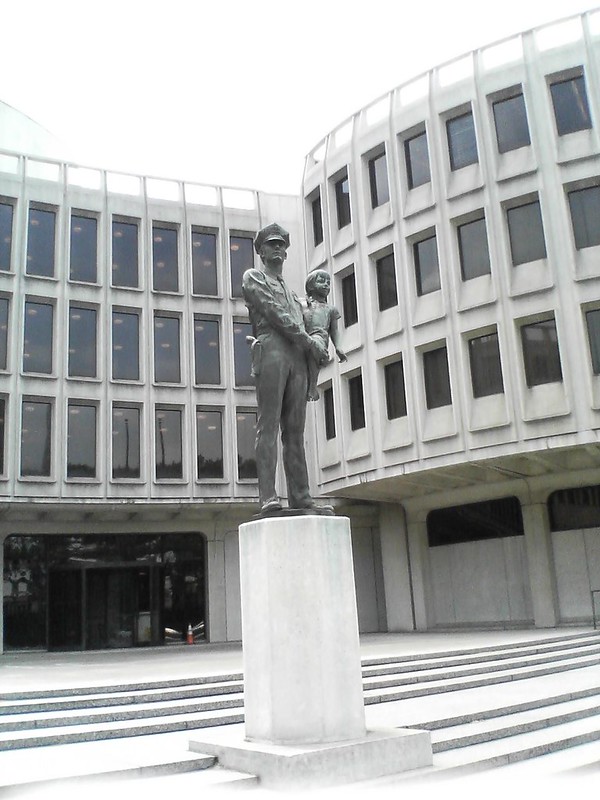
I was earlier today contemplating this statue, which stands outside of the Philadelphia Police Department Headquarters at 8th and Race Sts. Note the quintessential 1950s “professional officer” style of uniform… and also how there is a gun on his right hip, a little girl on his left hip. All kinds of signification going on here… N.B. also that the Philly PD HQ (partially visible in the photograph, behind the statue) looks like a set of locked handcuffs from an aerial view.
Police “material culture”
Police Accountability Theory
I’ve been helping out with some “applied criminology” courses at the University of Cambridge being run out of the Institute of Criminology there, and the majority of students are UK police officers. Next term, some of them will write an essay that aims to answer the following question:
“You are the chief constable of an agency that has been criticized over poor accountability because officers policing a demonstration concealed their name tags. Select a criminological theory relevant to this phenomenon, then design an evidence-based strategy for improving accountability in light of that theory. Describe the research methods you would use to evaluate the effectiveness of the strategy, and the leadership plan for carrying the entire effort forward.”
I am putting together a “core reading list” for persons who choose this essay question, and wondering if anyone has suggestions for “recommended readings” regarding theories of police accountability. Of course, the question specifically mentions “criminological theory”–but up to now, I have only found a few things in the “usual suspects” type criminology/police readers (i.e., “Policing: Key Readings” and “Handbook of Policing” edited by Tim Newburn). So anything is welcome. If you have ideas for the “research methods” part of the question, by all means share them please; but I’m mostly concerned about the theory part. Good ethnographic pieces are also welcome.
Job Openings at the University of Hong Kong
The sociology department at the University of Hong Kong is hiring three assistant professors on 3-year renewable fixed-term contracts, hoping to find people to start Jan.1 of 2011. One position is in culture & media studies, one in sociology, and one in criminology.
I have been here a year, and find it a good place to work. I would strongly encourage anyone with an interest in qualitative studies of policing to consider applying. If you have any questions, drop me a line at jtmartin ‘at’ hku ‘dot’ hk.
The departmental website is here.
The HK Policing Studies Forum is a work in progress, but a “real” website will eventually take shape here.
Anthropoliteia has a new look!
Check out the new layout and format here at Anthropoliteia. More slick, more urban, more… concrete gifs. Comments & reactions?
Conference: XIst Colloquium for Police History (University of Cologne, July 14th-17th, 2010)
Thought I’d circulate the info for a conference I’m very excited about attending next week, being sponsored by the University of Cologne, Germany. You can check out the flyer as a pdf here, or you can see the full schedule below.
I’d love to say a bit more about it now, but I’m furiously reworking my own talk after re-reading Security, Territory, Population. I’ll try to report back on the conference later, though, as I’m sure it will be of current (and future) interest to readers of the blog.
As I try to put together a course on “Policing in Society” for the upcoming semester at the same time that I try to figure out for myself the place of anthropology in criminology (or vice versa, or somesuch). I came across this article, which I think has particular potential for our discussions here:
Rethinking Criminology(ies) through the Inclusion of Political Violence and Armed Conflict as Legitimate Objects of Inquiry
Maritza Felices-Luna
University of Ottawa
Abstract: Criminology has yet to achieve full recognition as an independent discipline. Its development has been hampered by a multiplicity of often stale debates between a “traditional” and an “alternative” criminology over the legitimate object, theories, and methods of the discipline. Rather than pursuing the debate in its current form, this article explores how focusing on new objects of inquiry and the challenges they represent may help to bridge the criminological divide. By rendering the borders of criminology’s object permeable, we may produce a malleable and dynamic discipline that deals with processes of normalization/differentiation/othering as well as ordering, governance, and control from different normative and political perspectives, theories, and methods.
Articles referenced
Felices-Luna, M. (2010). Rethinking Criminology(ies) through the Inclusion of Political Violence and Armed Conflict as Legitimate Objects of Inquiry Canadian Journal of Criminology and Criminal Justice/La Revue canadienne de criminologie et de justice pénale, 52 (3), 249-269 DOI: 10.3138/cjccj.52.3.249
Rethinking Criminology(ies)
The UC library system doesn’t subscribe to the journal Policing, so I haven’t been able to check this out yet, but their April issue is on Academic/Police collaborations and should be of major interest to all the readers of this blog
Academic–Police Collaborations—Beyond ‘Two Worlds’
Karim Murji, Guest Editor*
via Introduction: Academic-Police Collaborations–Beyond ‘Two Worlds’ — Murji 4 (2): 92 — Policing.
Special Issue of the journal “Policing” on Academic/Police Collaborations
Workshop on British Colonial Policing in Historical Perspective, University of Hong Kong, Hong Kong
The sociology department at the University of Hong Kong is hosting a number of events this June, focusing on the legacies of British colonial policing, both in Hong Kong and globally. On June 22nd, Dr. Georgina Sinclair of the Open University will be giving a lecture on Internationalizing British Policing: 1945-2010. The following day we will hold a workshop on British Colonial Policing in Historical Perspective, which will bring local scholars working on policing in Hong Kong into dialogue around Dr. Sinclair’s comparative project. Prior to these events, in early June, we will be convening an informal group to read and discuss some foundational texts in the study of colonial and post-colonial policing.
The workshop is open to the public. The informal reading group will convene around the schedules of those interested in attending. Anyone interested in participating in it is warmly invited to contact Dr. Jeff Martin at jtmartin@hku.hk at their earliest convenience
 Anthropoliteia