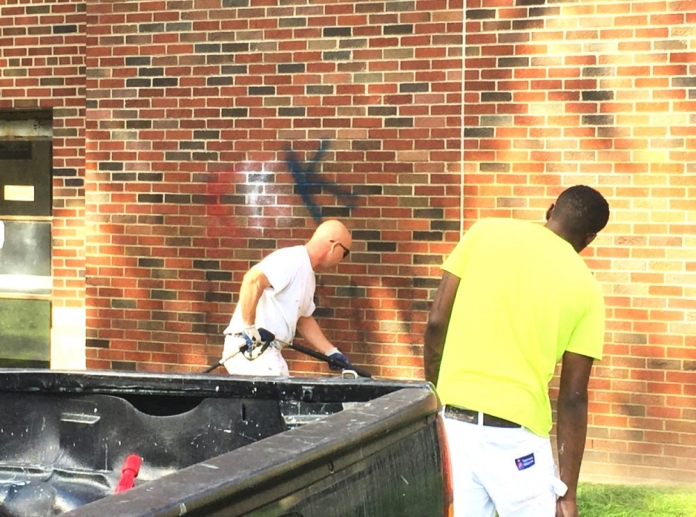
On Tuesday Sept. 20, around 9 a.m. graffiti was found on the outer wall of EMU’s King Hall depicting hate speech. Picture taken after some writing was removed. (photo credit: Shayler Barnes Jr. / The Eastern Echo)
On Tuesday Sept. 20, around 9 a.m. graffiti was found on the outer wall of EMU’s King Hall depicting hate speech. Picture taken after some writing was removed. (photo credit: Shayler Barnes Jr. / The Eastern Echo)
 It’s that time of year again: time for Anthropoliteia’s list of papers and panels pertaining to police, security, crime, law and punishment at the Annual Meeting s of the American Anthropological Association!
As impassioned followers of this blog know, we like to curate a list of sessions and papers of interest to our readers. We’ve created a Google Calendar, which you can find embedded below and import into your own. Be sure to keep an eye on @anthropoliteia’s twitter feed as well, where you’ll find coverage of the #AAA2016 hashtag with which several participants will be live-tweeting sessions ad other events.
Beyond that, we’d like to call your attention to two sessions in particular, which are direct offshoots of projects and collaborations on this blog:

Screen grab from post by SPDbodywornvideo CC BY-SA 4.0 2015 by Meg Stalcup
 The editors of Anthropoliteia would like to welcome Dr. Sameena Mulla to introduce our newest project, The Black Lives Matter Syllabus Project, which will mobilize anthropological work as a pedagogical exercise addressing the confluence of race, policing and justice.
If you’re like me, you may have had two academic articles with seemingly conflicting arguments run through your Facebook feed lately. The first, an article by Cody T. Ross published via PLOS ONE uses a multi-level Bayesian analysis to conclude that there exists
evidence of a significant bias in the killing of unarmed black Americans relative to unarmed white Americans, in that the probability of being {black, unarmed, and shot by police} is about 3.49 times the probability of being {white, unarmed, and shot by police} on average
The other, written by economist Roland G. Fryer and covered extensively in the New York Times Upshot column, concludes that in the case of “the most extreme use of force – officer-involved shootings – we find no racial differences in either the raw data or when contextual factors are taken into account.”
How can such diametrically opposed claims be made simultaneously in reputable scientific journals? While much of these claims seems to rest in a domain of advanced statistics with which anthropologists typically feel less confident, the key to understanding their different claims actually might depend on a more “ethnographic” sense of the data sets they build upon.

Welcome back to In the Journals, a look at some of the many recent publications on the law, sovereignty, security and the state. As winter is now well in the rear-view mirror for those of us north of the equator, you might want to spend some time in the sun as you work your way through some of these hand-picked articles.
Organizers: Victor Kumar (Johns Hopkins U) and Amrita Ibrahim (Georgetown U)
At a time when many aspects of law enforcement are coming under increased scrutiny, anthropologists have a renewed opportunity to investigate questions around police and policing. What can anthropology bring to an area of research whose terms, methods, and theories have traditionally been set by the disciplines of sociology and criminal justice? What approaches allow us to navigate this contested domain and understand its forms and effects inside and out, from those “on the beat,” to the recipients of police terror, from activists calling for justice to those whose radical alterity renders them “no-bodies” (Silva 2009)? How does an anthropologist’s loyalty to the state (our law-abidingness) affect the ways they take up our positions with respect to policing? One answer suggested by some anthropologists of police (Garriott 2013, Karpiak 2016) is that investigations are directed at the boundaries of police as a field of inquiry. Rather than assuming the police to be a bounded field site, it can be understood instead as a refractive lens that extends beyond policing as an official institution and reverberates in response to broader social phenomena. Others have argued that we should seek to develop new lexicons to describe, denounce, and theorize racialized policing practices and put them in the context of a broader security-knowledge system that informs subjugation at large (James 2006, Alves and Vargas 2015). In this panel, we seek new critical perspectives on longstanding issues involving police: violence, the body, community, citizenship, and rights. We are interested in exploring how issues such as racial and sexualized violence are positioned across the permeable boundaries between the police and subjects of enforcement without discarding critiques coming out of both the popular and scholarly spheres that have identified forms of structural violence in police work. Whether dropping the notion of a clear and fixed boundary (a “thin blue line”) or reanalyzing the police as operating within regimes of domination, ethnography has the potential to show how policing is both continuous and distinct from the broader social contexts in which it is embedded and attend to the diverse forms of life that fall under the heading of police. We argue that such modes of anthropological understanding can ultimately contribute greatly to projects of police reform or abolition.
Please submit your abstract of 250 words to Amrita Ibrahim at amritaibrahim@gmail.com and Victor Kumar at victorakumar@gmail.com by [UPDATE] April 13, 2016.

Welcome back to In the Journals, a look at recent publications in the world of security, law, crime, and governance. November has brought forth a number of engaging and provocative articles that we hope you can work your way through while recovering from your Thanksgiving gluttony.
 Anthropoliteia