
Although we here at Anthropoliteia don’t have any “existential answers” about how to process the recent events in Ferguson, we hope to provide a safe space for readers to reflect about and share their reactions.
Although we here at Anthropoliteia don’t have any “existential answers” about how to process the recent events in Ferguson, we hope to provide a safe space for readers to reflect about and share their reactions.

Don’t let the cute face fool you: Dale Lately of The Baffler reports how an increasing number of police officers are joining Facebook in trolling internet pages for “pre-crime” in the making.

Victoria Law reveals how carceral feminism has (unexpectedly?) lead to more violence for some.

The city’s where the crime’s at, right? Think again. Nic Groombridge reflects about the growing role of rural criminology.
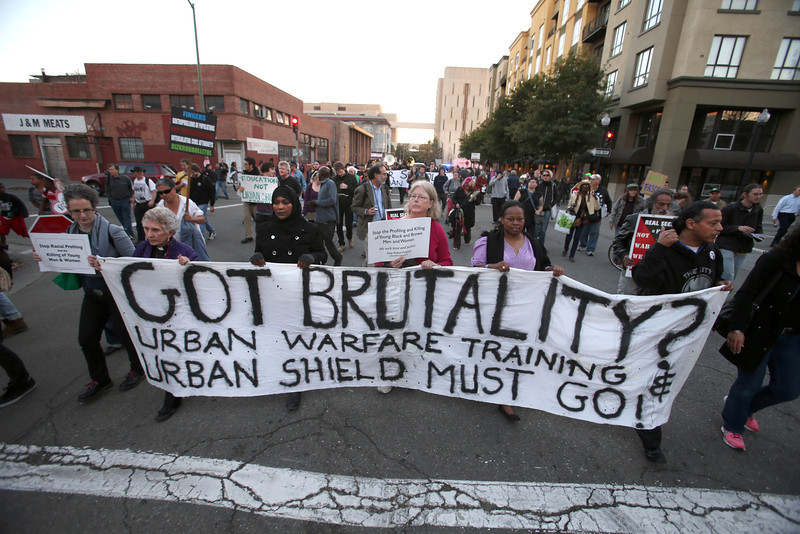
…just wait ’til you see the T-Shirts that were on sale at this year’s Urban Shield event.
“The claim that outside agitators had been the riot’s ringleaders…reiterated that black people were incapable of acting as political subjects in the defense of their humanity and rights as citizens,” writes Steven Gregory, professor of Anthropology and African American studies at Columbia University. Although applicable to the more recent Ferguson protests, Gregory’s words reference a series of similar events that occurred in 1930s Harlem. His recollection of several white-black, citizen-police fatalities exposes the need for not only institutional -but cultural- change.
Speaking of which, hopefully some of you were able to attend UC Berkeley’s forum, “Black lives matter: police violence, prisons and freedom visions” on September 19th. The event featured speakers such as CeCe McDonald, Julia Chinyere Oparah and Ashon Crawley.
What can anthropology contribute to discussions of race, state-condoned brutality and violence? Pem Davidson Buck reflects on this and other questions in her post for Anthropology News, The Violence of the Status Quo.
My award for most disturbing topic of the month goes to Shane Bauer’s coverage of the 2014 Urban Shield event that was held in Oakland, California. Every year members of police and SWAT teams attend the tradeshow, where the latest tactical gadgets (including things like armored vehicles, blindness inducing flashlights and canine mounted cameras) are unveiled. Wait ‘til you see pics of the T Shirts that were on sale at the event…
Coming in at a close second on the creepiness scale is Jaeah Lee’s post, “So Basically Everyone Killed by a Cop is a Criminal, According to the FBI” And yes, it truly is as bad as it sounds. The fact that the FBI –among other things- allows jurisdiction-by-jurisdiction variation in the definition of “felon” is among Lee’s most worrisome findings.
NPR’s Gregory Warner featured an opposing view of police brutality this month. A Kenyan officer charged with the fatal shooting of two men inspired a local protest…in his favor. Find out why this instance of police brutality was “warranted” in the minds of citizens in his jurisdiction.
Police brutality often brings images of Ferguson, militarization and white-black violence to mind. But what about the seldom-mentioned tactic of police seizure of funds from people not charged with a crime (and without a warrant)? An engaging three-part expose about the questionable search and seizure practice is featured in The Washington Post.
Phew, that was a lot of bad news. Now onto the good- the Anthropology of the Good to be precise. In the words of Professor Joel Robbins, “Consensus about what constitutes good and how we separate this from bad is hard to pin down.” Cheer yourself up by reading about Robbins’ research at the University of Cambridge as well as why an Anthropology of the Good is a necessary complement to the already prevalent Anthropology of Suffering.
Also bound to make you happy is AllegraLab’s call for editorial assistants! Find out if you qualify, then send an email to their team at stuff@allegralaboratory.net before September 30th.
Did I miss something? No worries- it does happen on occasion. If you have any suggestions for DragNet, or if you want to call attention to a specific blog or article, send an email to anthropoliteia@gmail.com with the words “DragNet” in the subject header and I’ll get on it!

Smile, you’re on camera!…or you will be soon. Police badge cameras have already debuted in several jurisdictions across the US including those in Florida and (soon) Washington, DC.
“The flow is not one way, (defense) institutions also return home transformed,” writes Stuart Schrader in his post Police Empire. Stuart helped us kick-off the month of September, picking up again with the theme of police militarization. Perhaps a surprise for many to learn, Stuart discusses how militarization and “blurred” policing boundaries are hardly novel developments. Though these topics reached an apex shortly after the death of Michael Brown, the tendency of police to apply foreign tactics in home territories has been happening for several decades.
Sasha Goldstein of the New York Daily News continued the militarization thread with the story of a Texas man who was shot by police recently at a Texas truck stop. Though some officers were armed with AR-15s, more attention was gained by the (now notorious) “fist bump” exchanged between two officers. The move was caught on video following the shooting. Despite being armed with a non-lethal BB gun, the man reportedly raised the replica and pointed it at officers before they open fired.
Between police militarization and never-ending streams about officer use of force, many are wondering what if anything is being done to ensure the effective monitoring of police in the field. If you are among those scratching their heads, be sure to catch NPR’s feature “Can Body Cameras Civilize Police Encounters?” Where the benefits of badge cameras are easily perceived by the public, the lesser-known “cons” (and implementation difficulties) are often overlooked. In addition to Ferguson, officers in several jurisdictions (including Florida and soon, Washington, DC) are already adopting the technology.
David Greene wins this week for favorite “off beat topic of September-so-far,” covering the mandate for NYPD officers to attend social media 101 training. In case you forgot, the reason behind the training stems back to the April 2014 twitter campaign disaster, #myNYPD.
And last but so-not-least, the folks at Anthropoliteia were pleased to offer not one but two new posts for your reading pleasure. The first, A new grammar of public security in Brazil, was featured September 1st in our Book Reviews section. Daniel Silva reviews Paulo Mesquita Neto’s “Essays on Civilian Security” (2011). We also welcomed back In the Journals, which offers a bi-monthly rundown of recent academic publications. Be sure to check out August’s highlights!
Did I miss something? No worries- it does happen on occasion. If you have any suggestions for DragNet, or if you want to call attention to a specific blog or article, send an email to anthropoliteia@gmail.com with the words “DragNet” in the subject header and I’ll get on it!

Mesquita Neto, Paulo. 2011. Ensaios sobre segurança cidadã [Essays on Citizen Security]. São Paulo: Quartier Latin/Fapesp.
Why has Brazil’s 1988 democratic constitution advanced in promoting broad civil and economic rights while leaving (almost) unchanged the regulation of the police and armed forces? What’s the impact of Brazil’s Human Rights National Program in recent efforts of democratizing Brazilian society and building up an alternative to a minimal neoliberal state? Why have some types of public security policies been defined without much clarity, especially those that target the non-white-elites? These are some of the questions that Paulo de Mesquita Neto – a Brazilian scholar in political science who prematurely died in 2008 – asks in this collection of essays that he gathered under the rubric of Essays on citizen security. The book as a whole bears the imprint of an author striving to combine the vocabulary and syntax of democratic rule with a scrutiny of public security in Latin America – a grammar not too simple to practice in a continent that during the 1960s and 1970s surrendered to several authoritarian regimes whose marks are still noticeable, if not overly prominent, in current political culture and public debates.
The book as a whole bears the imprint of an author striving to combine the vocabulary and syntax of democratic rule with a scrutiny of public security in Latin America

Whether you rely on Twitter, Facebook, Washington Post or Reddit for updates, chances are your August feed has been dominated by discussions surrounding the death of Michael Brown.
Whether you rely on Twitter, Facebook, Washington Post or Reddit for updates, chances are your August feed has been dominated by discussions surrounding the death of Michael Brown. Matt Thompson of Savage Minds touched upon the conflicting coverage of recent events in Ferguson (as well as the implications highlighted by news entities like The Washington Post and New York Times) in his entry, “What is a rioter?” Likewise, the short (and terrifyingly poignant) comic featured in Medium’s August 14th post expands upon the reality of modern police militarization. Among other problems, it emphasizes the role of basic training (or lack thereof) in the police use of military-issued equipment.
If militarization is of particular interest, be sure to check out Taylor Wofford’s piece in Newsweek. Although many associate the growing police use of military grade gear and weaponry with Ferguson protests, Wofford details how departments have been “silently preparing officers for battle” as far back as the early ‘90s.
The Economist’s post Cops or Soldiers? is also relevant to concerns about police militarization. More intriguing is the fact that the article was originally featured back in March (preceding the events in Ferguson). Although SWAT teams are implied as representing an important tool of departments, when and where such teams should be deployed remain key (unanswered) questions.
Of course, Anthropoliteia staff have not been silent bystanders to Ferguson discussions. Meg Stalcup offered insight about the series of events, providing the seldom-addressed topic of officer perceptions. Although the dynamic of officer-civilian relations remains mostly hostile, Stalcup posits that with officer’s “under threat perception, it’s not surprising, although unprofessional and deplorable, that officers menace the protestors they are supposed to protect.” Lastly, don’t miss Anthropoliteia’s second Ferguson post Blue on black violence and original crime: view from Oakland, California. Our developing forum featured Brad Erickson on August 21st. In his post, Erickson uses his own experiences researching the people and police of Oakland, CA to comment on the racial and militaristic implications of Michael Brown’s shooting.
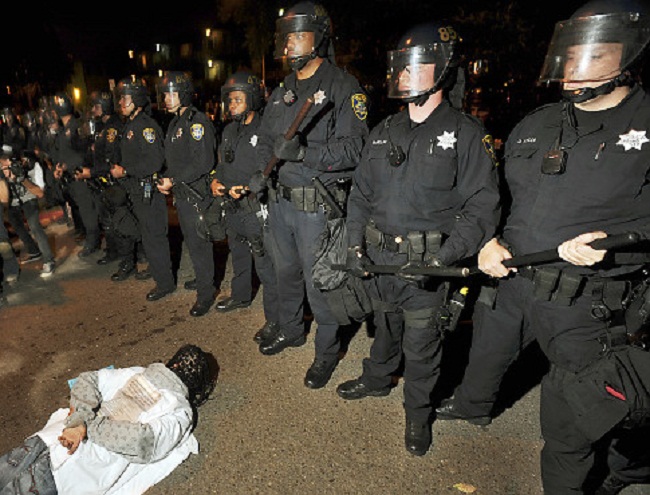
Oakland protest against murder of Oscar Grant. Image courtesy of Voice of Detroit
The editors of Anthropoliteia would like to welcome Brad Erickson with the latest entry in our developing Forum #Ferguson & Elsewhere
The police killing of an unarmed, 18-year old African American, Michael Brown, and the hyper-militarized response to public protest in Ferguson, Missouri, has prompted wide-ranging national discourse following several threads. The first, exemplified by the #BlackTwitter phenomenon, emphasizes the pattern of extrajudicial killings of black people by police, security guards and self-appointed vigilantes as the continuing exercise of racial domination in the United States. The second is the attempt to cast Michael Brown and other black victims as threatening criminals in order to justify their killings and deny the salience of racism. A third major theme is the militarization of police, a growing trend since the introduction of SWAT teams in the 1970s, now pushed into high gear through the federal distribution of idle war materiel including armored vehicles, grenade launchers, and machine guns. This militarization is often linked to a decline in civil liberties and violations of due process. Some commentators locate these trends in the contexts of the rise of a surveillance state, the crisis of inequality and the demise of democracy orchestrated by wealthy elites.
I would like to reflect on these trends via the perspectives of people deeply impacted by them. In 2013, I carried out an evaluation of Oakland’s community policing program, and also tracked the effectiveness of family support services in Oakland’s lowest performing middle schools. For the first project I interviewed Oakland police personnel including captains, sergeants, lieutenants, problem solving officers (PSOs—assigned to work with specific neighborhoods), and crime reduction team officers (CRTs—largely focused on gang activity). For the second project, I observed and interviewed parents and children, teachers, principals, school counselors, and a variety of school-based service providers including nurses, counselors, mental health professionals, legal advisors, food bank and community gardens personnel, and Teach for America volunteers.

After months of debate, the ACLU released previously sealed records regarding the cell phone-tracking tool in use by several departments.
The topic of surveillance packed a powerful punch this month, with the court releasing documents regarding Stingray technology capabilities. After months of debate, the ACLU released previously sealed records regarding the cell phone-tracking tool in use by several departments. The publication comes nearly 3 months after initial buzz about the tool that circulated after a suspect’s phone was used by police to track him to his apartment prior to obtaining a warrant. The more notable specifics of the technology can be found here.
The problem of prison over crowding is presented by Alyse Berenthal’s article in Anthropology News this month. As an anthropologist interested in the ethnographic aspects of justice, Berenthal spent time working with people in self-help legal clinics. By restricting definitions of justice to the individual level, Alyse work offers insights to the pitfalls of an over burdened justice system.
The truth is in the data. The proof is in the series of graphs presented by Nicole Flatlow in Think Progress’ article about the existential growth of the US prison population. States like California are so over-populated with prisoners that courts have ordered that prisons take steps to reduce inmate populations. Local jails are feeling the pain of overcrowding, with large volumes of low-risk or offenders awaiting trial making up a large proportion of total prisoner populations.
Also in surveillance is Kirsten Weld’s post about the institutionalization of intelligence gathering by the US. From the Spanish-American War, to FDR’s administration, to the aftermath of 9/11: it becomes apparent that data mining is nothing new to the US’ administrative history. Whether or not the US has a right to act as “global policeman” has yet to be determined by both the law and its citizens.
Stingray technology was not the only cause of raised eyebrows this month. James Eyers of Financial Review put tap-and-go credit card technology under scrutiny in a post from earlier this month. Some departments are criticizing tap and go transactions; pointing to higher theft and break-ins by criminals looking for this specific type of credit card. Banks are standing by their anti-identification policies, stating that crime inevitably changes alongside technological innovations and they as a financial entity cannot be held accountable.
First shared in May, Mother Jones’ post by Katie Quandt was popular again this month. Entitled “What it’s like to visit your mother in prison on mother’s day”, Quandt reflects about the impact of her foster sister’s incarceration on her role as a mother. The article comes shortly after Sesame Street’s recent initiative to talk about challenges children with parents in prison face, citing that 1 in 28 children fall into this category (with that stat increasing to 1 in 9 children among African American children).
Have plans to lounge beachside this summer? If so, you can’t miss David Thompson’s “must read” journal articles for Spring 2014. Catch up on the latest in anthropology and policing in scholarly publications here.
Border Criminologies announced their recent initiative to first digitize and eventually physically document material works by UK immigrants. The archive is intended to act as a reminder of the creative process of individuals even during times of extreme stress and uncertainty. It serves to emphasize the role of material culture in criminology.
Should community policing lead the way in 2014? Steve Early advocates for this approach in In These Times pose on June 23rd. He attributes the more “reactive policing” approaches to post-9/11 emphasis on response. Would regular officer assignments result in higher reliability ratings from the public? Should community relationship building be instated to replace reactive responses?
 Anthropoliteia