In the Journals

In the Journals – August 2015

Installing_razor_wire_at_Camp_XRay,_Guantanamo

Welcome back to In the Journals, a round-up of recent journal publications on security, crime, law enforcement and the state. After a brief hiatus over the summer, we’re happy to be back with a batch of the most recent articles and reviews for our dear readers.

Continue reading

Standard
DragNet

DragNet: April 20 – May 3, 2015

"I think you have to have a shared collective memory of the past to recognize another human being," writes Lawrence Jackson. His post, On Becoming More Human, examines the recent protests against police violence in Baltimore from his perspective as an African American man.

“I think you have to have a shared collective memory of the past to recognize another human being,” writes Lawrence Jackson. His post, On Becoming More Human, examines the recent protests against police violence in Baltimore from his perspective as an African American man.

I was happy to see Illana Feldman’s new book, Police Encounters: Security and Surveillance in Gaza Under Egyptian Rule, make the rounds on our twitter feed last month. In it, my former Anthropology professor at George Washington University discusses the topics of surveillance, control and police violence in Gaza during the period of Egyptian rule. Disclaimer: you’ll want to block off a few hours to tap into this one…it’s addictive from the start!

“I think you have to have a shared collective memory of the past to recognize another human being,” writes Lawrence Jackson for n plus one magazine. His post, On Becoming More Human, examines the recent protests against police violence in Baltimore from his perspective as an African American man. Jackson is a professor of African American Studies and English at Emory University, and is the author of the 2012 memoir, My Father’s Name: A Black Virginia Family after the Civil War. His post undoubtedly earns my vote for “best of the month”- if you have time for one (and only one) read today, this is it.

Those interested in coverage about the tragic police-related death of Freddie Gray shouldn’t miss NPR’s Weekend Edition that we shared late last month. In it, Scott Simon recounts his experience walking among the residents of West Baltimore in the wake of police protests. As the title attests, to many West Baltimoreans, the “largest gang is, in fact, the police.” We also recommend Ta-Nehisi Coates’ post, Nonviolence as Compliance, which was featured via The Atlantic.

What does the concept of “touch” mean, in a policing context? Mark Greif reflects on this question and more in his post, Seeing Through Police. He discusses the “rules” of police-citizen contact (i.e.- they touch you, you keep your hands to yourself), its many functions (intimidation, reassurance, “traffic direction”) and forms (hands vs. batons). What’s perhaps most intriguing about this post is its dual -and rather empathetic- consideration of police as police, and police as people. At the same time, it presents a critical and well-balanced portrait of modern police practices.

Finally, we are pleased to offer continuing coverage of the American Anthropological Association’s developing initiatives regarding police brutality. AAA recently announced they’ll be offering a working group to monitor racialized police brutality and extrajudicial violence. Co-chairs include David Simmons, Marla Frederick and Shalini Shankar. You can view the Working Group charge here.

Did I miss something? No worries- it does happen on occasion. If you have any suggestions for DragNet, or if you want to call attention to a specific blog or article, send an email to anthropoliteia@gmail.com with the words “DragNet” in the subject header and I’ll get on it!

Standard
In the Journals

In The Journals – February 2015

Weteye MK116 Mod O Nonpersistent GB Chemical Bomb - March 1964

Welcome back to In the Journals, a now monthly sweep of recent academic publications examining security, crime, policing and the law. As the slow winter months come to a close, we hope you can find some time before Spring to get some reading in. Here are some of the articles of interest to us, that we thought we should share with you.

Continue reading

Standard
Secularism & Security after Charlie Hebdo

On Charlie Hebdo: metaphor and the tyranny of secular liberalism

Embed from Getty Images

[Note: I struggled, as have many in the US media, over whether to include an example of Charlie Hebdo’s ugly ugly cartoons here.  I struggled in part because I think it’s necessary to have a sense of how callously, pointlessly, vile they could be when having rather abstract discussion of “freedom of speech”.  In the end, I still couldn’t include a drawing of a religious figure bent over and naked soliciting his own anal rape]

The difficult spot many of us who wish to take a critical stance towards the broader reaction to the Charlie Hebdo killing is that broad-based reactions such as #jesuischarlie immediately paint one as either “for” the supposed satire of Charlie Hebdo or “for” the slaughter of cartoonists in their board rooms.  It is possible, in fact probably necessary to be “for” neither.

Continue reading

Standard
Announcements, Conferences

Anthropoliteia @ #AAA2014

As long time readers may know, we like to offer a run down of the sessions, papers and events at the Annual Meetings of the American Anthropological Association that may be of interest for readers of this blog.  This has been made considerably easier the last couple of years by AAA’s personal scheduler function, which allows for the creation of sharable schedules.  You can see a full* list of these papers and sessions via our shared Google Calendar, here.  If you’re also a user of Google Calendar, you can easily copy individual events to your own schedule there.

In particular, though, I’d like to highlight a few events that are either directly sponsored or otherwise associated with Anthropoliteia.net.  Perhaps the most important of these is the first ever Anthropoliteia “Tweet-Up.”  Based on the previous success of similar events hosted by Savage Minds (among others), our Editorial Board has decided to extend an invitation to anyone interested to come meet with us–along with a select group of our various Section Editors and Contributors–to discuss, imbibe, and otherwise commiserate.  You can find** us Thursday, December 4th from 6-8pm at Murphy’s Irish Pub, around the corner from the conference hotel [UPDATE: Harry’s Pub, in the Wardman Park Marriott].

Besides the tweet-up, there are a few official sessions that come out of collaborations on Anthropoliteia and the CFP we circulated earlier this year:

On Wednesday, December 3rd from 4-5:45pm in Washington Room 3 of the Marriott Wardman Park will be the panel “Thinking Through Police, Producing Anthropological Theory: police ethnography as a tool for critical thought,” organized by and featuring yours truly, along with Avram Bornstein (John Jay-CUNY), Mirco Gopfert (U Konstanz), Beatrice Jauregui (U Toronto), Matthew Wolf-Meyer (UC Santa Cruz) and Matthew Hull (U Michigan).

On Friday, December 5th from 6:30-8:15pm in the Diplomat Ballroom of the Omni Shoreham will be a roundtable on “Critical Potentialities of the Anthropology of Policing.  Accounts of Police, Power and Politics on Public Display?” organized by our own Paul Mutsaers (Tilburg U) and featuring Beatrice Jauregui (U Toronto), Eilat Maoz (U Chicago), Simanti Dasgupta (U Dayton), Daniel Silva (Unicamp), Michelle L Stewart (U Regina), and Craig William Schuetze (UC, Santa Cruz).

Finally, on Saturday, December 6th from 9-10:15am, again in the Diplomat Ballroom of the Omni Shoreham, will be the panel “Violence and Ethics in Ethnographies of Security in Latin America,” organized by Stephanie Savell (Brown U), guest editor of this summer’s Forum “Security in Brazil: World Cup 2014 and Beyond“, and featuring Erika Robb Larkins (U Oklahoma), Aldo Civico (Rutgers U), Stephanie Savell (Brown U), Kristen Drybread (University São Paulo/ NEV) and Danial M. Goldstein (Rutgers U).

We hope to see you all there!

* As always, if you notice any oversights or would like to suggest additions send an email to anthropoliteia@google.com
** If you’re not sure who to look for, I basically look like this, possibly with shaggier hair.  Also, I’ll try to be attentive to twitter–@anthropoliteia and @kevinkarpiak–especially towards the beginning


Standard
DragNet

DragNet: October 21 – November 3, 2014

It is often the data that is not there that reveals what is most important. I was reminded of this fact again by Scott Vollum's post, The Ghost of the Condemned: What the Death Penalty Leaves Behind, Captured in a Snapshot

It is often the data that is not there that reveals what is most important. I was reminded of this fact again by Scott Vollum’s post, The Ghost of the Condemned: What the Death Penalty Leaves Behind, Captured in a Snapshot

Continue reading

Standard
DragNet

DragNet September 8 – 21, 2014

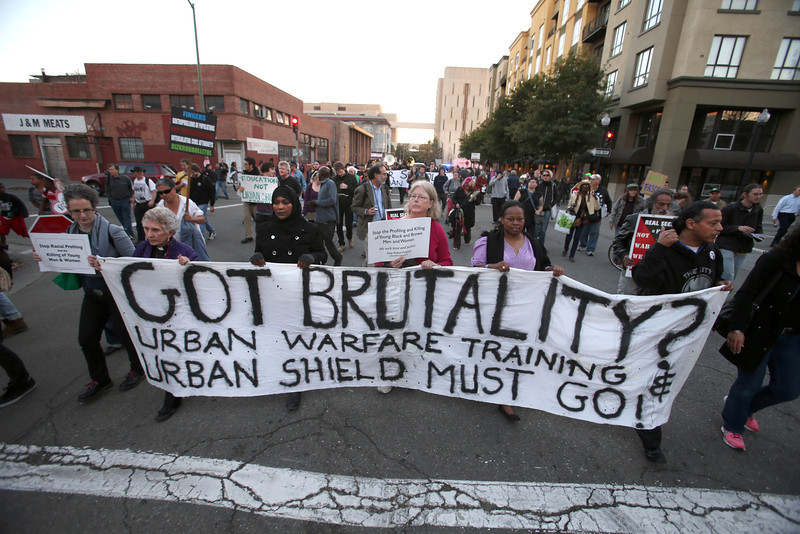
...just wait 'til you see the T-Shirts that were on sale at this year's Urban Shield event.

…just wait ’til you see the T-Shirts that were on sale at this year’s Urban Shield event.

“The claim that outside agitators had been the riot’s ringleaders…reiterated that black people were incapable of acting as political subjects in the defense of their humanity and rights as citizens,” writes Steven Gregory, professor of Anthropology and African American studies at Columbia University. Although applicable to the more recent Ferguson protests, Gregory’s words reference a series of similar events that occurred in 1930s Harlem. His recollection of several white-black, citizen-police fatalities exposes the need for not only institutional -but cultural- change.

Speaking of which, hopefully some of you were able to attend UC Berkeley’s forum, Black lives matter: police violence, prisons and freedom visions” on September 19th. The event featured speakers such as CeCe McDonald, Julia Chinyere Oparah and Ashon Crawley.

What can anthropology contribute to discussions of race, state-condoned brutality and violence? Pem Davidson Buck reflects on this and other questions in her post for Anthropology News, The Violence of the Status Quo.

My award for most disturbing topic of the month goes to Shane Bauer’s coverage of the 2014 Urban Shield event that was held in Oakland, California. Every year members of police and SWAT teams attend the tradeshow, where the latest tactical gadgets (including things like armored vehicles, blindness inducing flashlights and canine mounted cameras) are unveiled. Wait ‘til you see pics of the T Shirts that were on sale at the event…

Coming in at a close second on the creepiness scale is Jaeah Lee’s post, “So Basically Everyone Killed by a Cop is a Criminal, According to the FBI” And yes, it truly is as bad as it sounds. The fact that the FBI –among other things- allows jurisdiction-by-jurisdiction variation in the definition of “felon” is among Lee’s most worrisome findings.

NPR’s Gregory Warner featured an opposing view of police brutality this month. A Kenyan officer charged with the fatal shooting of two men inspired a local protest…in his favor. Find out why this instance of police brutality was “warranted” in the minds of citizens in his jurisdiction.

Police brutality often brings images of Ferguson, militarization and white-black violence to mind. But what about the seldom-mentioned tactic of police seizure of funds from people not charged with a crime (and without a warrant)? An engaging three-part expose about the questionable search and seizure practice is featured in The Washington Post.

Phew, that was a lot of bad news. Now onto the good- the Anthropology of the Good to be precise. In the words of Professor Joel Robbins, “Consensus about what constitutes good and how we separate this from bad is hard to pin down.” Cheer yourself up by reading about Robbins’ research at the University of Cambridge as well as why an Anthropology of the Good is a necessary complement to the already prevalent Anthropology of Suffering.

Also bound to make you happy is AllegraLab’s call for editorial assistants! Find out if you qualify, then send an email to their team at stuff@allegralaboratory.net before September 30th.


Did I miss something? No worries- it does happen on occasion. If you have any suggestions for DragNet, or if you want to call attention to a specific blog or article, send an email to anthropoliteia@gmail.com with the words “DragNet” in the subject header and I’ll get on it!

Standard
Book Reviews

A new grammar of public security in Brazil

Mesquita Neto, Paulo. 2011. Ensaios sobre segurança cidadã [Essays on Citizen Security]. São Paulo: Quartier Latin/Fapesp.

Review of: Mesquita Neto, Paulo. 2011. Ensaios sobre segurança cidadã [Essays on Citizen Security]. São Paulo: Quartier Latin/Fapesp.  By Daniel Silva

Why has Brazil’s 1988 democratic constitution advanced in promoting broad civil and economic rights while leaving (almost) unchanged the regulation of the police and armed forces? What’s the impact of Brazil’s Human Rights National Program in recent efforts of democratizing Brazilian society and building up an alternative to a minimal neoliberal state? Why have some types of public security policies been defined without much clarity, especially those that target the non-white-elites? These are some of the questions that Paulo de Mesquita Neto – a Brazilian scholar in political science who prematurely died in 2008 – asks in this collection of essays that he gathered under the rubric of Essays on citizen security. The book as a whole bears the imprint of an author striving to combine the vocabulary and syntax of democratic rule with a scrutiny of public security in Latin America – a grammar not too simple to practice in a continent that during the 1960s and 1970s surrendered to several authoritarian regimes whose marks are still noticeable, if not overly prominent, in current political culture and public debates.

The book as a whole bears the imprint of an author striving to combine the vocabulary and syntax of democratic rule with a scrutiny of public security in Latin America

Continue reading

Standard
Dossiers, From the Field

Economies of Security and Care in Catalonia, Spain

The editors of Anthropoliteia welcome Johanna Römer with a Dossier in our From the Field section.

Police Marcha Dignidad

Police presence at the Marcha por la Dignidad. Photo courtesy of Lee Douglas.


“The history of prisons in Spain?” a Catalan prison guard asked me, a man in his mid-forties, his hands resting on a heavy leather belt. “Everything has already been written. Our vocabulary, our forms of punishment – even the word cell itself, all come from Catholic and monastic practices.”

He turned to face the thick glass wall of the bunker.

“I spent years teaching…in law enforcement, in the private sector, and now I just want to be here, with these guys [inmates], where I can have peace and quiet,” he said, nodding towards a small group of men talking softly around a checked tablecloth whose color was imperceptible through the glass.

“Look at that. No one makes problems.”

While monitoring the inmates through the glass, the guard narrated other stories of prison work; but his last seemingly unremarkable comment, “no one makes problems,” stayed with me.

Continue reading

Standard
DragNet

DragNet: June 15 – 30, 2014

lancaster-pa-camera

After months of debate, the ACLU released previously sealed records regarding the cell phone-tracking tool in use by several departments.


The topic of surveillance packed a powerful punch this month, with the court releasing documents regarding Stingray technology capabilities. After months of debate, the ACLU released previously sealed records regarding the cell phone-tracking tool in use by several departments. The publication comes nearly 3 months after initial buzz about the tool that circulated after a suspect’s phone was used by police to track him to his apartment prior to obtaining a warrant. The more notable specifics of the technology can be found here.

The problem of prison over crowding is presented by Alyse Berenthal’s article in Anthropology News this month. As an anthropologist interested in the ethnographic aspects of justice, Berenthal spent time working with people in self-help legal clinics. By restricting definitions of justice to the individual level, Alyse work offers insights to the pitfalls of an over burdened justice system.

The truth is in the data.   The proof is in the series of graphs presented by Nicole Flatlow in Think Progress’ article about the existential growth of the US prison population. States like California are so over-populated with prisoners that courts have ordered that prisons take steps to reduce inmate populations. Local jails are feeling the pain of overcrowding, with large volumes of low-risk or offenders awaiting trial making up a large proportion of total prisoner populations.

Also in surveillance is Kirsten Weld’s post about the institutionalization of intelligence gathering by the US. From the Spanish-American War, to FDR’s administration, to the aftermath of 9/11: it becomes apparent that data mining is nothing new to the US’ administrative history. Whether or not the US has a right to act as “global policeman” has yet to be determined by both the law and its citizens.

Stingray technology was not the only cause of raised eyebrows this month. James Eyers of Financial Review put tap-and-go credit card technology under scrutiny in a post from earlier this month. Some departments are criticizing tap and go transactions; pointing to higher theft and break-ins by criminals looking for this specific type of credit card. Banks are standing by their anti-identification policies, stating that crime inevitably changes alongside technological innovations and they as a financial entity cannot be held accountable.

First shared in May, Mother Jones’ post by Katie Quandt was popular again this month. Entitled “What it’s like to visit your mother in prison on mother’s day”, Quandt reflects about the impact of her foster sister’s incarceration on her role as a mother. The article comes shortly after Sesame Street’s recent initiative to talk about challenges children with parents in prison face, citing that 1 in 28 children fall into this category (with that stat increasing to 1 in 9 children among African American children).

Have plans to lounge beachside this summer? If so, you can’t miss David Thompson’s “must read” journal articles for Spring 2014. Catch up on the latest in anthropology and policing in scholarly publications here.

Border Criminologies announced their recent initiative to first digitize and eventually physically document material works by UK immigrants. The archive is intended to act as a reminder of the creative process of individuals even during times of extreme stress and uncertainty. It serves to emphasize the role of material culture in criminology.

Should community policing lead the way in 2014? Steve Early advocates for this approach in In These Times pose on June 23rd. He attributes the more “reactive policing” approaches to post-9/11 emphasis on response. Would regular officer assignments result in higher reliability ratings from the public? Should community relationship building be instated to replace reactive responses?

Standard