DragNet

DragNet: June 15 – 30, 2014

lancaster-pa-camera

After months of debate, the ACLU released previously sealed records regarding the cell phone-tracking tool in use by several departments.


The topic of surveillance packed a powerful punch this month, with the court releasing documents regarding Stingray technology capabilities. After months of debate, the ACLU released previously sealed records regarding the cell phone-tracking tool in use by several departments. The publication comes nearly 3 months after initial buzz about the tool that circulated after a suspect’s phone was used by police to track him to his apartment prior to obtaining a warrant. The more notable specifics of the technology can be found here.

The problem of prison over crowding is presented by Alyse Berenthal’s article in Anthropology News this month. As an anthropologist interested in the ethnographic aspects of justice, Berenthal spent time working with people in self-help legal clinics. By restricting definitions of justice to the individual level, Alyse work offers insights to the pitfalls of an over burdened justice system.

The truth is in the data.   The proof is in the series of graphs presented by Nicole Flatlow in Think Progress’ article about the existential growth of the US prison population. States like California are so over-populated with prisoners that courts have ordered that prisons take steps to reduce inmate populations. Local jails are feeling the pain of overcrowding, with large volumes of low-risk or offenders awaiting trial making up a large proportion of total prisoner populations.

Also in surveillance is Kirsten Weld’s post about the institutionalization of intelligence gathering by the US. From the Spanish-American War, to FDR’s administration, to the aftermath of 9/11: it becomes apparent that data mining is nothing new to the US’ administrative history. Whether or not the US has a right to act as “global policeman” has yet to be determined by both the law and its citizens.

Stingray technology was not the only cause of raised eyebrows this month. James Eyers of Financial Review put tap-and-go credit card technology under scrutiny in a post from earlier this month. Some departments are criticizing tap and go transactions; pointing to higher theft and break-ins by criminals looking for this specific type of credit card. Banks are standing by their anti-identification policies, stating that crime inevitably changes alongside technological innovations and they as a financial entity cannot be held accountable.

First shared in May, Mother Jones’ post by Katie Quandt was popular again this month. Entitled “What it’s like to visit your mother in prison on mother’s day”, Quandt reflects about the impact of her foster sister’s incarceration on her role as a mother. The article comes shortly after Sesame Street’s recent initiative to talk about challenges children with parents in prison face, citing that 1 in 28 children fall into this category (with that stat increasing to 1 in 9 children among African American children).

Have plans to lounge beachside this summer? If so, you can’t miss David Thompson’s “must read” journal articles for Spring 2014. Catch up on the latest in anthropology and policing in scholarly publications here.

Border Criminologies announced their recent initiative to first digitize and eventually physically document material works by UK immigrants. The archive is intended to act as a reminder of the creative process of individuals even during times of extreme stress and uncertainty. It serves to emphasize the role of material culture in criminology.

Should community policing lead the way in 2014? Steve Early advocates for this approach in In These Times pose on June 23rd. He attributes the more “reactive policing” approaches to post-9/11 emphasis on response. Would regular officer assignments result in higher reliability ratings from the public? Should community relationship building be instated to replace reactive responses?

Standard
DragNet

DragNet: June 1 – 15, 2014

"The challenge of on-officer cameras is the tension between their potential to invade privacy and their strong benefit in promoting police accountability," ~ACLU

“The challenge of on-officer cameras is the tension between their potential to invade privacy and their strong benefit in promoting police accountability,” ~ACLU

June kicked off with a post by Scott Shafer of NPRNews regarding the drastic increase in California parole rates. Where previous years saw less than a 10% release rate for “lifers”, 2013 recorded a near doubling of this statistic. California governor Jerry Brown has reiterated that crime type is no longer as much of a determining factor for parole as is the level of threat an inmate poses to the community.  For more about the parole increase, check out Matt Levin’s article about lifers freed from prisons as well as his timeline cataloging the history of California parole trends.

“To the radicalized youth who demonstrated in 14 Brazilian state capitals on May 15, the World Cup represents a fundamental flaw in the Workers’ Party (PT) project,” writes Rodrigo Nunes in a news post from Aljazeera. While your friends are busy blowing up your Facebook feed about the soccer of World Cup, Brazilians continue to show outrage that the event has brought their country few winners, but many losers. For more about the political implications of the World Cup, check out Werner Krauss’ article on the Huffington Post.  Here, he dissects the event from a structural-ritual perspective. Anthropoliteia also featured a post from Meg Stalcup in our continuing coverage of the World Cup.

It’s not just police getting virtual these days- so are crime scenes. In a personal favorite post by Kashmir Hill of Forbes, Hill recounts the Internet trail left behind by Santa Barbara Shooter Elliot Rodger. The troubled youth produced several YouTube videos documenting his gradual decline into criminal violence.

What would Jeremy Bentham and Michel Foucault have to say about Lebanese prison systems? Yazan al-Saadi’s post on Al-Akhbar evokes this and other questions about surveillance and control. The original panopticon envisioned a top-down power structure wielded by authority figures over non-authority figures.  In the context of Lebanese prisons, however, this concept is turned on its head as it is the prisoner who seemingly wields ultimate control.  Also in surveillance, the wife of ex-IRA prisoner Anthony McIntyre has requested a formal investigation by the US state department after sensitive information from a phone call with the US embassy appeared in a popular tabloid a few days later.

An unlikely economical analysis of police body mounted cameras appeared in The Motley Fool’s investing section.  Ryan Lowery reflects on the potential profitability of the leading police tech companies (including TASER and L-3 Communications) that produce the majority of the equipment.

Issues of excessive force, surveillance and militarization come to a head in Kent Paterson’s post on CounterPunch. Using recent examples of militaristic responses by members of the Albuquerque police department, Paterson builds up to a broader discussion about the impact of police technologies on aggressive responses and use of force by US police departments.

Juvenile detention centers in California will be receiving $80 billion in coming months to rejuvenate current facilities. Several proposals for amenities and new features reinforce a community-based emphasis.  Officials hope the restructuring will help to solidify rehabilitation as a prevailing theme.

Tina Dupuy authored an engaging piece about casual vs. institutionalized racism in AlterNet this month. Why does the US rally more readily against casual comments than it does to institutionalized forms of racism (such as the prison system)? And further, does/can one form of racism lead to the other?

“Ban them, ban them all with a carve out for hunting weapons,” says Scott Martelle from LA Times Opinion. Referring to his admittedly minority stance on gun control in America, Martelle proposes the next steps for eliminating gun violence in America.

Standard
DragNet

DragNet, April 2014

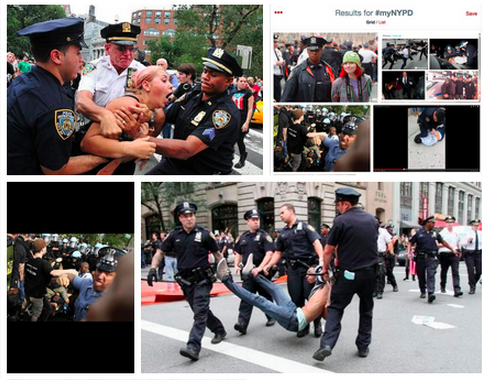
#myNYPD

What was on April’s Blog Menu, you ask? A flurry of posts covering everything from issues in ethnicity, crime stat validity, police social media involvement and ongoing Ukraine and surveillance coverage, of course! Continue reading

Standard
In the Journals

Michelle Stewart on the erasure of labour in the production of police experts

Our own Michelle Stewart has a fascinating article online over at M/C Journal using an ethnographic eye to attend to the labour (since it’s an Australian journal it has that extra ‘u’) that gets hidden in the production of police technologies.  Or, as she concludes:

Continue reading

Standard
Blotter

This past weekend I visited Detroit’s 2011 North American International Auto Show, where Ford used the opportunity to show off its new police Interceptors (check out Ford’s site complete with siren loading graphic and nationwide tour dates).  Seductively displayed in front of a slogan proclaiming, “Protecting Our Community. Securing Our Future,” and the message, “Ford salutes first responders. The heroes you depend on depend on Ford,” the cars were hard to miss.  There was something rather striking about the Interceptors -fierce yet sleek- that seemed to draw a continuous crowd of all ages.

The name alone is alluring: Interceptor.  It rolls off the tongue and brings forth images of blockbuster car chases complete with explosions and gritty, attractive male leads like Jason Statham or Daniel Craig.  As I stood listening to the soft “ooohs” and “ahhhhs” of passersby and watched dozens of people whip out their cameraphones (yours truly included), I asked myself who Ford was trying to sell the Interceptor to -the police or us?  Moreover, what was Ford really selling -the car itself, an “ideal” representation of the police, a car-chase fantasy, their own “Ford-tough” image, or all of the above?

Ford Interceptor Attracts Attention at the Detroit Auto Show…

Aside
Blotter

Anthropoliteia In the News 7/25/09

The Henry Louis Gates Affair

Besides the fiasco that occurred in and outside the home of prominent Harvard professor Henry Louis Gates Jr.– and that’s been burning up the news wires, television talk show circuit and radio waves (and being covered more exhaustively by our own Brian Lande, or socdeputy to you all)–there’s actually been some other news in the world…

Nancy Scheper-Hughes, anthropologist and crime fighter

Topping off any blog on the anthropology of policing is news that UC Berkeley anthropologist Nancy Scheper-Hughes was instrumental in the uncovering of a kidney-trafficking ring in New York and New Jersey.  Scheper-Hughes reportedly provided FBI officials with the name, address and phone number of Levy Izhak Rosenbaum, who appearently promised Moldovan villagers manual labor jobs in the U.S. before coercing them into “donating” their kidneys.  Both Somatosphere and Savage Minds have more extensive coverage of the affair, including an extensive audio interview between Scheper-Hughes and WNYC’s Brian Lehrer (at Somatosphere).

The View from France

Although French news wasn’t immune from the affair that burned up this side of the Atlantic, several other issues made note this week:

  • New French Minister of the Interior Brice Hortefeux announced the forthcoming unification of three police departments (Hauts-de-Seine, Seine-Saint-Denis and Val-de-Marne) under the control of the Prefect of Paris.  The move, which has historical precedent, is due in large part to response problems during the series of banlieue riots that have occurred outside Paris over the last several years.  At least one police union, SGP-FO, has applauded the move.
  • The controversy over the non-lethal arm known as the Flash-ball continues.  This week Stéphane Gatti, the father of the man injured in the Parisian suburb of Montreuil (see last week’s In the News), circulated an open letter on the internet denouncing police use of the arm.  In response, the Green Party proposed a law which would outlaw the use of the flash-ball, a move which quickly drew a response from all three major police unions.
  • French recruits to the Police Nationale are finding, increasingly, that the language of Moliere is no longer sufficient for conducting their everyday work.   What happens when a flic needs a Polish translator?  Eric from the blog Police Nationale Recruitement has some interesting insights.
  • This all is as news has come out that recruitment of all gardien-de-la-paix agents for next year will be canceled, for the first time ever.  the Minister of the Interior cites budget deficits, while union leaders point out that this will cause administrators to rely more on the less-paid, less-trained, less-job secure adjoints de sécurité (and more heavily minority-staffed) to do the same job.
  • Maurice Grimaud, Prefect of Paris during the May 1968 uprising, died.

“How many volts would you like with your waffle?”

Continuing our discussion of the use of tasers by police forces around the world, several officers from Gwinnett County Georgia find themselves in hot water after the appearently tased their waffle house waiter, whom they had repeatedly “teased” in previous encounters. “Miles told investigators that he only “spark tested” the Taser near the employee’s back “just to scare him a little bit,” according to the internal investigation file,” the Atlanta Constitution-Journal reports.

Police Tech

Other police technologies were also in the news.

  • The Economist has an article on using an underground radar system to locate illegal drug traffic at the border
  • British police canned a text-messaging program after it recorded an average of only 3 messages per day since its inception in March
  • The police of Seine-Saint-Denis, outside of Paris, will soon be equipped with individual mini-cameras which will be mounted on their ear and be about the size of a bluetooth device.
  • The Maryland Transportation Administration, provider of public transportation in the land of The Wire, announced, and then retracted, its desire to use microphones to record all conversations of trains and buses…
  • …while the town of Tiburon, CA announced that it will photograph every car that comes through town, and then use the license plate information to solve crimes. “As long as you don’t arrive in a stolen vehicle or go on a crime spree while you’re here, your anonymity will be preserved,” said Town Manager Peggy Curran. “We don’t care who you are and we don’t know who you are.”

Security before it happens

Friend of this blog and uber-cosmopolit anthropologist Limor Darash has an article in the new American Ethnologist in which she outlines the assemblage of biosecurity/threat responses she calls a “pre-event configuration.”  You can read more about it at Vital Systems Security.

“A bad economy is not good for the murder rate”

In what should be a surprise to no one, a team of researchers plan to publish a study in The Lancet that show that murder rates in the EU go up at a rate of about .8% for every 1% increase in unemployment.  As a result, the team suggests that social and economic services might, in fact, save lives: “The analysis also suggests that governments might be able to protect their populations, specifically by budgeting for measures that keep people employed, helping those who lose their jobs cope with the negative effects of unemployment, and enabling unemployed people to regain work quickly. We observed that social spending on active labour market programmes greater than $190 per head purchasing power parity mitigated the effect of unemployment on death rates from suicides, creating a specific opportunity for stimulus packages to align labour market investments with health promotion.”

Police Locally

In more local news (well, local to some of us) UC Berkeley finally named its new police chief.  Assistant Police Chief Mitch Celaya will take over on August 1st from UCPD Chief Victoria Harrison, who is set to retire.  Ceyaya, a member of the UCPD since 1982, had been one of two finalists (along with David Kozicki, deputy chief for the Oakland Police Department) for the position.

In a June interview, Celaya gave a broad outline of his philosophy for policing Berkeley: “Besides loving my job, the campus culture, and the communit…. I am in tune to the culture and what people expect from the department. I would like to enhance the interactions with the student community. Some students feel that they have not developed relationships with us and we want to change that, working with the Associated Students of UC Berkeley and setting up mentor groups.”

Gates redux

And just in case you still haven’t got enough of the Henry Louis Gates Jr story:

  • The New York Times has an interesting article on the training police officers receive in order to handle verbal abuse and insults in tense situations–and whether or not such training is helpful
  • Peter Moskos, at Cop in the Hood, has a post detailing the technique, apparently used in the gates case, whereby a police officer invites an emotionally-charged individual outside, where he is then arrested for disorderly conduct.
  • Jonathan Simon (of Governing Through Crime) offers some historical context, over at PrawfsBlawg, for the Gates affair before considering whether obama should use this as a “teaching moment” as gates has suggested.  Simon’s answer?  Probably not.
  • Finally, the Chronicle of Higher Education‘s blog, Brainstorm, has two articles of note on the issue.  One by anthropologist John L. Jackson Jr., which attempts to “connect dots between Gatesian accusations (of race-thinking) and a cop’s defense (of colorblindness and racial neutrality)” and another post, which offers a passage written by Gates himself in 1995, which tries to explain how police are perceived in black communities: “It’s a commonplace that white folks trust the police and black folks don’t. Whites recognize this in the abstract, but they’re continually surprised at the depth of black wariness. They shouldn’t be. …Wynton Marsalis says, “My worst fear is to have to go before the criminal-justice system.” Absurdly enough, it’s mine, too.”

Citations Available Online

SAMIMIAN-DARASH, L. (2009). A pre-event configuration for biological threats: Preparedness and the constitution of biosecurity events American Ethnologist, 36 (3), 478-491 DOI: 10.1111/j.1548-1425.2009.01174.x

Stuckler, D., Basu, S., Suhrcke, M., Coutts, A., & McKee, M. (2009). The public health effect of economic crises and alternative policy responses in Europe: an empirical analysis The Lancet, 374 (9686), 315-323 DOI: 10.1016/S0140-6736(09)61124-7


Standard