DragNet

DragNet August 1 – 24, 2014

Whether you rely on Twitter, Facebook, Washington Post or Reddit for updates, chances are your August feed has been dominated by discussions surrounding the death of Michael Brown.

Whether you rely on Twitter, Facebook, Washington Post or Reddit for updates, chances are your August feed has been dominated by discussions surrounding the death of Michael Brown.

Whether you rely on Twitter, Facebook, Washington Post or Reddit for updates, chances are your August feed has been dominated by discussions surrounding the death of Michael Brown. Matt Thompson of Savage Minds touched upon the conflicting coverage of recent events in Ferguson (as well as the implications highlighted by news entities like The Washington Post and New York Times) in his entry, “What is a rioter?” Likewise, the short (and terrifyingly poignant) comic featured in Medium’s August 14th post expands upon the reality of modern police militarization. Among other problems, it emphasizes the role of basic training (or lack thereof) in the police use of military-issued equipment.

If militarization is of particular interest, be sure to check out Taylor Wofford’s piece in Newsweek. Although many associate the growing police use of military grade gear and weaponry with Ferguson protests, Wofford details how departments have been “silently preparing officers for battle” as far back as the early ‘90s.

The Economist’s post Cops or Soldiers? is also relevant to concerns about police militarization. More intriguing is the fact that the article was originally featured back in March (preceding the events in Ferguson). Although SWAT teams are implied as representing an important tool of departments, when and where such teams should be deployed remain key (unanswered) questions.

Of course, Anthropoliteia staff have not been silent bystanders to Ferguson discussions. Meg Stalcup offered insight about the series of events, providing the seldom-addressed topic of officer perceptions. Although the dynamic of officer-civilian relations remains mostly hostile, Stalcup posits that with officer’s “under threat perception, it’s not surprising, although unprofessional and deplorable, that officers menace the protestors they are supposed to protect.” Lastly, don’t miss Anthropoliteia’s second Ferguson post Blue on black violence and original crime: view from Oakland, California. Our developing forum featured Brad Erickson on August 21st. In his post, Erickson uses his own experiences researching the people and police of Oakland, CA to comment on the racial and militaristic implications of Michael Brown’s shooting.
Standard
#Ferguson & Elsewhere, Commentary & Forums

Blue on black violence and original crime: a view from Oakland, California

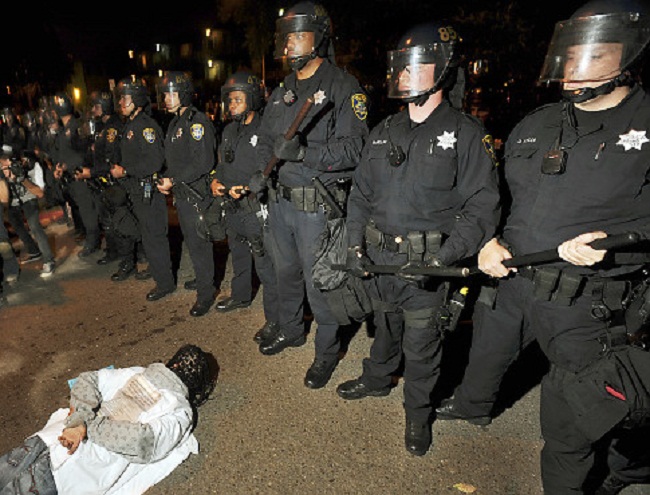
Oakland protest against murder of Oscar Grant. Image courtesy of Voice of Detroit


The editors of Anthropoliteia would like to welcome Brad Erickson with the latest entry in our developing Forum #Ferguson & Elsewhere

 The police killing of an unarmed, 18-year old African American, Michael Brown, and the hyper-militarized response to public protest in Ferguson, Missouri, has prompted wide-ranging national discourse following several threads. The first, exemplified by the #BlackTwitter phenomenon, emphasizes the pattern of extrajudicial killings of black people by police, security guards and self-appointed vigilantes as the continuing exercise of racial domination in the United States. The second is the attempt to cast Michael Brown and other black victims as threatening criminals in order to justify their killings and deny the salience of racism. A third major theme is the militarization of police, a growing trend since the introduction of SWAT teams in the 1970s, now pushed into high gear through the federal distribution of idle war materiel including armored vehicles, grenade launchers, and machine guns. This militarization is often linked to a decline in civil liberties and violations of due process. Some commentators locate these trends in the contexts of the rise of a surveillance state, the crisis of inequality and the demise of democracy orchestrated by wealthy elites.

I would like to reflect on these trends via the perspectives of people deeply impacted by them. In 2013, I carried out an evaluation of Oakland’s community policing program, and also tracked the effectiveness of family support services in Oakland’s lowest performing middle schools. For the first project I interviewed Oakland police personnel including captains, sergeants, lieutenants, problem solving officers (PSOs—assigned to work with specific neighborhoods), and crime reduction team officers (CRTs—largely focused on gang activity). For the second project, I observed and interviewed parents and children, teachers, principals, school counselors, and a variety of school-based service providers including nurses, counselors, mental health professionals, legal advisors, food bank and community gardens personnel, and Teach for America volunteers.

Continue reading

Standard
#Ferguson & Elsewhere, Commentary & Forums

Notes on Ferguson: Some factors in the policing of protests

 
Ferguson Missouri protests

Ferguson, MO – Protests Day 4 –August 14th 2014
By Loavesofbread (Own work) [CC-BY-SA-4.0 ] via Wikimedia Commons

A friend sent me an article which quoted a police officer in Ferguson, MO snarling to a crowd, “Bring it. You fucking animals, bring it.” She asked for my thoughts. I’d seen the article earlier, part of the news reporting and blogosphere discussion of people of color killed by on-duty officers and the accompanying demonstrations against police violence. I think that coverage has correctly pointed to 1) entrenched racism, such that black faces are reflexively perceived as suspicious and dangerous, 2) and militarization of the police. But even with these explanations there seems to remain something incomprehensible, and I think that comes from just how differently the police tend to understand what they do.

Continue reading

Standard
DragNet

DragNet: July 15 – 31, 2014


With facial recognition technology growing in popularity (think Facebook), companies like CV Dazzle are responding with creative solutions aimed at protecting privacy (and, for that matter, your face).

With facial recognition technology growing in popularity (think Facebook), companies like CV Dazzle are responding with creative solutions aimed at protecting privacy (and, for that matter, your face).

Continue reading

Standard
Practicum

Applying Anthropology in Criminal Justice Evaluation: An Interview with Patricia San Antonio

Police Call Box, Washington, DC © Jennie Simpson 2014

Police Call Box, Washington, DC © Jennie Simpson 2014

Welcome to the latest edition of the Practicum feature! In today’s column, I highlight my conversation with Dr. Patricia San Antonio, an applied anthropologist who has worked in the field of monitoring and evaluation of criminal justice programs for the last 20 years. Dr. San Antonio is a senior research analyst and project director at a social sciences consulting firm in the Washington DC metropolitan area.  In the interview we discussed Dr. San Antonio’s career, her focus on monitoring and evaluation of criminal programs and the unique contribution of applied anthropologists in criminal justice work. Read on for more!
 

Continue reading

Standard
Interrogations

Interrogations: Heath Cabot and William Garriot on Policing and Contemporary Governance

Palgrave MacMillan (2013)

Policing and Contemporary Governance: the anthropology of police in practice. William Garriott, editor (Palgrave MacMillan 2013).

The editors of Anthropoliteia would like to introduce yet another in our series of new features: Interrogations, an interview series with authors and other people of potential interest to our readers.  The term ‘interrogation’ comes  the Latin inter “between” and rogare “question”.  It thus originally meant something like “to question between” (as opposed, for example, to examiner “to test, try, torture”).  Our plans for the series, which will edited by Kristen Drybread & Johanna Romer, are aimed at exploring this sense of the term.
We are happy to present to you the first in this series,  a conversation between Heath Cabot & William Garriott focused on Garriott’s edited volume Policing and Contemporary Governance: The Anthropology of Police in Practice (2013).
 

Continue reading

Standard
Dossiers, From the Field

Economies of Security and Care in Catalonia, Spain

The editors of Anthropoliteia welcome Johanna Römer with a Dossier in our From the Field section.

Police Marcha Dignidad

Police presence at the Marcha por la Dignidad. Photo courtesy of Lee Douglas.


“The history of prisons in Spain?” a Catalan prison guard asked me, a man in his mid-forties, his hands resting on a heavy leather belt. “Everything has already been written. Our vocabulary, our forms of punishment – even the word cell itself, all come from Catholic and monastic practices.”

He turned to face the thick glass wall of the bunker.

“I spent years teaching…in law enforcement, in the private sector, and now I just want to be here, with these guys [inmates], where I can have peace and quiet,” he said, nodding towards a small group of men talking softly around a checked tablecloth whose color was imperceptible through the glass.

“Look at that. No one makes problems.”

While monitoring the inmates through the glass, the guard narrated other stories of prison work; but his last seemingly unremarkable comment, “no one makes problems,” stayed with me.

Continue reading

Standard
Commentary & Forums, Dossiers, From the Field, Security in Brazil: World Cup 2014 and Beyond

The Brazilian Military, Public Security, and Rio de Janeiro’s “Pacification”

The editors of Anthropoliteia welcome Stephanie Savell with the latest entry in our forum Security in Brazil: World Cup 2014 and Beyond.
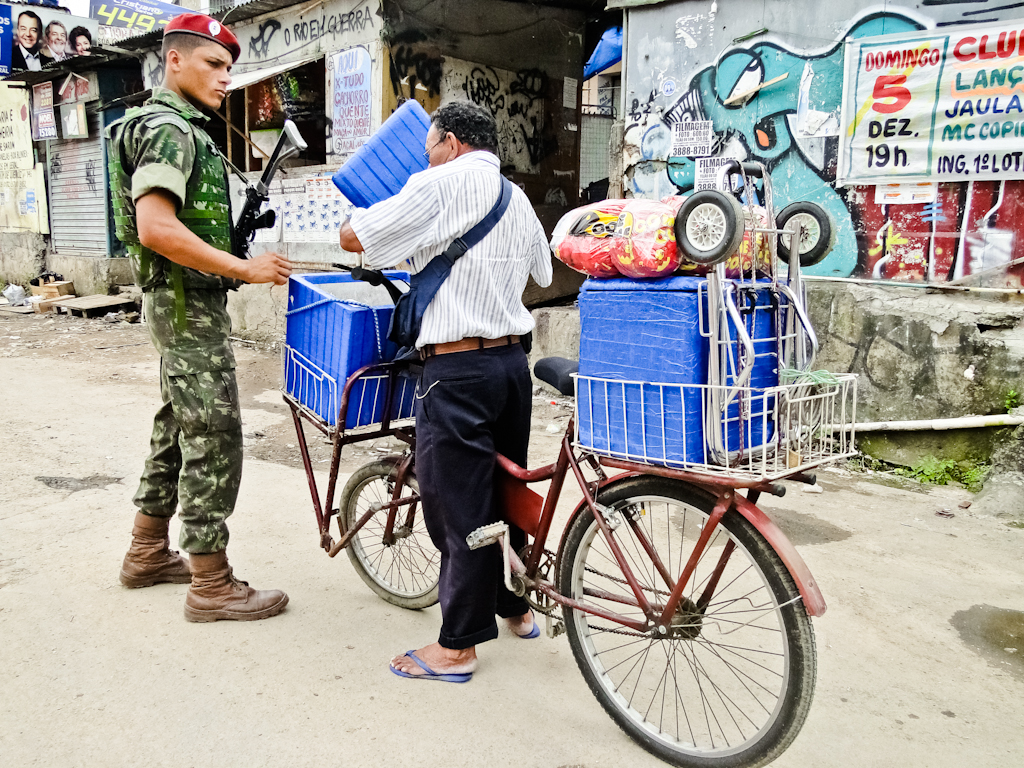
Army soldier addresses resident of Complexo do Alemão. Photo: Bruno Itan.

Army soldier addresses resident of Complexo do Alemão. Photo: Bruno Itan.

The Brazilian army and marines have in recent years played a more visible role in the provision of public security in Rio de Janeiro. The army currently occupies the sprawling set of informal neighborhoods, or favelas, known as Complexo da Maré, a “temporary solution” timed to accompany World Cup events in the city. The occupation, intended to repress the local control of drug trafficking gangs, will be followed by the installation of more permanent “Police Pacifying Units,” or “UPPs,” as part of Rio’s favela “pacification” program.

Between 2011 and 2012, the armed forces similarly occupied the favela Complexo do Alemão, where I lived for a year conducting ethnographic research (2013-2014). Here, based on that research, I examine the significance of the army’s participation in public security.

Many insiders and keen observers of security in Rio were quick to tell me that the army’s deployment in police pacification is not a trend – Alemão was unique, they said. But in addition to the current deployment in Maré, there are other indications to the contrary. In recent years, the constitutional clause, Garantia da Lei e da Ordem (GLO), or “Guarantee of Law and Order,” which allows for the use of the military in public security operations, has been continuously elaborated and refined. Under former President Lula’s administration, and now under Dilma Rousseff, the military has been used for an increasing number of situations, from pacification to oil auctions to the Pope’s visit and the World Cup. These are not isolated events; they invite us to question the military’s provision of public security and how it is understood, especially by security forces and by the urban poor whose neighborhoods the military patrols. Continue reading

Standard
Commentary & Forums, Security in Brazil: World Cup 2014 and Beyond

The Politics of Violence and Brazil’s World Cup

The editors of Anthropoliteia welcome Sean T. Mitchell with the latest entry in our forum Security in Brazil: World Cup 2014 and Beyond.

A June 19, 2014 São Paulo protest called by the Movimento Passe Livre (Free Fare Movement) to protest transport fares and conditions, but mischaracterized internationally as an “Antigovernment” and “World Cup” protest. The banner in front reads, “There will be no fare.” Photo. Oliver Kornblihtt/ Midia NINJA

A June 19, 2014 São Paulo protest called by the Movimento Passe Livre (Free Fare Movement) to protest transport fares and conditions was mischaracterized internationally as an “Antigovernment” and “World Cup” protest. The banner in front reads, “There will be no fare.” Photo: Oliver Kornblihtt/ Midia NINJA


On Failure, Violence, and the World Cup

Not unlike the 2010 hoopla anticipating that year’s South Africa World Cup, the breathless expectation of failure and security breakdown that characterized much international coverage of the lead up to Brazil’s 2014 World Cup, now, midway through the month-long event, seems to have been illfounded.

When reporting wasn’t merely what Meg Stalcup characterized on this forum as fluff—which much of it was—pre World Cup coverage in the global north press was overheated and macabre.  Why?

The last year has seen the emergence of large scale Brazilian protest movements of clear importance, and the World Cup has been a target of their criticism.  But the macabre emphasis on violence and failure has obscured much more than it has illuminated about these movements, and about the real violence and social conflicts in contemporary Brazil.

To understand why so much coverage has taken this lurid form, it helps to look at historical representations of peace and violence in Brazil, as well as contemporary politics in Brazil and abroad.

Continue reading

Standard