
Category Archives: Round Ups
Periodic and occasional summaries of anthropoliteia-related work, news, events and discussions
In the Journals – August 2015

Welcome back to In the Journals, a round-up of recent journal publications on security, crime, law enforcement and the state. After a brief hiatus over the summer, we’re happy to be back with a batch of the most recent articles and reviews for our dear readers.
Anthropoliteia and the Political and Legal Anthropology Review (PoLAR)

Two bits of news concerning both Anthropoliteia and the journal Political and Legal Anthropology Review (PoLAR):
First, we’re all so excited that our own William Garriot, along with friend-of-Anthropoliteia Heath Cabot, have taken over as co-editors of the journal. We can’t wait to see what a Cabot-Garriot tenure will bring!
Also of note to readers of this blog: PoLAR just recently published an Open Access Virtual Issue on “The Promise and Pathos of Law,” which includes several recent and classic articles on the topic (including my own article “Of Heroes and Polemics: the ‘policeman’ in urban ethnography“) as well as new and original “supplementary” postscripts in which each author reflects on their contribution through the lens of time. My own essay focuses on the exciting development of “anthropology of policing” since the publication of “Of Heroes…” in 2010.
In the Journals – June 2015

In the Journals – May 2015

Open Access Articles from the American Anthropological Association
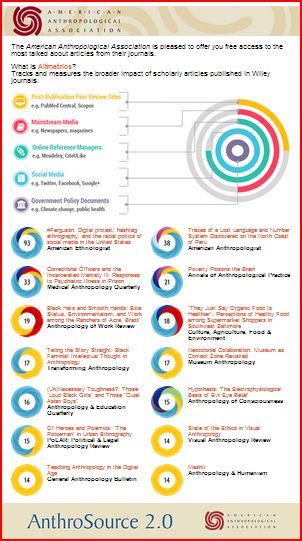 The AAA has decided to feature the “most-discussed” articles (as measured by Altmetrics) from Anthrosource by making them temporarily open-access. Among these are several articles that might be of interest to our readers:
- BONILLA, Y. and ROSA, J. (2015), #Ferguson: Digital protest, hashtag ethnography, and the racial politics of social media in the United States. American Ethnologist, 42: 4–17. doi: 10.1111/amet.12112
- Galanek, J. D. (2015), Correctional Officers and the Incarcerated Mentally Ill: Responses to Psychiatric Illness in Prison. Medical Anthropology Quarterly, 29: 116–136. doi: 10.1111/maq.12137
and (*ahem* cough, cough)
DragNet: April 20 – May 3, 2015

“I think you have to have a shared collective memory of the past to recognize another human being,” writes Lawrence Jackson. His post, On Becoming More Human, examines the recent protests against police violence in Baltimore from his perspective as an African American man.
I was happy to see Illana Feldman’s new book, Police Encounters: Security and Surveillance in Gaza Under Egyptian Rule, make the rounds on our twitter feed last month. In it, my former Anthropology professor at George Washington University discusses the topics of surveillance, control and police violence in Gaza during the period of Egyptian rule. Disclaimer: you’ll want to block off a few hours to tap into this one…it’s addictive from the start!
“I think you have to have a shared collective memory of the past to recognize another human being,” writes Lawrence Jackson for n plus one magazine. His post, On Becoming More Human, examines the recent protests against police violence in Baltimore from his perspective as an African American man. Jackson is a professor of African American Studies and English at Emory University, and is the author of the 2012 memoir, My Father’s Name: A Black Virginia Family after the Civil War. His post undoubtedly earns my vote for “best of the month”- if you have time for one (and only one) read today, this is it.
Those interested in coverage about the tragic police-related death of Freddie Gray shouldn’t miss NPR’s Weekend Edition that we shared late last month. In it, Scott Simon recounts his experience walking among the residents of West Baltimore in the wake of police protests. As the title attests, to many West Baltimoreans, the “largest gang is, in fact, the police.” We also recommend Ta-Nehisi Coates’ post, Nonviolence as Compliance, which was featured via The Atlantic.
What does the concept of “touch” mean, in a policing context? Mark Greif reflects on this question and more in his post, Seeing Through Police. He discusses the “rules” of police-citizen contact (i.e.- they touch you, you keep your hands to yourself), its many functions (intimidation, reassurance, “traffic direction”) and forms (hands vs. batons). What’s perhaps most intriguing about this post is its dual -and rather empathetic- consideration of police as police, and police as people. At the same time, it presents a critical and well-balanced portrait of modern police practices.
Finally, we are pleased to offer continuing coverage of the American Anthropological Association’s developing initiatives regarding police brutality. AAA recently announced they’ll be offering a working group to monitor racialized police brutality and extrajudicial violence. Co-chairs include David Simmons, Marla Frederick and Shalini Shankar. You can view the Working Group charge here.
Did I miss something? No worries- it does happen on occasion. If you have any suggestions for DragNet, or if you want to call attention to a specific blog or article, send an email to anthropoliteia@gmail.com with the words “DragNet” in the subject header and I’ll get on it!
In the Journals – April 2015

DragNet: April 6 – 19, 2015
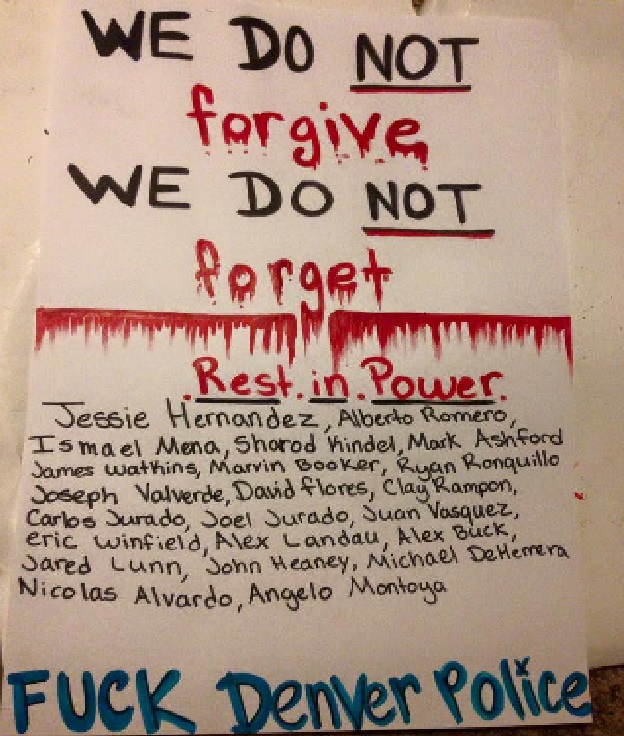
In an unusual demonstration against Denver police, supporters of Jessie Hernandez have allegedly been expressing their discontent by stealing cars. Hernandez was fatally shot by police in January.
| The police-involved killing of Walter Scott dominates policing news by far this month. Video footage, shot with the cell phone of a bystander who witnessed the event, seems to offer key (and yet incomplete) evidence of how the shooting evolved. Scott had apparently been stopped during a “routine traffic stop” for a broken tail-light. Although the video recording did not capture the full nature of the altercation, it did capture the officer proceeding to shoot Scott in the back while he was running more than 20 feet away from the officer.
Edward Bryant II, head of North Charleston’s NAACP chapter was among those interviewed about the incident by Martin Kaste on NPR’s Morning Edition. While addressing the moment of the film that captured the officer “dropping something” -perhaps the very Taser Scott was charged with stealing- Bryant says that it “reflects something very distasteful…like it’s already been practiced. It’s been already done.” Among organizations taking a stance against the continuation of racialized police violence is the American Anthropological Association, who’s post we shared via Jeff Martin. Stay tuned for their specific initiatives regarding policing culture, which are to be listed soon. |
| All Things Considered also joined the law enforcement culture conversation, with Audie Cornish’s interview with Seth Stoughton. Stoughton is an assistant professor at the University of South Carolina’s School of Law. He suggests the paradign of policing in American is is need of a major makeover; suggesting the current “warrior mindset” should be exchanged for one that is conducive to a “guardian” role. |
| A 73-year-old undercover Tulsa reserve deputy sheriff who fatally shot an unarmed black man during an undercover operation gone wrong turned himself in on Tuesday last week. He allegedly mistook his gun for his taser; fatally wounding the unarmed man. Robert Bates has been charged with second degree manslaughter involving culpable negligence. He was released on $25,000 bail and is awaiting trial, according to Lindsey Bever and Sarah Larimer of the Washington Post. |
| In an unusual demonstration against the Denver police, supporters of Jessie Hernandez have allegedly been expressing their discontent by stealing cars. As reported by Michael Roberts for Westword, Hernandez was fatally shot by police back in January after two officers responded to a call about a suspicious vehicle. According to one source, 126 vehicles have been stolen in the area since the beginning of the year, which is nearly double the amount recorded for the same period last year.
Did I miss something? No worries- it does happen on occasion. If you have any suggestions for DragNet, or if you want to call attention to a specific blog or article, send an email to anthropoliteia@gmail.com with the words “DragNet” in the subject header and I’ll get on it! |
DragNet: March 23 – April 5, 2015

“What would it take for today’s gang members to bring peace to the neighborhood?” writes Laurence Ralph in his post for Anthropoliteia last month. Ralph recounts the story of his friendship with an elderly member of one of Chicago’s most notorious gangs, The Divine Knights. But the story reveals the little known history of the gang, as well as a strikingly “tender” side of the group previously known only among local community members.
To record, or not to record; that is the question! Last month, we shared Carlos Miller’s post for Photography is Not a Crime. According to legislators in Texas, members of the general public should not be allowed to film or record officers by law. But a policy being proposed by a political duo in Colorado begs to differ. Joe Salazar and Daneya Esgar have teamed up to co-sponsor a bill that would award up to $15,000 (plus attorney fees) to citizens who have cameras or recording devices confiscated by officers without a warrant. You can read a copy of the proposed bill here and decide for yourself.
The small town of Madison, Wisconsin is putting a whole new spin on the meaning of “officer next door” in an attempt to foster peaceful interactions between police and local community members. Melissa Block hosts this episode of All Thing Considered for NPR and details how officers and neighborhood residents have reacted to the police department literally moving in next store to high crime areas. The key to the community initiative’s success apparently lies in its exposure of officers and citizens to one another in everyday contexts- both good and bad.
If you, like me, have been amazed to discover how very impossible it is to obtain even the slightest estimates about lethal use of force by police for any given year, you’ve got to read Tom McCarthy’s post for The Guardian ASAP. Finally, we learn why there are no reliable estimates about police-related homicides: it was too difficult, so “we just gave up”. (Yeah, I’m not buying it either!) Although the Bureau of Justice Statistics arguably places a number on all kinds of similar measures, they’re reporting difficulties assessing lethal use of force nation-wide. Among other stumbling blocks are incomplete or never-filed reports (from departments such as NYPD) and inconsistent reporting. Now it’s time to play the waiting game to see if Obama’s newly created Policing Task Force will follow through with his request for “more” (or any?) data…
“What would it take for today’s gang members to bring peace to the neighborhood?” writes Laurence Ralph in his post for Anthropoliteia last month. Not that we need to remind you, but the newest Tip of the Cap feature is up and hungry for your feedback. Ralph recounts the story of his friendship with an elderly member of one of Chicago’s most notorious gangs, The Divine Knights. But the story reveals the little known history of the gang, as well as a strikingly “tender” side of the group previously known only among local community members. Laurence Ralph is an Assistant Professor of African and African American Studies as well as Anthropology at Harvard University. If you leave the post wanting more, be sure to check out his book, “Renegade Dreams: Living Through Injury in Gangland Chicago“.
To end on a fun note (and just because I’m feeling random), treat yourself to browsing through Radio Free Europe Radio Liberty’s eclectic collection of bizarre Soviet Police posters from back in the day. Among my own personal favorites are, “concerned looking smoking guy” and “Gee! My facial angle looks great in this lighting!“. If you’re also the kind of person that likes a healthy amount of “crazy crap” on your walls, you’ll thank me for including a link that can hook you up with your next police-inspired addition.
Did I miss something? No worries- it does happen on occasion. If you have any suggestions for DragNet, or if you want to call attention to a specific blog or article, send an email to anthropoliteia@gmail.com with the words “DragNet” in the subject header and I’ll get on it!
 Anthropoliteia