Category Archives: Round Ups
Periodic and occasional summaries of anthropoliteia-related work, news, events and discussions
Michelle Stewart on the erasure of labour in the production of police experts
 Our own Michelle Stewart has a fascinating article online over at M/C Journal using an ethnographic eye to attend to the labour (since it’s an Australian journal it has that extra ‘u’) that gets hidden in the production of police technologies. Or, as she concludes:
“Today the world, once again, is watching South Africa’s response to  police violence. Emerging from a violent Apartheid past, the newly branded South African Police Services was meant to be a shining example of how best to protect law and order, while ensuring a free democratic society for all. However, recent events in Ficksburg, Marikana and Cato Crest shake the foundation of this vision.”
Kerry Chance on South African Policing
Anthropoliteia in Anthropology news

 “Fault Lines in an Anthropology of Police, Both Public and Global” in Anthropology News
Another commentary by yours truly at Anthropology News. AN format forbids in-text citations and footnotes, but if you’ll follow the links you’ll find a dense web of Anthropoliteia contributors’ work!
Special Issue of Anthropology News features two articles on Police
Although there’s been quite a bit of rumbling over the AAA’s “open access” policies over the last several years, one positive development IMHO has been to move the association’s newsletter, Anthropology News, to an online and OA format.

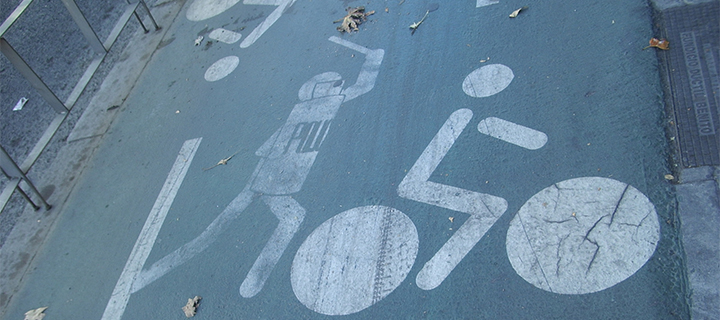
Police propaganda billboard advertising goals for building a “Peaceful and Healthy Society.” This photograph was taken in Taiwan in the early 2000s. Photo courtesy Jeffrey T Martin
And now readers of this blog can benefit. The most recent issue features several articles on the Anthropology of Law in its “In Focus” section, including two articles on the anthropology of policing: one from Anthropoliteia’s own Jeff Martin, entitled “How the Law Matters to the Taiwanese Police” and another by Jennie Simpson, a recent PhD from American University, “Building the Anthropology of Policing” (the latter featuring a short–and unexpected cameo from yours truly).
Personally, I’m super-psyched that the anthropology of policing is beginning to carve out a space in the larger world of anthropology. Not only am I currently brainstorming how to incorporate these blog posts into my course on Policing in Society, but I’m secretly formulating a response to Jeff arguing that his use of my beloved Max Weber is all wrong!
In The News: Anthropologists, Criminologists (and some others) on the Newtown Shootings
I still haven’t found much of a voice or aptitude for addressing current events in a timeframe that seems relevant, so like the Trayvon Martin incident, I feel like this blog post is a bit “late to the game” and with less than I’d like to offer. This is of course made more difficult by the fact that research on gun violence has been blocked in the U.S. along multiple lines for some time.
Despite these impediments, there have been several serious attempts to gain an understanding of the role of guns and gun accessibility on mass shootings:
Continue reading
In the spirit of continuing our discussion of the British “riots”, Jonathan Simon has an interesting post that I think echoes many of the things that came up in our own discussion. Here’s one particularly cogent nut he offers up in describing the importation of American criminal justice techniques to Britain over the past decade:
“….[C]hronic overuse of criminal justice as a ready made tool for addressing social insecurity under Neo-liberal economic assumptions has led to collapse of both deterrence and legitimacy.”
Now there’s a thesis. Thoughts?
Following up on the British “riots”: Jonathan Simon on GTC
In The News: Police-Community Relations
TORONTO – A Toronto police officer recently apologized for suggesting that women could prevent sexual assault by not dressing “like sluts” during a campus safety information session at York University last month. Toronto police spokesman, Mark Pugash, stated that the officer’s remarks were “diametrically opposed to the way in which [they] train [their] people, the way in which [they] train [their] investigators and the way in which [they] write about sexual assault.” Although the officer has been disciplined, many -including Mila Guidorizzi, part of York University’s Sexual Assault Survivors’ Support Line- believe that this cannot make up for the damage that may have been caused by the Toronto officer’s insinuation that women are to blame for sexual assault as it may decrease the likelihood that survivors of sexual assault will report their assaults or seek counseling. Others, such as the vice-president of campaigns and advocacy for the York Federation of Students Darshika Selvasivam, believes the Toronto police’s procedures for handling sexual assault cases should be evaluated by a third party as current police training “clearly isn’t sufficient enough because this officer clearly felt comfortable (making the comments) despite the training that he had received.” Toronto police asserted that they have worked with a number of outside organizations to create an adequate training program for sexual assault investigators and maintains that the officer in question does not represent the force.
SAN JOSE – Facing increasing numbers of racial profiling and other bias allegations, the San Jose police department has broadened its definition of profiling to include “any biased behavior at any time during an encounter with the public.” Prior to the change, San Jose’s Police Duty Manual stated that an officer must not “initiate a contact solely” based on factors including race, color, nationality and gender,” however, it is difficult to prove biased policing has taken place under this definition as officers could argue the person in question was stopped for a valid reason such as a broken taillight of failing to signal. While the new definition does not directly address this issue, the city’s independent police auditor believes the change is a “huge” move in the right direction, noting past attempts to get the previous police chief to address issues of biased policing. It is hoped that the new definition with help rebuild the “strained” relationship between San Jose’s minority communities and the police. This is just one change in a series of alterations to the department’s operation. Last year, the new police chief stopped his officers from impounding the cars of unlicensed drivers who were picked up for minor traffic violations, a practice many believed to target undocumented Latino immigrants.
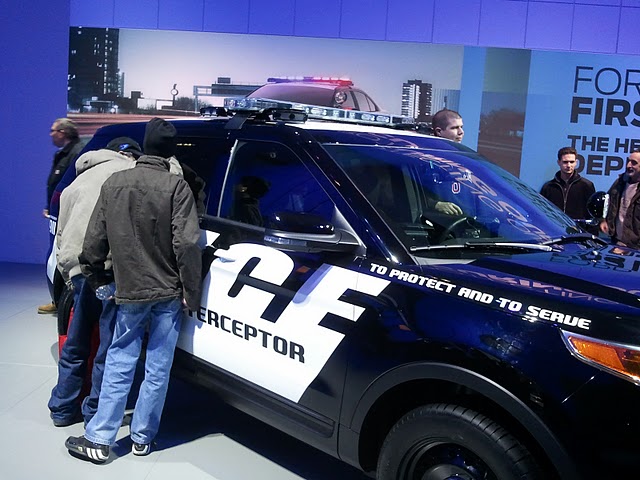

 This past weekend I visited Detroit’s 2011 North American International Auto Show, where Ford used the opportunity to show off its new police Interceptors (check out Ford’s site complete with siren loading graphic and nationwide tour dates). Seductively displayed in front of a slogan proclaiming, “Protecting Our Community. Securing Our Future,” and the message, “Ford salutes first responders. The heroes you depend on depend on Ford,” the cars were hard to miss. There was something rather striking about the Interceptors -fierce yet sleek- that seemed to draw a continuous crowd of all ages.
The name alone is alluring: Interceptor. It rolls off the tongue and brings forth images of blockbuster car chases complete with explosions and gritty, attractive male leads like Jason Statham or Daniel Craig. As I stood listening to the soft “ooohs” and “ahhhhs” of passersby and watched dozens of people whip out their cameraphones (yours truly included), I asked myself who Ford was trying to sell the Interceptor to -the police or us? Moreover, what was Ford really selling -the car itself, an “ideal” representation of the police, a car-chase fantasy, their own “Ford-tough” image, or all of the above?
Ford Interceptor Attracts Attention at the Detroit Auto Show…
In the News: Police and Technology
Perhaps this past holiday season you got an iPad, a Blackberry Torch, the new iPod Touch with the built-in camera to keep you in constant face-to-face contact with your old roommate from college, your spouse, or whomever. Even if you didn’t, you probably spent a significant amount of time staying in touch with the world through various forms of technology and social networking. While this seems to have become the norm, might the ever-expanding world of technology and communication be encroaching upon our civil liberties…?
This week it was revealed that police forces in England and Wales have gathered data on millions of people who have called to report possible crimes or pass on information, recording names, addresses and contact details, and in some cases asking for the callers’ date of birth and ethnicity. Critics like Daniel Hamilton of the pressure group Big Brother Watch forewarn that this sort of police data collection could lead to a “Big Brother” state and argue that data could easily be accessed via freedom of information requests; 13 police forces have already complied with such requests. “For the police to log this kind of information isn’t just wrong -it’s dangerous,” he urged, noting that “the public must be confident that, when they report a crime, they do so in the comfort of anonymity and without risk of their details being stored on a central police database which can be accessed by thousands of people.” While senior officers admitted details could potentially be used in future investigations, they maintain that databases like these are necessary to “fight crime, protect vulnerable people and ensure concerns were dealt with appropriately”.
If that doesn’t bring you to pause, how about hidden camera police interrogations? Sometime next month the New York Police Department will begin tests of its new plan to videotape interrogations of people suspected of felony assault. The pilot program will run in two precincts: The 67th Precinct in Brooklyn and the 48th Precinct in the Bronx. One squad will run tests with the camera in plain view, while the other squad will use a camera that “will not be obvious,” to those being interrogated in order to examine how cameras impact interrogations. Interestingly, the police will only be required to disclose the presence of the camera if someone under questioning directly asks about it.
Finally on a more collaborative note, some police departments have found ways to work with the public via social media networks to combat crime. With car thefts are on the rise in Seattle, the Seattle Police Department has resorted to a new tactic for recovering stolen cars: Twitter. The new plan involves tweeting the details -including color, year, make, model, body style, and license plate- of stolen cars and asks Twitter followers who come across the stolen rides to call 911 and provide their locations. Seattle PD also emphasized that citizens should not confront individuals occupying stolen cars.
 Anthropoliteia