
DragNet

DragNet: June 1 – 15, 2014

"The challenge of on-officer cameras is the tension between their potential to invade privacy and their strong benefit in promoting police accountability," ~ACLU

“The challenge of on-officer cameras is the tension between their potential to invade privacy and their strong benefit in promoting police accountability,” ~ACLU

June kicked off with a post by Scott Shafer of NPRNews regarding the drastic increase in California parole rates. Where previous years saw less than a 10% release rate for “lifers”, 2013 recorded a near doubling of this statistic. California governor Jerry Brown has reiterated that crime type is no longer as much of a determining factor for parole as is the level of threat an inmate poses to the community.  For more about the parole increase, check out Matt Levin’s article about lifers freed from prisons as well as his timeline cataloging the history of California parole trends.

“To the radicalized youth who demonstrated in 14 Brazilian state capitals on May 15, the World Cup represents a fundamental flaw in the Workers’ Party (PT) project,” writes Rodrigo Nunes in a news post from Aljazeera. While your friends are busy blowing up your Facebook feed about the soccer of World Cup, Brazilians continue to show outrage that the event has brought their country few winners, but many losers. For more about the political implications of the World Cup, check out Werner Krauss’ article on the Huffington Post.  Here, he dissects the event from a structural-ritual perspective. Anthropoliteia also featured a post from Meg Stalcup in our continuing coverage of the World Cup.

It’s not just police getting virtual these days- so are crime scenes. In a personal favorite post by Kashmir Hill of Forbes, Hill recounts the Internet trail left behind by Santa Barbara Shooter Elliot Rodger. The troubled youth produced several YouTube videos documenting his gradual decline into criminal violence.

What would Jeremy Bentham and Michel Foucault have to say about Lebanese prison systems? Yazan al-Saadi’s post on Al-Akhbar evokes this and other questions about surveillance and control. The original panopticon envisioned a top-down power structure wielded by authority figures over non-authority figures.  In the context of Lebanese prisons, however, this concept is turned on its head as it is the prisoner who seemingly wields ultimate control.  Also in surveillance, the wife of ex-IRA prisoner Anthony McIntyre has requested a formal investigation by the US state department after sensitive information from a phone call with the US embassy appeared in a popular tabloid a few days later.

An unlikely economical analysis of police body mounted cameras appeared in The Motley Fool’s investing section.  Ryan Lowery reflects on the potential profitability of the leading police tech companies (including TASER and L-3 Communications) that produce the majority of the equipment.

Issues of excessive force, surveillance and militarization come to a head in Kent Paterson’s post on CounterPunch. Using recent examples of militaristic responses by members of the Albuquerque police department, Paterson builds up to a broader discussion about the impact of police technologies on aggressive responses and use of force by US police departments.

Juvenile detention centers in California will be receiving $80 billion in coming months to rejuvenate current facilities. Several proposals for amenities and new features reinforce a community-based emphasis.  Officials hope the restructuring will help to solidify rehabilitation as a prevailing theme.

Tina Dupuy authored an engaging piece about casual vs. institutionalized racism in AlterNet this month. Why does the US rally more readily against casual comments than it does to institutionalized forms of racism (such as the prison system)? And further, does/can one form of racism lead to the other?

“Ban them, ban them all with a carve out for hunting weapons,” says Scott Martelle from LA Times Opinion. Referring to his admittedly minority stance on gun control in America, Martelle proposes the next steps for eliminating gun violence in America.
Standard
DragNet

DragNet, April 2014

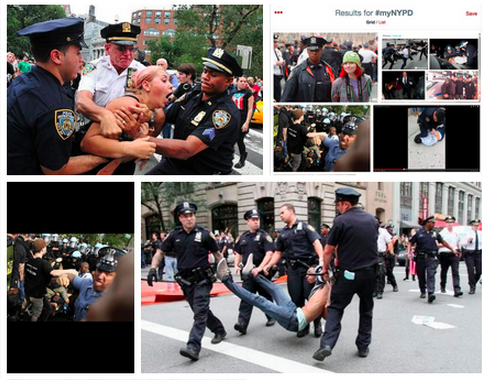
#myNYPD

What was on April’s Blog Menu, you ask? A flurry of posts covering everything from issues in ethnicity, crime stat validity, police social media involvement and ongoing Ukraine and surveillance coverage, of course! Continue reading

Standard
What's going on in Ukraine?

Police violence and ideas of the state in Ukrainian ‘Euromaidan’

The editors of Anthropoliteia would like to welcome Taras Fedirko with the latest entry in our developing Forum What’s Going on in Ukraine?

Violence as other; other as the authorities

In their responses to police violence during the ‘Euromaidan’in Ukraine, protesters and engaged commentators often located the source of brutality in some sort of unofficial, ‘other’realm within the state. Narratives of police brutality became narratives of the state as the riot police came to be imagined as commanded directly by the president Yanuokovych; authorities were thought to conspire against the Maidan; and snipers shooting at protesters on February 18-20 were said to be ‘Russian-trained.’

My interest here is in how protesters and sympathetic media represented the standoff between Maidan and ‘Berkut’ riot police not so much in terms of the enforcement of public order or contestations over what such order is/should be, but in terms of a confrontation between protesters and the authorities (rather than the police). The term for the ‘authorities’in Ukrainian is vlada, which simultaneously means abstract ‘power’and ‘people in/holding power’. Although it has an official usage (e.g. orhany vlady—state institutions, literally ‘organs of power’), it is crucial that in Ukrainian there is no word for ‘authority’and, I would add, no pragmatic difference between power and authority. The ‘realist’term vlada therefore maps the lack of emic differentiation between the official and unofficial power. I suggest that the displacement of the source of police agency to vlada was premised on understandings of vlada as the source of both official/formal and informal power in the society. Continue reading

Standard
Dossiers

Policing an Occupied Legislature (or “Institutional memory will get you through a time of no constitution better than a constitution will get you through a time of no institutional memory”).

Image

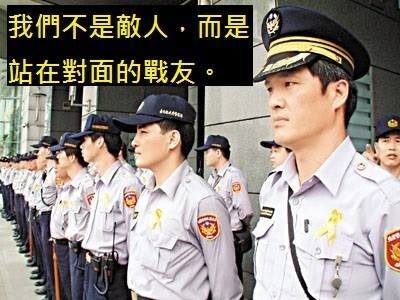
“We are not enemies. We are allies that stand facing one another” (caption to a picture that is purportedly an expression of police attitudes towards the recent occupation of Taiwan’s legislature)

In the context of a loving relationship between consenting adults, it’s normal for police to get screwed from both sides. Taiwanese democracy is sometimes a strained marriage, however. Tensions are introduced to any enterprise of collective self-determination when the great power next door insists your state does not exist. The existential tensions of Taiwanese democracy are currently being expressed in a constitutional crisis.  Last Tuesday night, the unpopular president’s ham-fisted attempt to fudge the procedures involved in his party’s pursuit of economic integration with China blew up in his face. Dissident students (later joined by their professors, constitutional law scholars and, increasingly, the general public) occupied the legislative assembly to physically prevent the conclusion of a process that would have endowed an agreement concluded between legislatively unqualified bodies with the force of statutory law.

Continue reading

Standard
Dossiers

The Perlocution Will Not Be Televised: The Oscar Pistorius trial and the fate of language

The editors of Anthropoliteia would like to welcome a special guest post from Thomas Cousins

On Monday 3 March, 2014, the murder trial of Oscar Pistorius began with a flurry of international media coverage. The famous “Blade Runner”, now made infamous for shooting and killing his girlfriend on Valentine’s Day 2013, is defending his actions as a case of mistaken identity. The fact of the shooting is not in doubt, and as Margie Orford’s oped (now gone viral) brilliantly shows, the three bodies at stake and their arrangement in relation to one another is clear. Those three bodies are: the cyborg body of the Olympic athlete now fallen from grace; the “exquisite corpse” of the former model; and the imagined body of the racialized stranger intent on robbery, rape, and murder.

Continue reading

Standard
What's going on in Ukraine?

Bakhtin at the front

The editors of Anthropoliteia would like to welcome a special guest post from Monica Eppinger as part of our developing Forum What’s Going on in Ukraine?

I’m an anthropologist of law and other serious speech acts, with fieldwork concentrated in Ukraine. Meg and Kevin asked me, “What’s going on over there?” I’ll try to give a range of possible answers in a series of posts.

Over the weekend, after reports of foreign troops taking over Crimea circulated in Kyiv, one prominent Ukrainian took to the internet urging several resistance tactics. Some were predictable: national unity, “information warfare.” But one was not: laughter. His reasoning was, it’s the best way to counter those whose tactics are meant to inspire fear and hatred. Plus, it has the advantage of surprise.

Troops taking over (or besieging) Ukrainian military installations and neighboring residential neighborhoods across Crimea have faced a sea of cell phone-cameras. In the initial footage that’s reached me, I’ve noticed a second “secret weapon” at Ukrainians’ disposal, discourse. Ukrainians have not lost the intense passion for or engagement in discourse that Alexei Yurchak describes marking the late Soviet period.  The readiness to engage in it seems to take the interlocutors by surprise.

And so, this footage: On the front, armed with discourse and laughter.  In this encounter, a Ukrainian journalist interviews men who have taken over a Ukrainian installation in Balaklava, Sevastopl (a part of Crimea, Ukraine). The journalist is, himself, questioned by women standing nearby (who seem to be local employees of the installation, or family members of employees). (Even if you don’t understand Russian, you can get the flavor of the interaction.)

The men are in unmarked uniforms but one wears a baseball cap with the name of a Russian city, Ryazan (where a famous paratrooper school is located). The journalist asks the men why their uniforms have no insignia. His line of questions is as much inquiry as it is an invitation to self-reflection along a certain logical argument.

— He says, “What do you call it when the armed forces of a foreign country occupy the territory and government installations of another country? That’s called war, isn’t it?”
— He points out, “Sooner or later, war means death.”
— He reminds them that their president (Putin) is insisting that there are no Russian Federation troops in Crimea, only local “self-defense forces.”
— He asks them, “So why don’t your uniforms have any insignia? Your beautiful country, your beautiful president, has sent you here in uniforms without any identifying marks.” His camera investigates: No country indicators, no rank indicators, no flags, no nothing. [He zooms in on the only identifying mark on the battle-ready newcomer, which is a Batman pin.] “Don’t you realize, when the shooting starts, your country is not going to acknowledge you as its soldier? How do you want to be remembered after your death?”

Heavy questions, light touch. And such bravery.

Monica Eppinger is an Assistant Professor at the Saint Louis University College of Law. She has extensive experience in diplomacy, serving nine years as a diplomat in the U.S. Foreign Service with tours of duty at the U.S. Consulate General in Kaduna, Nigeria; U.S. Embassy, Kiev, Ukraine; and at the State Department in Washington, D.C. where her responsibilities included policy in the former Soviet Union, Caspian basin energy development, and West African security. Her research concentrates on sovereignty and selfhood. Her main areas of expertise include property, national security, and international law.
Standard