
It is often the data that is not there that reveals what is most important. I was reminded of this fact again by Scott Vollum’s post, The Ghost of the Condemned: What the Death Penalty Leaves Behind, Captured in a Snapshot
It is often the data that is not there that reveals what is most important. I was reminded of this fact again by Scott Vollum’s post, The Ghost of the Condemned: What the Death Penalty Leaves Behind, Captured in a Snapshot

Victoria Law reveals how carceral feminism has (unexpectedly?) lead to more violence for some.

The city’s where the crime’s at, right? Think again. Nic Groombridge reflects about the growing role of rural criminology.
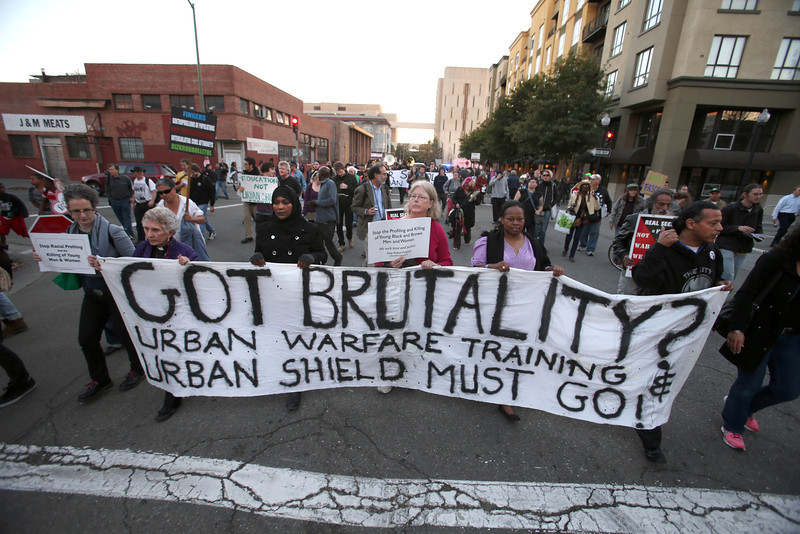
…just wait ’til you see the T-Shirts that were on sale at this year’s Urban Shield event.
“The claim that outside agitators had been the riot’s ringleaders…reiterated that black people were incapable of acting as political subjects in the defense of their humanity and rights as citizens,” writes Steven Gregory, professor of Anthropology and African American studies at Columbia University. Although applicable to the more recent Ferguson protests, Gregory’s words reference a series of similar events that occurred in 1930s Harlem. His recollection of several white-black, citizen-police fatalities exposes the need for not only institutional -but cultural- change.
Speaking of which, hopefully some of you were able to attend UC Berkeley’s forum, “Black lives matter: police violence, prisons and freedom visions” on September 19th. The event featured speakers such as CeCe McDonald, Julia Chinyere Oparah and Ashon Crawley.
What can anthropology contribute to discussions of race, state-condoned brutality and violence? Pem Davidson Buck reflects on this and other questions in her post for Anthropology News, The Violence of the Status Quo.
My award for most disturbing topic of the month goes to Shane Bauer’s coverage of the 2014 Urban Shield event that was held in Oakland, California. Every year members of police and SWAT teams attend the tradeshow, where the latest tactical gadgets (including things like armored vehicles, blindness inducing flashlights and canine mounted cameras) are unveiled. Wait ‘til you see pics of the T Shirts that were on sale at the event…
Coming in at a close second on the creepiness scale is Jaeah Lee’s post, “So Basically Everyone Killed by a Cop is a Criminal, According to the FBI” And yes, it truly is as bad as it sounds. The fact that the FBI –among other things- allows jurisdiction-by-jurisdiction variation in the definition of “felon” is among Lee’s most worrisome findings.
NPR’s Gregory Warner featured an opposing view of police brutality this month. A Kenyan officer charged with the fatal shooting of two men inspired a local protest…in his favor. Find out why this instance of police brutality was “warranted” in the minds of citizens in his jurisdiction.
Police brutality often brings images of Ferguson, militarization and white-black violence to mind. But what about the seldom-mentioned tactic of police seizure of funds from people not charged with a crime (and without a warrant)? An engaging three-part expose about the questionable search and seizure practice is featured in The Washington Post.
Phew, that was a lot of bad news. Now onto the good- the Anthropology of the Good to be precise. In the words of Professor Joel Robbins, “Consensus about what constitutes good and how we separate this from bad is hard to pin down.” Cheer yourself up by reading about Robbins’ research at the University of Cambridge as well as why an Anthropology of the Good is a necessary complement to the already prevalent Anthropology of Suffering.
Also bound to make you happy is AllegraLab’s call for editorial assistants! Find out if you qualify, then send an email to their team at stuff@allegralaboratory.net before September 30th.
Did I miss something? No worries- it does happen on occasion. If you have any suggestions for DragNet, or if you want to call attention to a specific blog or article, send an email to anthropoliteia@gmail.com with the words “DragNet” in the subject header and I’ll get on it!

Smile, you’re on camera!…or you will be soon. Police badge cameras have already debuted in several jurisdictions across the US including those in Florida and (soon) Washington, DC.
“The flow is not one way, (defense) institutions also return home transformed,” writes Stuart Schrader in his post Police Empire. Stuart helped us kick-off the month of September, picking up again with the theme of police militarization. Perhaps a surprise for many to learn, Stuart discusses how militarization and “blurred” policing boundaries are hardly novel developments. Though these topics reached an apex shortly after the death of Michael Brown, the tendency of police to apply foreign tactics in home territories has been happening for several decades.
Sasha Goldstein of the New York Daily News continued the militarization thread with the story of a Texas man who was shot by police recently at a Texas truck stop. Though some officers were armed with AR-15s, more attention was gained by the (now notorious) “fist bump” exchanged between two officers. The move was caught on video following the shooting. Despite being armed with a non-lethal BB gun, the man reportedly raised the replica and pointed it at officers before they open fired.
Between police militarization and never-ending streams about officer use of force, many are wondering what if anything is being done to ensure the effective monitoring of police in the field. If you are among those scratching their heads, be sure to catch NPR’s feature “Can Body Cameras Civilize Police Encounters?” Where the benefits of badge cameras are easily perceived by the public, the lesser-known “cons” (and implementation difficulties) are often overlooked. In addition to Ferguson, officers in several jurisdictions (including Florida and soon, Washington, DC) are already adopting the technology.
David Greene wins this week for favorite “off beat topic of September-so-far,” covering the mandate for NYPD officers to attend social media 101 training. In case you forgot, the reason behind the training stems back to the April 2014 twitter campaign disaster, #myNYPD.
And last but so-not-least, the folks at Anthropoliteia were pleased to offer not one but two new posts for your reading pleasure. The first, A new grammar of public security in Brazil, was featured September 1st in our Book Reviews section. Daniel Silva reviews Paulo Mesquita Neto’s “Essays on Civilian Security” (2011). We also welcomed back In the Journals, which offers a bi-monthly rundown of recent academic publications. Be sure to check out August’s highlights!
Did I miss something? No worries- it does happen on occasion. If you have any suggestions for DragNet, or if you want to call attention to a specific blog or article, send an email to anthropoliteia@gmail.com with the words “DragNet” in the subject header and I’ll get on it!

Whether you rely on Twitter, Facebook, Washington Post or Reddit for updates, chances are your August feed has been dominated by discussions surrounding the death of Michael Brown.
Whether you rely on Twitter, Facebook, Washington Post or Reddit for updates, chances are your August feed has been dominated by discussions surrounding the death of Michael Brown. Matt Thompson of Savage Minds touched upon the conflicting coverage of recent events in Ferguson (as well as the implications highlighted by news entities like The Washington Post and New York Times) in his entry, “What is a rioter?” Likewise, the short (and terrifyingly poignant) comic featured in Medium’s August 14th post expands upon the reality of modern police militarization. Among other problems, it emphasizes the role of basic training (or lack thereof) in the police use of military-issued equipment.
If militarization is of particular interest, be sure to check out Taylor Wofford’s piece in Newsweek. Although many associate the growing police use of military grade gear and weaponry with Ferguson protests, Wofford details how departments have been “silently preparing officers for battle” as far back as the early ‘90s.
The Economist’s post Cops or Soldiers? is also relevant to concerns about police militarization. More intriguing is the fact that the article was originally featured back in March (preceding the events in Ferguson). Although SWAT teams are implied as representing an important tool of departments, when and where such teams should be deployed remain key (unanswered) questions.
Of course, Anthropoliteia staff have not been silent bystanders to Ferguson discussions. Meg Stalcup offered insight about the series of events, providing the seldom-addressed topic of officer perceptions. Although the dynamic of officer-civilian relations remains mostly hostile, Stalcup posits that with officer’s “under threat perception, it’s not surprising, although unprofessional and deplorable, that officers menace the protestors they are supposed to protect.” Lastly, don’t miss Anthropoliteia’s second Ferguson post Blue on black violence and original crime: view from Oakland, California. Our developing forum featured Brad Erickson on August 21st. In his post, Erickson uses his own experiences researching the people and police of Oakland, CA to comment on the racial and militaristic implications of Michael Brown’s shooting.

Ferguson, MO – Protests Day 4 –August 14th 2014
By Loavesofbread (Own work) [CC-BY-SA-4.0 ] via Wikimedia Commons
A friend sent me an article which quoted a police officer in Ferguson, MO snarling to a crowd, “Bring it. You fucking animals, bring it.” She asked for my thoughts. I’d seen the article earlier, part of the news reporting and blogosphere discussion of people of color killed by on-duty officers and the accompanying demonstrations against police violence. I think that coverage has correctly pointed to 1) entrenched racism, such that black faces are reflexively perceived as suspicious and dangerous, 2) and militarization of the police. But even with these explanations there seems to remain something incomprehensible, and I think that comes from just how differently the police tend to understand what they do.

After months of debate, the ACLU released previously sealed records regarding the cell phone-tracking tool in use by several departments.
The topic of surveillance packed a powerful punch this month, with the court releasing documents regarding Stingray technology capabilities. After months of debate, the ACLU released previously sealed records regarding the cell phone-tracking tool in use by several departments. The publication comes nearly 3 months after initial buzz about the tool that circulated after a suspect’s phone was used by police to track him to his apartment prior to obtaining a warrant. The more notable specifics of the technology can be found here.
The problem of prison over crowding is presented by Alyse Berenthal’s article in Anthropology News this month. As an anthropologist interested in the ethnographic aspects of justice, Berenthal spent time working with people in self-help legal clinics. By restricting definitions of justice to the individual level, Alyse work offers insights to the pitfalls of an over burdened justice system.
The truth is in the data. The proof is in the series of graphs presented by Nicole Flatlow in Think Progress’ article about the existential growth of the US prison population. States like California are so over-populated with prisoners that courts have ordered that prisons take steps to reduce inmate populations. Local jails are feeling the pain of overcrowding, with large volumes of low-risk or offenders awaiting trial making up a large proportion of total prisoner populations.
Also in surveillance is Kirsten Weld’s post about the institutionalization of intelligence gathering by the US. From the Spanish-American War, to FDR’s administration, to the aftermath of 9/11: it becomes apparent that data mining is nothing new to the US’ administrative history. Whether or not the US has a right to act as “global policeman” has yet to be determined by both the law and its citizens.
Stingray technology was not the only cause of raised eyebrows this month. James Eyers of Financial Review put tap-and-go credit card technology under scrutiny in a post from earlier this month. Some departments are criticizing tap and go transactions; pointing to higher theft and break-ins by criminals looking for this specific type of credit card. Banks are standing by their anti-identification policies, stating that crime inevitably changes alongside technological innovations and they as a financial entity cannot be held accountable.
First shared in May, Mother Jones’ post by Katie Quandt was popular again this month. Entitled “What it’s like to visit your mother in prison on mother’s day”, Quandt reflects about the impact of her foster sister’s incarceration on her role as a mother. The article comes shortly after Sesame Street’s recent initiative to talk about challenges children with parents in prison face, citing that 1 in 28 children fall into this category (with that stat increasing to 1 in 9 children among African American children).
Have plans to lounge beachside this summer? If so, you can’t miss David Thompson’s “must read” journal articles for Spring 2014. Catch up on the latest in anthropology and policing in scholarly publications here.
Border Criminologies announced their recent initiative to first digitize and eventually physically document material works by UK immigrants. The archive is intended to act as a reminder of the creative process of individuals even during times of extreme stress and uncertainty. It serves to emphasize the role of material culture in criminology.
Should community policing lead the way in 2014? Steve Early advocates for this approach in In These Times pose on June 23rd. He attributes the more “reactive policing” approaches to post-9/11 emphasis on response. Would regular officer assignments result in higher reliability ratings from the public? Should community relationship building be instated to replace reactive responses?

“An armored military assault vehicle was donated to the department by the US military, fueling discussions about whether there should be (or is) a separation of US police and US military.”
The U.S. isn’t the only country experiencing a stark growth in prison populations. While true that the US has the highest proportion of its citizens behind bars, Brazil and China are among other countries recording higher prison population numbers. In honor of the 40th anniversary of Foucault’s Discipline and Punish: The Birth of the Prison (1975) the Weatherhead Initiative on Global History will be hosting a global conference for social sciences and humanities researchers to discuss the rising role of the prison in the modern age.
A supposedly “shifting” image of the typical heroin user in the 21st century strikingly resembles the rich, white, socialite users of 1880s Boston. A feature by Adam Rathge appeared in Points Blog; chronicling the shift of opiate usage by race and social class during this time frame. Special attention is paid to the impact of state legislation and local law enforcement initiatives prior to the passing of official federal mandates. In other opiate-related news, the question as to whether heroin use should be pursued as a crime versus an illness is being debated in states such as Rhode Island. With this past January seeing a more than doubled rate of lethal heroin overdoses, the state is pushing to equip officers with Narcan to better prevent heroin-related deaths. Read the interview with the state’s Director of Health, Dr. Michael Fine, for details.
$6.2 billion (to most of us) is quite a large sum of money. This is precisely the amount allocated to US police departments by the 41 million speeding tickets issued in any given year. What would happen to law enforcement budgets if cars were (almost magically) able to “drive themselves”? Google’s driverless cars are raising precisely this question among law enforcement officials and civilians alike.
Have you suddenly started noticing people talking a lot about Netflix’s newest series, Orange is the New Black? Even without being caught up, you can still enjoy a roundtable discussion inspired by the show that was hosted by the folks at Public Books.
Is live monitoring of surveillance cameras the way to ensure “effective panopticism”? Syracuse Chief of Police Frank Fowler seems to think so. Earlier in May, Fowler proposed that officers should evolve from their current, reactive use of cameras to respond to crimes that have already committed. Fowler argues that live monitoring of surveillance feeds by officers will convert cameras into a proactive policing tool.
If you’re planning a summer vacation that requires a considerable amount of time in the car, plug into NPR News’ RSS feed we shared last month. A myriad of police-related podcasts are featured, and are sure to make the ride feel faster. In case you exhaust that list, we recommend Archipelago’s feature on policing in downtown Oakland. Listen to Bryan Finoki, Nick Sowers and Javier Arbona as they explore the hyper-policed areas of the former Occupy movement.
Originally published 35 years ago, Policing the Crisis regained the spotlight in our Book Reviews section in May. Merijn Oudenampsen discusses how the book’s message has evolved since its first publication and applies its take-aways to the current climate of Dutch politics.
Speaking of anniversaries, 2014 also marks 10 years since Jacque’s Derrida’s passing. Anthropoliteia circulated information about an upcoming gathering of Derridian legal scholars organized by Critical Legal Thinking. Speakers include Aggie Hirst and Cathering Kellogg.
In other news, Hamtramck, MI police inspired mixed emotions upon the debut of its newest “addition”. An armored military assault vehicle was donated to the department by the US military, fueling discussions about whether there should be (or is) a separation of US police and US military.
Macedonian police also made headlines in May, with ethnic rioting in Skopje provoking criticisms about excessive use of force. Thanks to Tweeter Chris Diming, who provided an additional post from the Independent Balkan News Agency.
Do anthropologists belong in police departments? Anthropoliteia’s newest regular feature –Practicum– debuted with a post from our new author Jennie Simpson. Tune in to read Jennie’s reflections and experiences about what its like to be a social scientist working for/with departments.
 A study conducted through a collaboration of biostaticians and lawyers attracted attention this month, with the duo evaluating the overall success rate of the criminal justice system. Using death penalty cases as a “control group” of sorts, they argue against the claim that “99.973%” of US Court cases are processed accurately. They also found that ~36% of death row inmates are reassigned to life in prison if question about their guilt remains, fueling discussions of whether there is, in fact, an “acceptable” error rate.
The ACLU called for a reconsideration of Border Patrol Officer discretionary power with respect to the use of deadly force. Does throwing a rock at an officer warrant a lethal response? John Burnett of NPR also tackled the question (somewhat unsuccessfully), while NBC Nightly News covered a DOJ report that also exposes a pattern of excessive force by officers in New Mexico.
Use of force gave way to topics in police technology, with attention being paid to the use of “shooting simulators” by some courts in Texas. The technology allows jurors to experience a simulation of a crime before it is heard in court. Praised by some for its ability to “put the juror in the shoes of the defendant or officer”, some insist it is a pro-law enforcement ploy to justify officer use of deadly force. Also in technology, a crowd-sourcing tool known as LEEDIR was used by the LAPD last month during investigations of a widespread riot. Officers praised its ability to quickly process digital evidence, while others point to its potential to subject innocent bystanders in public areas to police surveillance. Anthropoliteia author Orisanmi Burton also reflected on police technology in a post about Sky Watch stations in Brooklyn. Is this form of surveillance technology yet another chapter in the Domain Awareness initiative?
…just when you thought you knew everything Anthropoliteia has to offer, we throw a new feature at you! Guest author Stephanie Savell talks about the hidden side of police and security in Brazil. Fill in the gaps of World Cup media coverage with Savell’s holistic historical analysis.
Anthropoliteia was pleased to see former contributor Michael Bobick publish a piece through the Council for European Studies Reviews & Critical Commentary’s site. In it, he targets and addresses 3 questions about the separatist forces operating in Ukraine.
According to the National Institute of Mental Health, about 1 in 4 adult in the US suffers from a diagnosable mental disorder. Perhaps stats like these are behind the growth of Crisis Intervention Teams. Read how one police department in Fairfield, CT invested (and benefits) from enrolling 20% of its officers in mental health response training. The role of mental health and policing lend to issues in homelessness, with Anthropology News featuring a thesis overview by Maegen Miller about the slow evolution of homelessness into a prosecutable crime.
Lastly, don’t miss 2014 Society of Cultural Anthropology conference materials that were presented on May 9th and 10th. Anthropoliteia’s own Kevin Karpiak and Michelle Stewart attended to present papers on the work of police. View the SCA 2014 agenda here.
 Anthropoliteia