Commentary & Forums

Thinking about Tina Fontaine Murder(s): The Role of the Police, Inquiries, and Settlers in Canada

This will be the first in a series of blogs by Michelle Stewart who will be exploring the issues raised in this blog by thinking about the anthropology of policing in the context of a settler state. Michelle is an Assistant Professor in the Department of Justice Studies at the University of Regina where she teaches the social justice stream and investigates health disparities, often racialized, in relationship to the justice system and the state.


In the past week and a half there has been a wave of stories out of Winnipeg that shine a spotlight not only on police practices but larger questions about the ongoing legacies of colonialism, structural violence and institutional racism that play out in this settler nation. More specifically, I am talking about Tina Fontaine as her case returned to the headlines last week with the sentencing of her father’s killers; and an admission by Winnipeg police that officers saw the missing teen and did not take her into protective custody—it is believed she was murdered shortly thereafter.

I will state here, at the outset, that I am not writing this article to blame these police officers for Tina’s death. On the contrary, I am writing this to join many other voices that are pointing out the need for systemic change in Canada.

Continue reading

Standard
In the Journals

In the Journals – October 2014

DSC_0081

Welcome back to In the Journals, a bi-monthly look at the recent academic publications that deal with issues of security, crime, policing and the law. The last few months have seen a slew of new journal issues and many noteworthy articles of interest to anthropoliteia’s readers – below are just a few of these to browse through over the Fall.
 

Continue reading

Standard
DragNet

DragNet: Sept 22 – Oct 5, 2014

The city's where the crime's at, right? Think again. Nic Groombridge covers how rural criminology is becoming a growing problem.

The city’s where the crime’s at, right? Think again. Nic Groombridge reflects about the growing role of rural criminology.

Continue reading

Standard
Practicum

Confinement, Surveillance, Control: Renewing Anthropology’s Relationship with Criminal Justice Systems

IMG_1341

Police Call Box 3, © Jennie Simpson, 2014

This month, Practicum would like to welcome Scott Catey, Ph.D., J.D. who will be a regular contributor to the section. Dr. Catey is a Senior Program Specialist at the National Council on Crime and Delinquency (NCCD) and the National PREA Resource Center (PRC). PREA is the Prison Rape Elimination Act, a federal statute designed to reduce the incidence and prevalence of sexual violence in confinement facilities at federal, state, and local levels. The statute was passed in 2003, and the national PREA standards were issued in 2012 to provide the detailed regulatory requirements for PREA implementation and compliance in confinement facilities. Prior to working at NCCD and PRC, Dr. Catey worked as the PREA Coordinator for the Montana Department of Corrections, and as adjunct professor at Georgia State University and Agnes Scott College.  

Continue reading

Standard
Announcements, Call for papers

CFP: Anthropologists at the Intersections of Applied Anthropology and Criminal Justice

In March 2015, the Society for Applied Anthropology will hold its annual meeting in Pittsburg, PA. The following Call for Proposals might be of interest to some of our Anthropoliteia readers. Please direct questions to the organizers at their email addresses below.

Seeking contributions to the panel “Anthropologists at the Intersections of Applied Anthropology and Criminal Justice” at the Society for the Applied Anthropology Meeting in Pittsburg (March 24-28, 2015)

Patricia San Antonio (CRS, Inc), Jennie M. Simpson (American Anthropological Association) and Scott Catey (National Council on Crime and Delinquency)

Anthropology has a long history of scholarship on crime, security, law, and justice, including significant work by major figures in the discipline, such as Malinowski, Nader, and the Comaroffs, among others. Yet, work by applied and practicing anthropologists in criminal justice settings and on criminal justice systems, including policing, courts, corrections, and policy, has been notably missing from discussions of crime, security, law and justice in academic scholarship. In this session, we seek to bring together practicing and applied anthropologists working in criminal justice fields to highlight the contributions made by these anthropologists to scholarship, policy, direct services and other areas of applied practice, as well as the potential of this work to inform theoretical practice. Proposals are welcome that highlight anthropological research, policy and/or direct service work in criminal justice. Topical and geographic areas are open.

Please, send your abstracts to Patricia San Antonio (psananton1@gmail.com), Jennie Simpson (jenmsimpson@gmail.com) and Scott Catey (catey.scott@gmail.com) by October 6th. Selected session participants will be notified by Friday, October 10hPlease note that session participants must register and pay for the conference before the abstract deadline on October 15th.

Standard
DragNet

DragNet September 8 – 21, 2014

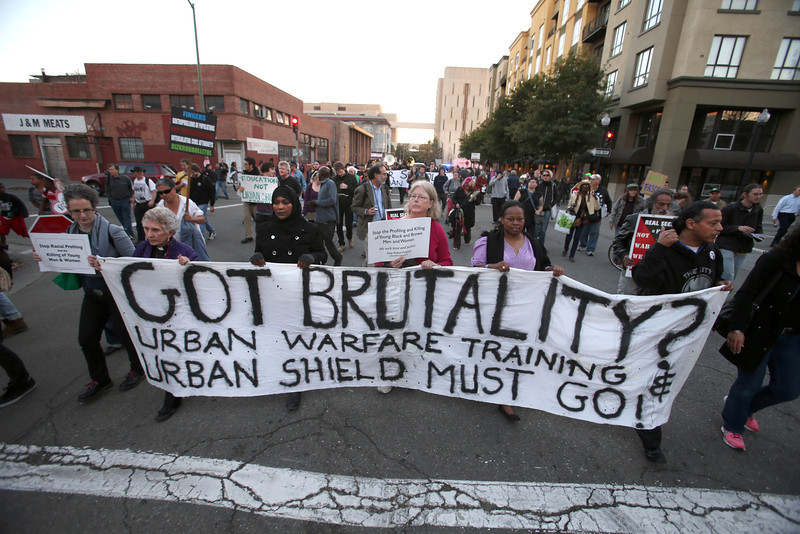
...just wait 'til you see the T-Shirts that were on sale at this year's Urban Shield event.

…just wait ’til you see the T-Shirts that were on sale at this year’s Urban Shield event.

“The claim that outside agitators had been the riot’s ringleaders…reiterated that black people were incapable of acting as political subjects in the defense of their humanity and rights as citizens,” writes Steven Gregory, professor of Anthropology and African American studies at Columbia University. Although applicable to the more recent Ferguson protests, Gregory’s words reference a series of similar events that occurred in 1930s Harlem. His recollection of several white-black, citizen-police fatalities exposes the need for not only institutional -but cultural- change.

Speaking of which, hopefully some of you were able to attend UC Berkeley’s forum, Black lives matter: police violence, prisons and freedom visions” on September 19th. The event featured speakers such as CeCe McDonald, Julia Chinyere Oparah and Ashon Crawley.

What can anthropology contribute to discussions of race, state-condoned brutality and violence? Pem Davidson Buck reflects on this and other questions in her post for Anthropology News, The Violence of the Status Quo.

My award for most disturbing topic of the month goes to Shane Bauer’s coverage of the 2014 Urban Shield event that was held in Oakland, California. Every year members of police and SWAT teams attend the tradeshow, where the latest tactical gadgets (including things like armored vehicles, blindness inducing flashlights and canine mounted cameras) are unveiled. Wait ‘til you see pics of the T Shirts that were on sale at the event…

Coming in at a close second on the creepiness scale is Jaeah Lee’s post, “So Basically Everyone Killed by a Cop is a Criminal, According to the FBI” And yes, it truly is as bad as it sounds. The fact that the FBI –among other things- allows jurisdiction-by-jurisdiction variation in the definition of “felon” is among Lee’s most worrisome findings.

NPR’s Gregory Warner featured an opposing view of police brutality this month. A Kenyan officer charged with the fatal shooting of two men inspired a local protest…in his favor. Find out why this instance of police brutality was “warranted” in the minds of citizens in his jurisdiction.

Police brutality often brings images of Ferguson, militarization and white-black violence to mind. But what about the seldom-mentioned tactic of police seizure of funds from people not charged with a crime (and without a warrant)? An engaging three-part expose about the questionable search and seizure practice is featured in The Washington Post.

Phew, that was a lot of bad news. Now onto the good- the Anthropology of the Good to be precise. In the words of Professor Joel Robbins, “Consensus about what constitutes good and how we separate this from bad is hard to pin down.” Cheer yourself up by reading about Robbins’ research at the University of Cambridge as well as why an Anthropology of the Good is a necessary complement to the already prevalent Anthropology of Suffering.

Also bound to make you happy is AllegraLab’s call for editorial assistants! Find out if you qualify, then send an email to their team at stuff@allegralaboratory.net before September 30th.


Did I miss something? No worries- it does happen on occasion. If you have any suggestions for DragNet, or if you want to call attention to a specific blog or article, send an email to anthropoliteia@gmail.com with the words “DragNet” in the subject header and I’ll get on it!

Standard
DragNet

DragNet: September 1 – 7, 2014

Smile, you're on camera. Or you will be soon. Police badge cameras have already debuted in several jurisdictions across the US including those in Florida and (soon) Washington, DC.

Smile, you’re on camera!…or you will be soon. Police badge cameras have already debuted in several jurisdictions across the US including those in Florida and (soon) Washington, DC.

“The flow is not one way, (defense) institutions also return home transformed,” writes Stuart Schrader in his post Police Empire. Stuart helped us kick-off the month of September, picking up again with the theme of police militarization. Perhaps a surprise for many to learn, Stuart discusses how militarization and “blurred” policing boundaries are hardly novel developments. Though these topics reached an apex shortly after the death of Michael Brown, the tendency of police to apply foreign tactics in home territories has been happening for several decades.

Sasha Goldstein of the New York Daily News continued the militarization thread with the story of a Texas man who was shot by police recently at a Texas truck stop. Though some officers were armed with AR-15s, more attention was gained by the (now notorious) “fist bump” exchanged between two officers. The move was caught on video following the shooting. Despite being armed with a non-lethal BB gun, the man reportedly raised the replica and pointed it at officers before they open fired.

Between police militarization and never-ending streams about officer use of force, many are wondering what if anything is being done to ensure the effective monitoring of police in the field. If you are among those scratching their heads, be sure to catch NPR’s feature “Can Body Cameras Civilize Police Encounters?” Where the benefits of badge cameras are easily perceived by the public, the lesser-known “cons” (and implementation difficulties) are often overlooked. In addition to Ferguson, officers in several jurisdictions (including Florida and soon, Washington, DC) are already adopting the technology.

David Greene wins this week for favorite “off beat topic of September-so-far,” covering the mandate for NYPD officers to attend social media 101 training. In case you forgot, the reason behind the training stems back to the April 2014 twitter campaign disaster, #myNYPD.

And last but so-not-least, the folks at Anthropoliteia were pleased to offer not one but two new posts for your reading pleasure. The first, A new grammar of public security in Brazil, was featured September 1st in our Book Reviews section. Daniel Silva reviews Paulo Mesquita Neto’s “Essays on Civilian Security” (2011). We also welcomed back In the Journals, which offers a bi-monthly rundown of recent academic publications. Be sure to check out August’s highlights!

Did I miss something? No worries- it does happen on occasion. If you have any suggestions for DragNet, or if you want to call attention to a specific blog or article, send an email to anthropoliteia@gmail.com with the words “DragNet” in the subject header and I’ll get on it!

Standard
Book Reviews

A new grammar of public security in Brazil

Mesquita Neto, Paulo. 2011. Ensaios sobre segurança cidadã [Essays on Citizen Security]. São Paulo: Quartier Latin/Fapesp.

Review of: Mesquita Neto, Paulo. 2011. Ensaios sobre segurança cidadã [Essays on Citizen Security]. São Paulo: Quartier Latin/Fapesp.  By Daniel Silva

Why has Brazil’s 1988 democratic constitution advanced in promoting broad civil and economic rights while leaving (almost) unchanged the regulation of the police and armed forces? What’s the impact of Brazil’s Human Rights National Program in recent efforts of democratizing Brazilian society and building up an alternative to a minimal neoliberal state? Why have some types of public security policies been defined without much clarity, especially those that target the non-white-elites? These are some of the questions that Paulo de Mesquita Neto – a Brazilian scholar in political science who prematurely died in 2008 – asks in this collection of essays that he gathered under the rubric of Essays on citizen security. The book as a whole bears the imprint of an author striving to combine the vocabulary and syntax of democratic rule with a scrutiny of public security in Latin America – a grammar not too simple to practice in a continent that during the 1960s and 1970s surrendered to several authoritarian regimes whose marks are still noticeable, if not overly prominent, in current political culture and public debates.

The book as a whole bears the imprint of an author striving to combine the vocabulary and syntax of democratic rule with a scrutiny of public security in Latin America

Continue reading

Standard
In the Journals, What's going on in Ukraine?

In the Journals – August 2014

Welcome back to In the Journals, now a bi-monthly look at the recent academic publications that have come within anthropoliteia’s orbit. Summer is drawing to a close and many of us head are undoubtedly heading back to the slog of the academic year, but should you find yourself with a free moment here are some recent articles and reviews dealing critically with issues of law and order, policing, crime and the state.

Continue reading

Standard