Dossiers

Views of Venezuelan Protests, Pt. 3: Who is Policing the Protests? A Perspective from Venezuela’s National Bolivarian Police

The editors of Anthropoliteia would like to welcome a special guest post, the third in a series from Rebecca Hanson on recent political developments in Venezuela. 
Embed from Getty Images

“It is better to think of the police as providing support to the National Guard in the protests [as opposed to the other way around].  The National Guard has more experience and more training…and they aren’t restricted [in their use of force] like us…We can’t even defend ourselves.”  –National Police officer-in-training

Continue reading

Standard
Dossiers

Order by the Books: Suicide crime scene investigations in southern Mexico

The editors of Anthropoliteia would like to welcome a special guest post from Beatriz Reyes-Foster as part of our series of anthropological reports From the Field

Abstract

The complex and contested relationship between representatives of a Mexican law enforcement agency and the citizenry it claims to protect is visible in the documents it produces. Ethnographic material further deepens our understanding of the ways in which law enforcement agents and common citizens form relationships based on negotiation and distrust.

Continue reading

Standard
Dossiers

Thoughts on policing in Turkey – Football and beyond

The editors of Anthropoliteia would like to welcome a special guest post from Yağmur Nuhrat as part of our series of anthropological reports From the Field

Over the past summer, international audiences became aware of severe police violence during Turkey’s Gezi protests. In summer 2013, what started out as a peaceful demonstration in Istanbul to save a public park quickly led to a national uprising against the government. The resistance was marked with intense police violence in the form of tear gas, plastic bullets and pressurized water from cannons. In October 2013, Amnesty International called these actions “gross human rights violations.” Continue reading

Standard
Dossiers

Views of Venezuelan Protests Part II: La Desconfianza and the Venezuelan Opposition

The editors of Anthropoliteia would like to welcome a special guest post, the second in a series from Rebecca Hanson on recent political developments in Venezuela. A version of this piece originally appeared on the blog Venezuela Politics and Human Rights as “La Desconfianza: The View from Western Caracas II
Mural from a wall in Catia © Rebecca Hanson

Mural from a wall in Catia. The literal translation is “knee on the ground” but the term originally arose from the military to refer to the position of a shooter with one knee on the ground to take a shot. Chavistas use it metaphorically to mean that they are prepared for battle or to do whatever it takes to protect the Bolivarian Revolution. © Rebecca Hanson

“It makes no sense! You go into a Chavista’s house and Chávez and Maduro’s faces are everywhere but you open their fridge and it is empty!  Empty!” This was the passionate reaction I received from an acquaintance I was chatting with yesterday when I commented that protests in Caracas have not seemed to receive support from popular sectors in the city.

Continue reading

Standard
Dossiers

Policing an Occupied Legislature, Part Three: Throwing Police Under the Bus.

[Updated 2014/03/25]

Propaganda from a Taiwanese protest camp

Fig. 1. Propaganda from the protest camp regarding last night’s police action: “You go to sleep. When you awake, Taiwan is not the same”

“Police friends,” said the student with a microphone, speaking over the heads of people facing him to the riot troops massing in the street behind them, “We have a chance to make history tonight! Join with us! Show the autocratic Ma government that the people and police are united!”

Continue reading

Standard
Dossiers

Views of Venezuelan Protests Part I: Where are the Poor Protestors?

The editors of Anthropoliteia would like to welcome the first in a series of special guest posts from Rebecca Hanson on recent political developments in Venezuela.   This piece originally appeared on the blog Venezuela Politics and Human Rights as “Venezuelan Protests from the View of Western Caracas

Images of burning tires, masked youth, and clashes between citizens and state security forces have accompanied almost all news coverage of Venezuela for the past few weeks.  And these well-documented protests and the government response to them have, as blogger Francisco Toro wrote, changed the political game in Venezuela for the foreseeable future.

To fully appreciate these changes, however, we need to also appreciate the geographical limits of the opposition protests. Taking into account where protests are not occurring, and why, is important in understanding what they represent for residents who do not live in the zones where protests have erupted.

Continue reading

Standard
Dossiers

Policing an Occupied Legislature (part 2).

(Continued from part one)

IMG_2914

Fig. 1 A note reading “Everyone, police, thank you for your struggle” hangs on a barbed wire barricade.

An emphasis on unity between the police and the people has emerged as a core element in the struggle by Taiwanese protestors to control representations of their movement. Where the Presidential Office has sought to describe them as a “Violent Mob,” they have successfully asserted the peaceful qualities inherent in the sympathetic bond that stretches across the barricades, uniting them with the rank and file policemen called up to contain them.

Continue reading

Standard
Dossiers

Policing an Occupied Legislature (or “Institutional memory will get you through a time of no constitution better than a constitution will get you through a time of no institutional memory”).

Image

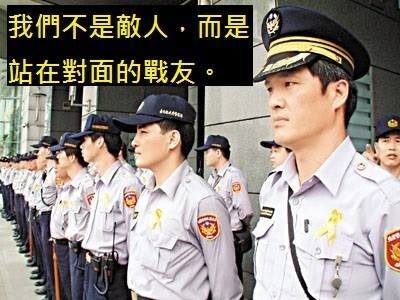
“We are not enemies. We are allies that stand facing one another” (caption to a picture that is purportedly an expression of police attitudes towards the recent occupation of Taiwan’s legislature)

In the context of a loving relationship between consenting adults, it’s normal for police to get screwed from both sides. Taiwanese democracy is sometimes a strained marriage, however. Tensions are introduced to any enterprise of collective self-determination when the great power next door insists your state does not exist. The existential tensions of Taiwanese democracy are currently being expressed in a constitutional crisis.  Last Tuesday night, the unpopular president’s ham-fisted attempt to fudge the procedures involved in his party’s pursuit of economic integration with China blew up in his face. Dissident students (later joined by their professors, constitutional law scholars and, increasingly, the general public) occupied the legislative assembly to physically prevent the conclusion of a process that would have endowed an agreement concluded between legislatively unqualified bodies with the force of statutory law.

Continue reading

Standard
Dossiers

Policing and “Safety in Numbers” in a Post-Panoptic Age

The editors of Anthropoliteia are pleased to welcome a special commentary from our own Kristin Castner.

Let’s face it: Americans are living in an age of extreme surveillance.  The government is listening to our phone calls, capable of controlling our computer cameras remotely and (perhaps) reading our Facebook messages.

Continue reading

Standard
Dossiers

The Perlocution Will Not Be Televised: The Oscar Pistorius trial and the fate of language

The editors of Anthropoliteia would like to welcome a special guest post from Thomas Cousins

On Monday 3 March, 2014, the murder trial of Oscar Pistorius began with a flurry of international media coverage. The famous “Blade Runner”, now made infamous for shooting and killing his girlfriend on Valentine’s Day 2013, is defending his actions as a case of mistaken identity. The fact of the shooting is not in doubt, and as Margie Orford’s oped (now gone viral) brilliantly shows, the three bodies at stake and their arrangement in relation to one another is clear. Those three bodies are: the cyborg body of the Olympic athlete now fallen from grace; the “exquisite corpse” of the former model; and the imagined body of the racialized stranger intent on robbery, rape, and murder.

Continue reading

Standard