Announcements, Conferences

Anthropoliteia Sessions @ #AAA2015

Hello, Dear Reader, it is that very special time of year again: The American Anthropological Association’s Annual Meeting. This year in Denver Colorado. As impassioned followers of this blog know, we like to curate a list of sessions and papers of interest to our readers.  This year we’ve created a Google Calendar, which you can find embedded below and import into your own.  Be sure to keep an eye on @anthropoliteia’s twitter feed as well, where you’ll find coverage of the #AAA2015 hashtag with which several participants will be live-tweeting sessions ad other events.

Beyond that, we’d like to call your attention to two sessions in particular, which are direct offshoots of projects and collaborations on this blog:

Continue reading

Standard
Announcements, In the Journals

Anthropoliteia and the Political and Legal Anthropology Review (PoLAR)

FullSizeRender (1)

Two bits of news concerning both Anthropoliteia and the journal Political and Legal Anthropology Review (PoLAR):

First, we’re all so excited that our own William Garriot, along with friend-of-Anthropoliteia Heath Cabot, have taken over as co-editors of the journal.  We can’t wait to see what a Cabot-Garriot tenure will bring!

Also of note to readers of this blog: PoLAR just recently published an Open Access Virtual Issue on “The Promise and Pathos of Law,” which includes several recent and classic articles on the topic (including my own article “Of Heroes and Polemics: the ‘policeman’ in urban ethnography“) as well as new and original “supplementary” postscripts in which each author reflects on their contribution through the lens of time.  My own essay focuses on the exciting development of “anthropology of policing” since the publication of “Of Heroes…” in 2010.

Standard
Announcements, In the Journals

Open Access Articles from the American Anthropological Association

aaa altmetricsThe AAA has decided to feature the “most-discussed” articles (as measured by Altmetrics)  from Anthrosource by making them temporarily open-access. Among these are several articles that might be of interest to our readers:

and (*ahem* cough, cough)

Standard
DragNet

DragNet: April 20 – May 3, 2015

"I think you have to have a shared collective memory of the past to recognize another human being," writes Lawrence Jackson. His post, On Becoming More Human, examines the recent protests against police violence in Baltimore from his perspective as an African American man.

“I think you have to have a shared collective memory of the past to recognize another human being,” writes Lawrence Jackson. His post, On Becoming More Human, examines the recent protests against police violence in Baltimore from his perspective as an African American man.

I was happy to see Illana Feldman’s new book, Police Encounters: Security and Surveillance in Gaza Under Egyptian Rule, make the rounds on our twitter feed last month. In it, my former Anthropology professor at George Washington University discusses the topics of surveillance, control and police violence in Gaza during the period of Egyptian rule. Disclaimer: you’ll want to block off a few hours to tap into this one…it’s addictive from the start!

“I think you have to have a shared collective memory of the past to recognize another human being,” writes Lawrence Jackson for n plus one magazine. His post, On Becoming More Human, examines the recent protests against police violence in Baltimore from his perspective as an African American man. Jackson is a professor of African American Studies and English at Emory University, and is the author of the 2012 memoir, My Father’s Name: A Black Virginia Family after the Civil War. His post undoubtedly earns my vote for “best of the month”- if you have time for one (and only one) read today, this is it.

Those interested in coverage about the tragic police-related death of Freddie Gray shouldn’t miss NPR’s Weekend Edition that we shared late last month. In it, Scott Simon recounts his experience walking among the residents of West Baltimore in the wake of police protests. As the title attests, to many West Baltimoreans, the “largest gang is, in fact, the police.” We also recommend Ta-Nehisi Coates’ post, Nonviolence as Compliance, which was featured via The Atlantic.

What does the concept of “touch” mean, in a policing context? Mark Greif reflects on this question and more in his post, Seeing Through Police. He discusses the “rules” of police-citizen contact (i.e.- they touch you, you keep your hands to yourself), its many functions (intimidation, reassurance, “traffic direction”) and forms (hands vs. batons). What’s perhaps most intriguing about this post is its dual -and rather empathetic- consideration of police as police, and police as people. At the same time, it presents a critical and well-balanced portrait of modern police practices.

Finally, we are pleased to offer continuing coverage of the American Anthropological Association’s developing initiatives regarding police brutality. AAA recently announced they’ll be offering a working group to monitor racialized police brutality and extrajudicial violence. Co-chairs include David Simmons, Marla Frederick and Shalini Shankar. You can view the Working Group charge here.

Did I miss something? No worries- it does happen on occasion. If you have any suggestions for DragNet, or if you want to call attention to a specific blog or article, send an email to anthropoliteia@gmail.com with the words “DragNet” in the subject header and I’ll get on it!

Standard
DragNet

DragNet: April 6 – 19, 2015

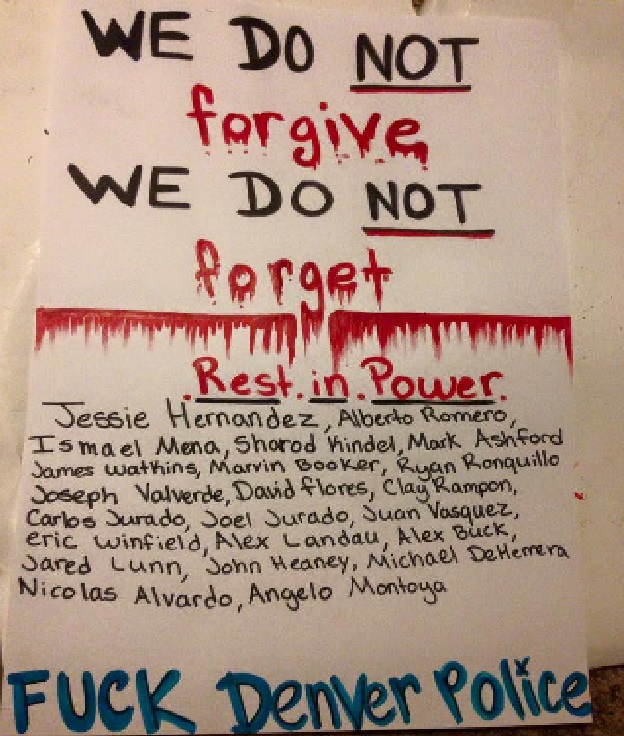
In an unusual demonstration against Denver police, supporters of Jessie Hernandez have allegedly been expressing their discontent by stealing cars. Hernandez was fatally shot by police in January.

In an unusual demonstration against Denver police, supporters of Jessie Hernandez have allegedly been expressing their discontent by stealing cars. Hernandez was fatally shot by police in January.

The police-involved killing of Walter Scott dominates policing news by far this month. Video footage, shot with the cell phone of a bystander who witnessed the event, seems to offer key (and yet incomplete) evidence of how the shooting evolved. Scott had apparently been stopped during a “routine traffic stop” for a broken tail-light. Although the video recording did not capture the full nature of the altercation, it did capture the officer proceeding to shoot Scott in the back while he was running more than 20 feet away from the officer.

Edward Bryant II, head of North Charleston’s NAACP chapter was among those interviewed about the incident by Martin Kaste on NPR’s Morning Edition. While addressing the moment of the film that captured the officer “dropping something” -perhaps the very Taser Scott was charged with stealing- Bryant says that it “reflects something very distasteful…like it’s already been practiced. It’s been already done.” Among organizations taking a stance against the continuation of racialized police violence is the American Anthropological Association, who’s post we shared via Jeff Martin. Stay tuned for their specific initiatives regarding policing culture, which are to be listed soon.

All Things Considered also joined the law enforcement culture conversation, with Audie Cornish’s interview with Seth Stoughton. Stoughton is an assistant professor at the University of South Carolina’s School of Law. He suggests the paradign of policing in American is is need of a major makeover; suggesting the current “warrior mindset” should be exchanged for one that is conducive to a “guardian” role.
A 73-year-old undercover Tulsa reserve deputy sheriff who fatally shot an unarmed black man during an undercover operation gone wrong turned himself in on Tuesday last week. He allegedly mistook his gun for his taser; fatally wounding the unarmed man. Robert Bates has been charged with second degree manslaughter involving culpable negligence. He was released on $25,000 bail and is awaiting trial, according to Lindsey Bever and Sarah Larimer of the Washington Post.
In an unusual demonstration against the Denver police, supporters of Jessie Hernandez have allegedly been expressing their discontent by stealing cars. As reported by Michael Roberts for Westword, Hernandez was fatally shot by police back in January after two officers responded to a call about a suspicious vehicle. According to one source, 126 vehicles have been stolen in the area since the beginning of the year, which is nearly double the amount recorded for the same period last year.

Did I miss something? No worries- it does happen on occasion. If you have any suggestions for DragNet, or if you want to call attention to a specific blog or article, send an email to anthropoliteia@gmail.com with the words “DragNet” in the subject header and I’ll get on it!

Standard
DragNet

DragNet: March 9 – 22, 2015

Speaking of departments that have gotten a bad rap, Police Chief Alejandro Lares Valladares of the Tijuana police department recently equipped officers with body-worn cameras. He hopes the initiative will both improve police-citizen relations while holding each accountable for their actions.

Speaking of departments that have gotten a bad rap, Police Chief Alejandro Lares Valladares of the Tijuana police department recently equipped officers with body-worn cameras. He hopes the initiative will both improve police-citizen relations while holding each accountable for their actions.

You’d think members of a police department as big as NYPD would know somebody somewhere might be able to trace Wikipedia page edits to their network. We shared Kelly Weill’s post for The Capital, which exposes how a computer linked to NYPD allegedly altered information on Wikipedia pages about police use of force against Eric Garner, Sean Bell and Amadou Diallo. Also bleak is their revelation that additional edits have been linked to the same NYPD IP addresses for entries covering stop-and-frisk, NYPD scandals and local NYPD and political leaders.

Speaking of departments that have gotten a bad rap, Police Chief Alejandro Lares Valladares of the Tijuana police department recently equipped officers with body-worn cameras. He hopes the initiative will both improve police-citizen relations while holding each accountable for their actions. Carrie Kahn of NPR recounts why, despite a long history of corruption, Lares believes the cameras will also capture how “citizens try to criticize my police officers.” Will body-worn cameras finally even the playing field?

According to Peter Moskos, it’s not just NYPD or Tijuana officers who are guilty of corruption: it’s “The Whole Damn System!”. We shared his post for Cop in the Hood, which explains how the recently issued (and damning) DOJ report of Ferguson’s police department “is about a whole system of government using the criminal justice system to legally steal from its residents.” Do you agree with his conclusion that, “one could be blind to race and still be outraged?” Feel free to weigh-in in the Comments section.

We previously shared AAA President Monica Heller’s call to fellow anthropologists to contemplate and discuss the intersection of race and justice. The events in Ferguson, as well as the subsequent police shooting of Eric Garner, made this topic one of utmost importance to the general public and scholars alike. In the same vein, we shared Jennifer Curtis’ post for Political and Legal Anthropology earlier this month. Learn how you (and/or fellow colleagues) can join this crucial discussion by submitting your ideas and suggestions to Jeff Martin at jmart@illinois.edu. APLA will be hosting a coordinated discussion of race and justice in Denver, November 2015.

Whether your own interests lie within the field of anthropology, sociology or criminal justice, chances are that you’ve heard a little (or a lot!) about Emile Durkheim. In my favorite “open-access” voucher of the month, Berghahn Journals announced they will offer free access to some of Durkheim’s original works in honor of the 24th anniversary of the British Centre for Durkheimian Studies. You can enjoy reading his pieces in their original French, or English translated, versions.

Did I miss something? No worries- it does happen on occasion. If you have any suggestions for DragNet, or if you want to call attention to a specific blog or article, send an email to anthropoliteia@gmail.com with the words “DragNet” in the subject header and I’ll get on it!

Standard
DragNet

DragNet: January 26 – February 8, 2015

"I see how challenging the tour is to my class…they describe their discomfort of being the observers in what many liken to a human zoo," writes Ieva Jusionyte in my favorite post of the month.

“I see how challenging the tour is to my class…they describe their discomfort of being the observers in what many liken to a human zoo,” writes Ieva Jusionyte in my favorite post of the month.

It might be time for New York City’s Bill de Blasio to compare policing notes with Rafael Correa, writes Greg Grandin for The Nation. Ecuador’s president not only faced similar police-related challenges back in 2010, but managed to come out stronger than ever. Stay tuned to Anthropoliteia’s twitter feed for ongoing coverage of the NYPD-de Blasio fiasco.

What’s in a case study? The possibility that it is just that- a single set of potential results. Although police departments across the US are quickly adopting body-worn cameras, the results obtained by Rialto, CA’s pilot study are coming under scrutiny. New questions of interest include whether the verbal warnings (“You’re being recorded”) given by officers are the source of reduced citations, and whether any observed reductions in offenses will fade over time.

“I see how challenging the tour is to my class…they describe their discomfort of being the observers in what many liken to a human zoo,” writes Ieva Jusionyte in my favorite post of the month. Jusionyte demonstrates how the often “bland” classroom topics of theory and the criminal justice system take on new meanings when studied in the up-close-and-personal context of Florida State Prison. Jusionyte is an Assistant Professor of Anthropology at the University of Florida.

Our loyal readers will recognize this familiar question posed by Dylan Kerrigan: Do police agencies need anthropologists? Kerrigan discussed issues raised by Anthropoliteia’s Jennie Simpson in his post for The Guardian Trinidad & Tobago last month. Perhaps a new question to ask is whether or not police agencies are ready to face “the cultural dynamics obstructing their innovation”.

Anthropoliteia was pleased to feature a “rebuttal” to the police-anthropologist question. Professor Wilson Pena-Pinzon’s post, “A Response to ‘Do Police Departments Need Anthropologists?'”, examines the flip-side of the police-anthropology coin by approaching it from a cross-cultural perspective. Pena-Pinzon is a professor and researcher for the Department of Anthropology at the Universidad Nacional de Colombia and the Escuela Colombiana de Carreras Industriales.

Finally, be sure to check out Anthropoliteia’s YouTube channel for new episodes in our interview series. Dr. A. Lynn Bolles sits with us to discuss police racism, violence and the actions of the 2014 AAA Meetings. Dr. Bolles is an affiliate faculty in the University of Maryland’s Anthropology, African American Studies, American Studies, Comparative Literature AND Latin American Studies departments (phew!).

Did I miss something? No worries- it does happen on occasion. If you have any suggestions for DragNet, or if you want to call attention to a specific blog or article, send an email to anthropoliteia@gmail.com with the words “DragNet” in the subject header and I’ll get on it!

Standard
DragNet, Uncategorized

DragNet: January 13 – 25, 2015

Screen shot 2015-01-25 at 2.40.16 PM

Despite nearly 2 decades separated from the things he loves by prison bars, it’s apparent that Agustin’s mind has kept memories of them in pristine condition.

NY Daily News‘ Juan Gonzalez‘ critique of Patrick Lynch kicked-off a series of posts covering the current NYPD-de Blasio scuffle. Some question whether Lynch’s “screaming and yelling” leads to better lives for officers, or merely more headaches.

While many have voiced concern about racist practices of NYPD, one group in particular has been rendered silent: minority NYPD officers. Heather Mac Donald recently interviewed several current and former minority NYPD officers about their experiences of racist police practices while both on and off-duty. These conversations update those Mac Donald originally conducted back in 2002.

If you’re a New Yorker, chances are you’ve heard a lot less people complaining about traffic citations over the past few weeks. About two-thirds less people, to be exact. With Mayor Bill de Blasio’s “perceived lack of support” for NYPD, the city’s largest police union has urged officers to retaliate by not arresting individuals unless it is absolutely imperative to do so. Read about the impact this directive has had on New York’s total arrest rate.

What does everyone get wrong about Charlie Hebdo and racism? Well, it’s complicated. But here’s a hint: it usually has to do with one of its two layers, according to Max Fisher of Vox.com. Get the full explanation about the magazine’s multidimensional message here.

Anthropoliteia shared a link to our newest entry in Interrogations, titled “A Lynn Bolles on Political Action at the 2014 American Anthropological Association Meeting“. Feel free to read the highlights from the interview, or catch the full length video here.

Last but not least (and, in fact, in my favorite post of the month) Bruno Renero-Hannan shares the stories of Agustin Luna Valencia. The latter served as mayor of San Agustin Loxicha, a Zapotec village, but has been incarcerated since 1996. Renero-Hannan beautifully reflects Agustin’s memories and love of animals as well as the tales that surround them according to the traditions of his village. Despite nearly 2 decades separated from the things he loves by prison bars, it’s apparent that Agustin’s mind has kept memories of them in pristine condition.

Did I miss something? No worries- it does happen on occasion. If you have any suggestions for DragNet, or if you want to call attention to a specific blog or article, send an email to anthropoliteia@gmail.com with the words “DragNet” in the subject header and I’ll get on it!

Standard
#Ferguson & Elsewhere, Interrogations

A. Lynn Bolles on Political Action at the 2014 American Anthropological Association Meeting

Here at Anthropoliteia we’re always looking for new ways to explore new technologies to broaden the discussion on police, security, law and punishment from global and anthropological perspectives.  In this vein, the Editors are happy to announce a new (semi) regular series of video conversations that we’re calling Interrogations.  Although the series will be edited by Kristen Drybread and Johanna Rohmer, this first episode was moderated by our General Editor, Kevin Karpiak.

This first conversation consists of a discussion with Dr. A. Lynn Bolles that begins with the events leading up to and occurring at the 2014 American Anthropological Association Meetings in Washington D.C. but traverses other issues in the anthropology of policing, including the specific challenges and opportunities anthropologists face in their intersecting roles as scholars, educators, and political subjects.

Continue reading

Standard
#Ferguson & Elsewhere

Die-in Protest at the 2014 American Anthropological Association Meetings

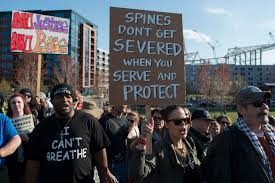
Here at Anthropoliteia we have plans to continue the conversation we’ve already been engaged in, for example through our series #Ferguson & Elsewhere, around police, violence, justice and anthropology.  For now we would just like to share with you some images from today’s protest at the American Anthropological Association Meetings in Washington DC, courtesy of visual anthropologist Richard Freeman (whose work you can also find at visualquotations.com).  We welcome reactions, ideas and comments, either here, via our Open Forum or by contacting us directly at anthropoliteia@gmail.com.

This slideshow requires JavaScript.


Standard