
The World Cup may have come to an end this week, but Anthropoliteia was pleased to contribute additional posts in our ongoing coverage of the event. Among them was The Politics of Violence and Brazil’s World Cup by Sean Mitchell.
The World Cup may have come to an end this week, but Anthropoliteia was pleased to contribute additional posts in our ongoing coverage of the event. Among them was The Politics of Violence and Brazil’s World Cup by Sean Mitchell.
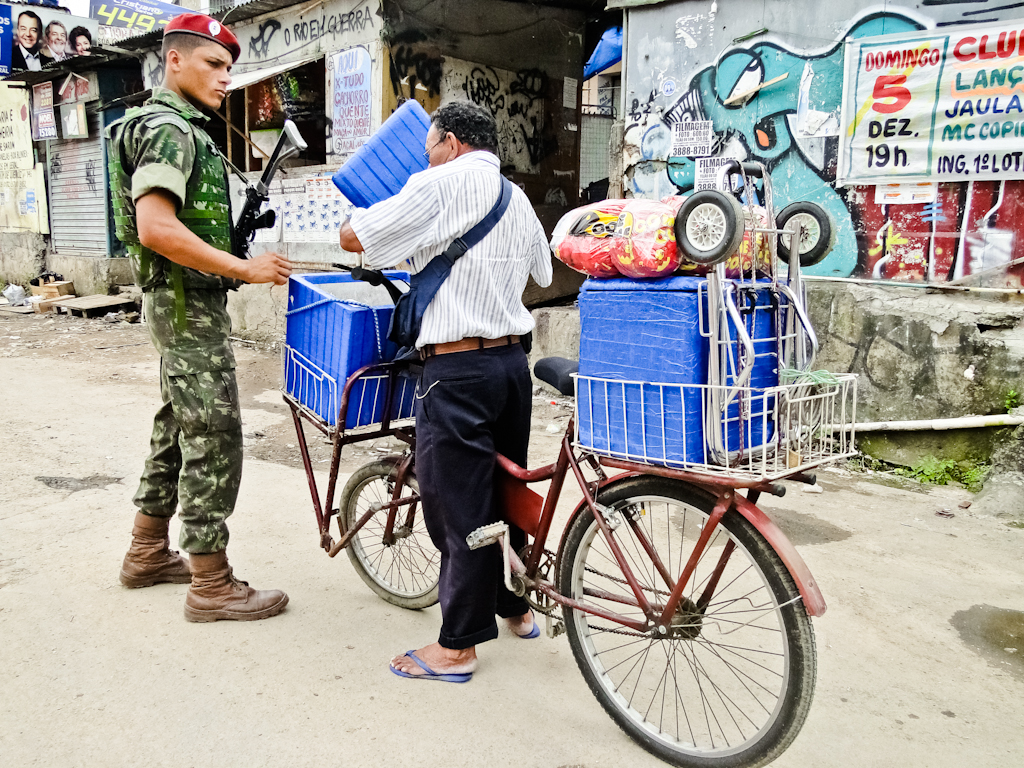
Army soldier addresses resident of Complexo do Alemão. Photo: Bruno Itan.
The Brazilian army and marines have in recent years played a more visible role in the provision of public security in Rio de Janeiro. The army currently occupies the sprawling set of informal neighborhoods, or favelas, known as Complexo da Maré, a “temporary solution” timed to accompany World Cup events in the city. The occupation, intended to repress the local control of drug trafficking gangs, will be followed by the installation of more permanent “Police Pacifying Units,” or “UPPs,” as part of Rio’s favela “pacification” program.
Between 2011 and 2012, the armed forces similarly occupied the favela Complexo do Alemão, where I lived for a year conducting ethnographic research (2013-2014). Here, based on that research, I examine the significance of the army’s participation in public security.
Many insiders and keen observers of security in Rio were quick to tell me that the army’s deployment in police pacification is not a trend – Alemão was unique, they said. But in addition to the current deployment in Maré, there are other indications to the contrary. In recent years, the constitutional clause, Garantia da Lei e da Ordem (GLO), or “Guarantee of Law and Order,” which allows for the use of the military in public security operations, has been continuously elaborated and refined. Under former President Lula’s administration, and now under Dilma Rousseff, the military has been used for an increasing number of situations, from pacification to oil auctions to the Pope’s visit and the World Cup. These are not isolated events; they invite us to question the military’s provision of public security and how it is understood, especially by security forces and by the urban poor whose neighborhoods the military patrols. Continue reading
The editors of Anthropoliteia welcome Sean T. Mitchell with the latest entry in our forum Security in Brazil: World Cup 2014 and Beyond.

A June 19, 2014 São Paulo protest called by the Movimento Passe Livre (Free Fare Movement) to protest transport fares and conditions was mischaracterized internationally as an “Antigovernment” and “World Cup” protest. The banner in front reads, “There will be no fare.” Photo: Oliver Kornblihtt/ Midia NINJA
On Failure, Violence, and the World Cup
Not unlike the 2010 hoopla anticipating that year’s South Africa World Cup, the breathless expectation of failure and security breakdown that characterized much international coverage of the lead up to Brazil’s 2014 World Cup, now, midway through the month-long event, seems to have been ill–founded.
When reporting wasn’t merely what Meg Stalcup characterized on this forum as fluff—which much of it was—pre World Cup coverage in the global north press was overheated and macabre. Why?
The last year has seen the emergence of large scale Brazilian protest movements of clear importance, and the World Cup has been a target of their criticism. But the macabre emphasis on violence and failure has obscured much more than it has illuminated about these movements, and about the real violence and social conflicts in contemporary Brazil.
To understand why so much coverage has taken this lurid form, it helps to look at historical representations of peace and violence in Brazil, as well as contemporary politics in Brazil and abroad.

A young boy playing in Fazenda dos Mineiros. Many of the toys provided to the children are donations from church organizations and other social programs aimed at helping these communities. They are insured to be in good working condition before donation, but due to the large demand for toys, children remain with the same toy for years. Photo by Nick Wong CC BY-NC-SA 4.0
Our first contact with the Fazenda dos Mineiros community was by chance encounter. We were invited to visit the home of a friend, Gilberto Lima, a community leader who works in Rio de Janeiro and São Gonçalo on children’s rights, among other issues of social justice. Gilberto was the uncle of a friend back in the US who helped one of us prepare for our respective Fulbright terms, and for hospitality’s sake, he invited us over for lunch. What we didn’t know was how much the visit would influence our nine months in Brazil.
Located 15 miles across the Guanabara Bay from Rio de Janeiro’s historic downtown, the city of São Gonçalo has followed a much different path than its famous neighbor.[1] Continue reading

“The challenge of on-officer cameras is the tension between their potential to invade privacy and their strong benefit in promoting police accountability,” ~ACLU
June kicked off with a post by Scott Shafer of NPRNews regarding the drastic increase in California parole rates. Where previous years saw less than a 10% release rate for “lifers”, 2013 recorded a near doubling of this statistic. California governor Jerry Brown has reiterated that crime type is no longer as much of a determining factor for parole as is the level of threat an inmate poses to the community. For more about the parole increase, check out Matt Levin’s article about lifers freed from prisons as well as his timeline cataloging the history of California parole trends.
“To the radicalized youth who demonstrated in 14 Brazilian state capitals on May 15, the World Cup represents a fundamental flaw in the Workers’ Party (PT) project,” writes Rodrigo Nunes in a news post from Aljazeera. While your friends are busy blowing up your Facebook feed about the soccer of World Cup, Brazilians continue to show outrage that the event has brought their country few winners, but many losers. For more about the political implications of the World Cup, check out Werner Krauss’ article on the Huffington Post. Here, he dissects the event from a structural-ritual perspective. Anthropoliteia also featured a post from Meg Stalcup in our continuing coverage of the World Cup.
It’s not just police getting virtual these days- so are crime scenes. In a personal favorite post by Kashmir Hill of Forbes, Hill recounts the Internet trail left behind by Santa Barbara Shooter Elliot Rodger. The troubled youth produced several YouTube videos documenting his gradual decline into criminal violence.
What would Jeremy Bentham and Michel Foucault have to say about Lebanese prison systems? Yazan al-Saadi’s post on Al-Akhbar evokes this and other questions about surveillance and control. The original panopticon envisioned a top-down power structure wielded by authority figures over non-authority figures. In the context of Lebanese prisons, however, this concept is turned on its head as it is the prisoner who seemingly wields ultimate control. Also in surveillance, the wife of ex-IRA prisoner Anthony McIntyre has requested a formal investigation by the US state department after sensitive information from a phone call with the US embassy appeared in a popular tabloid a few days later.
An unlikely economical analysis of police body mounted cameras appeared in The Motley Fool’s investing section. Ryan Lowery reflects on the potential profitability of the leading police tech companies (including TASER and L-3 Communications) that produce the majority of the equipment.
Issues of excessive force, surveillance and militarization come to a head in Kent Paterson’s post on CounterPunch. Using recent examples of militaristic responses by members of the Albuquerque police department, Paterson builds up to a broader discussion about the impact of police technologies on aggressive responses and use of force by US police departments.
Juvenile detention centers in California will be receiving $80 billion in coming months to rejuvenate current facilities. Several proposals for amenities and new features reinforce a community-based emphasis. Officials hope the restructuring will help to solidify rehabilitation as a prevailing theme.
Tina Dupuy authored an engaging piece about casual vs. institutionalized racism in AlterNet this month. Why does the US rally more readily against casual comments than it does to institutionalized forms of racism (such as the prison system)? And further, does/can one form of racism lead to the other?
“Ban them, ban them all with a carve out for hunting weapons,” says Scott Martelle from LA Times Opinion. Referring to his admittedly minority stance on gun control in America, Martelle proposes the next steps for eliminating gun violence in America.
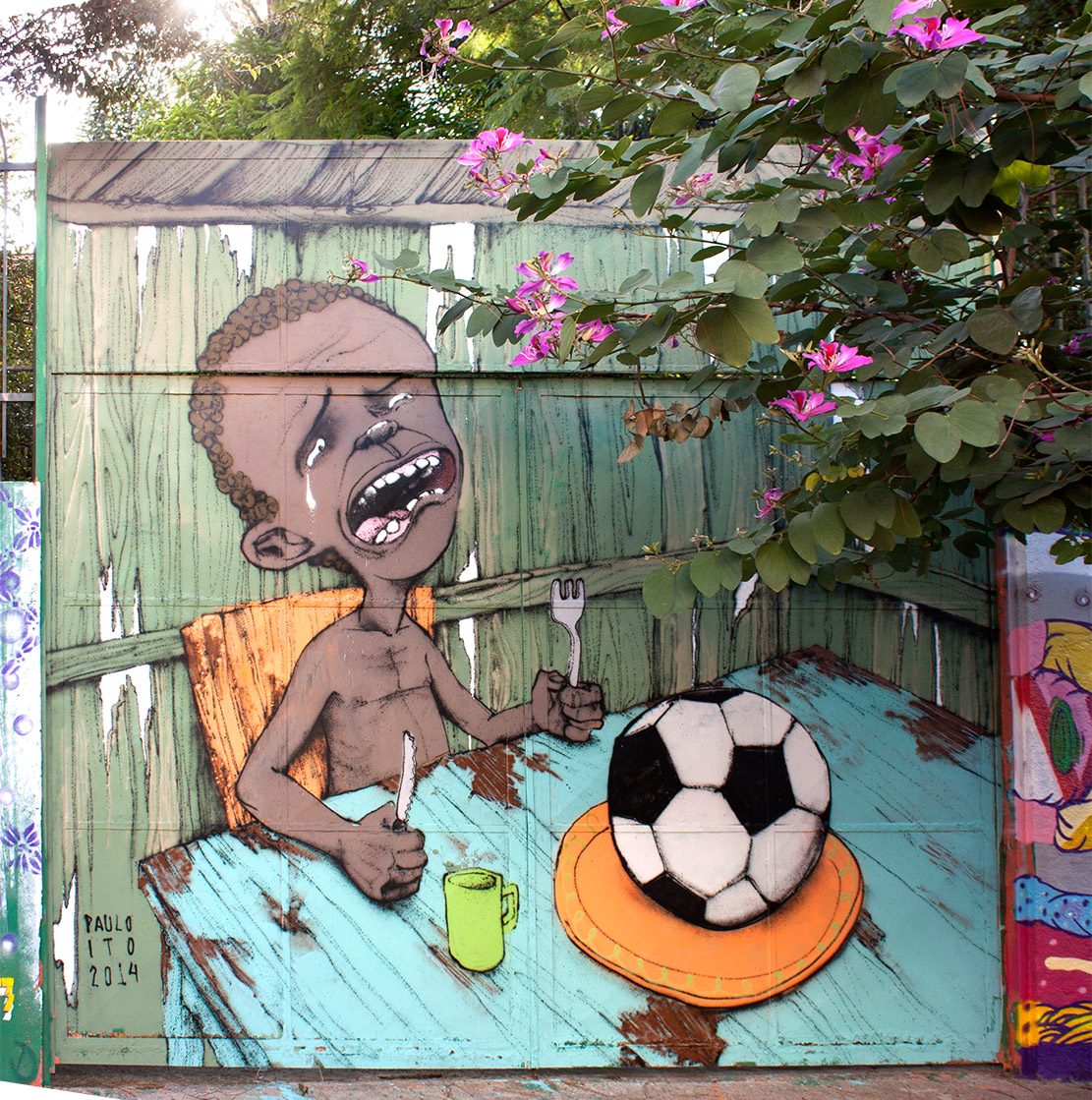
“evento da pompéia 2014.” Paulo Ito. Courtesy of the artist CC BY-NC-ND 2.0
News and social media around the world are carrying stories about the tear-gassed transportation strikers in São Paulo, violence and conflict with the police in Rio’s favelas, and – witty but no less serious – John Oliver’s scathing explanation of the problems with the Fédération Internationale de Football Association (FIFA), which drew on major media reports about the organization’s well-known illegal cash-for-contracts corruption, and also its scandalously legal pillaging of World Cup host countries.
For those who have been following the preparations for the World Cup in international reporting, or this forum, strikes, protests and corruption are no surprise. Continue reading

Photo: Deco Cabral (published with permission of the author)
The scene was impeccably staged. The Special Operations Police Battalion (commonly referred to as BOPE and famously depicted in the film Elite Squad and its sequel) had set up a temporary command center on the edge of the plaza. More than a hundred of their police, armed to the teeth, with bulletproof vests and helmets, were milling around in the sweltering heat with nothing to do after taking control of the area without a shot being fired. Sky, the television company, had set up a small table under an umbrella and was hoping to sign up residents for their cable package. A helicopter made low passes over the plaza. City sanitation workers pushed around piles of garbage, pretending to work. In the midst of all of this, BOPE police were giving rides to kids on several horses as dozens of journalists snapped photos of the delighted children. Later in the afternoon, BOPE raised their flag alongside the Brazilian national flag in the middle of the plaza. With much pomp and circumstance, Complexo da Maré, the largest group of favelas in Rio de Janeiro, had officially begun the pacification process.[1]
Located in the sprawling, industrial northern zone of the city, Complexo da Maré is a cluster of 16 favelas with a population of roughly 130,000. It is a public security concern because it is home to several non-state armed actors (two separate gang factions and a militia) and is located at the intersection of three of the major traffic arteries that connect the international airport to the rest of the city. I have been residing in Maré for the past year conducting dissertation field research. This has allowed me the opportunity to witness BOPE operations first hand and interview residents and community leaders about the tenuous and shifting public security situation. I will argue that BOPE’s pattern of abusive tactics and violence comprised an overall strategy to threaten and terrorize these communities into submission in an effort to “retake” these favela territories. And while such a strategy may have produced more effective tactical operations and short-term results, it is counter-productive to the pacification process in the long run and requires a major reassessment by the public security apparatus moving forward. Continue reading
 A study conducted through a collaboration of biostaticians and lawyers attracted attention this month, with the duo evaluating the overall success rate of the criminal justice system. Using death penalty cases as a “control group” of sorts, they argue against the claim that “99.973%” of US Court cases are processed accurately. They also found that ~36% of death row inmates are reassigned to life in prison if question about their guilt remains, fueling discussions of whether there is, in fact, an “acceptable” error rate.
The ACLU called for a reconsideration of Border Patrol Officer discretionary power with respect to the use of deadly force. Does throwing a rock at an officer warrant a lethal response? John Burnett of NPR also tackled the question (somewhat unsuccessfully), while NBC Nightly News covered a DOJ report that also exposes a pattern of excessive force by officers in New Mexico.
Use of force gave way to topics in police technology, with attention being paid to the use of “shooting simulators” by some courts in Texas. The technology allows jurors to experience a simulation of a crime before it is heard in court. Praised by some for its ability to “put the juror in the shoes of the defendant or officer”, some insist it is a pro-law enforcement ploy to justify officer use of deadly force. Also in technology, a crowd-sourcing tool known as LEEDIR was used by the LAPD last month during investigations of a widespread riot. Officers praised its ability to quickly process digital evidence, while others point to its potential to subject innocent bystanders in public areas to police surveillance. Anthropoliteia author Orisanmi Burton also reflected on police technology in a post about Sky Watch stations in Brooklyn. Is this form of surveillance technology yet another chapter in the Domain Awareness initiative?
…just when you thought you knew everything Anthropoliteia has to offer, we throw a new feature at you! Guest author Stephanie Savell talks about the hidden side of police and security in Brazil. Fill in the gaps of World Cup media coverage with Savell’s holistic historical analysis.
Anthropoliteia was pleased to see former contributor Michael Bobick publish a piece through the Council for European Studies Reviews & Critical Commentary’s site. In it, he targets and addresses 3 questions about the separatist forces operating in Ukraine.
According to the National Institute of Mental Health, about 1 in 4 adult in the US suffers from a diagnosable mental disorder. Perhaps stats like these are behind the growth of Crisis Intervention Teams. Read how one police department in Fairfield, CT invested (and benefits) from enrolling 20% of its officers in mental health response training. The role of mental health and policing lend to issues in homelessness, with Anthropology News featuring a thesis overview by Maegen Miller about the slow evolution of homelessness into a prosecutable crime.
Lastly, don’t miss 2014 Society of Cultural Anthropology conference materials that were presented on May 9th and 10th. Anthropoliteia’s own Kevin Karpiak and Michelle Stewart attended to present papers on the work of police. View the SCA 2014 agenda here.

Photo: SEASDH – Secretaria de Assistência Social e Direitos Humanos, Rio de Janeiro
The editors of Anthropoliteia would like to welcome Ben Penglase with the latest entry in our developing forum, Security in Brazil: World Cup 2014 and Beyond.
Brazil’s favela “pacification” policy, implemented by the state government of Rio de Janeiro beginning in 2008, is the most recent example of efforts by the Brazilian authorities to produce security. Coming before Brazil hosts the 2014 World Cup this June, and before Rio hosts the Olympics in 2016, and tackling that most visible and now internationally-renowned symbol of urban chaos – the city’s hillside favelas – the policy has attracted widespread attention. The Rio authorities have lost no opportunity to dramatize the supposed “take-over” of favelas by the army and police – often planting the Brazilian flag in neighborhoods “rescued” from drug traffickers – and the UPP (Unidade de Polícia Pacificadora, or Police Pacifying Unit) policy has become symbolic of a wider attempt by Brazilian authorities to create a safe urban landscape. Yet events in the past two years have called the UPP’s success into question. Shoot-outs between drug-dealers and police in several favelas where UPP units are in place, and a massive protest by residents of the favelas of Pavão-Pavãozinho and Cantagalo after the suspicious death of Douglas “DG” Pereira, have brought media attention to those who question the policy’s effectiveness.
In the midst of all this visibility and scrutiny of the UPP policy, several fundamental assumptions about the “pacification” policy often go unexamined. Drawing upon my own history of observing changes and continuities in policing in Brazil, and especially in Rio, for over twenty years, I would like to problematize these guiding assumptions which have often framed depictions of the pacification policy by both the media and Rio’s policy-makers. Continue reading

Riot police gather in front of a mural of the mascot for the 2014 World Cup soccer tournament, called Fuleco, near the Maracanã stadium ahead of the Confederations Cup soccer final between Brazil and Spain in Rio de Janeiro, Brazil, Sunday, June 30, 2013. (Source: AP Photo/Victor R. Caivano)
The Editors of Anthropoliteia would like to welcome Stephanie Savell as guest editor of an invited developing Forum on Security in Brazil: World Cup 2014 and Beyond
The media is full of stories about Brazil, particularly stories of urban violence, protest, and police repression. Many news stories make the link to the upcoming June 2014 World Cup and the 2016 Olympics in Rio de Janeiro, wondering more or less explicitly whether such violence will affect the games and visitors to Brazil. Brazilian activists and citizens have been protesting the massive spending on infrastructure and highly visible public security measures being taken in preparation for the global games, asking, among other things, “What happens in 2017?”
In Rio de Janeiro, much controversy revolves around the flagship program known as “pacification,” in which state security forces wrest territorial control of favelas from drug gangs and install police posts in these informal settlements. I just spent the past year living in the “pacified” Complexo do Alemão, a sprawling favela notorious for its crime-related street violence. Here residents perceive an ongoing battle for control between police and the still present but now slightly more covert gangs, and many believe the gangs are gaining ground. In recent months, escalating violence has many in Rio wondering whether the pacification program will collapse.
From an anthropological viewpoint, the significance of how security in urban Brazil has been developing reaches far beyond what the media portrays as preparation for the games. Current trends must be understood in the context of a history of both repressive policing and alternative community policing programs in Brazil. There are pressing questions to be asked about the deployment of the military in urban neighborhoods and the use of private security firms and personnel to fill gaps in state capacity. Additionally, there are multiple dimensions of a broader understanding of the term “security” that are obscured by the focus on public security in the context of the forthcoming global sporting events. For example, many Brazilians protest the economic and social costs of hosting the games, at a time when the government fails to meet the basic needs of citizens, and as many favela residents are displaced by infrastructure projects and real estate interests. Unemployment, racism, gender disparities, suppression of popular uprisings, lack of freedom of the press, environmental precariousness, and the enforcement of state regulations in informal settlements are just a few of the insecurities at stake in pre- and post-World Cup security practices.
Anthropologists like myself, and ethnographers in other disciplines, have in recent years been investigating ever more closely how security is experienced, understood, and contested in the everyday lives of urban Brazilians. Through historical and ethnographic fieldwork, such analyses seek to characterize the forms of governance through which security emerges. In a timely discussion leading up to the June 2014 World Cup, several of us will take the opportunity to share posts as part of a special invited forum on Anthropoliteia to discuss and reflect on some of the issues of the contemporary security moment in Brazil and shed light on what takes place behind the news.
 Anthropoliteia