In the Journals

In the Journals, Spring 2014

Welcome back to In the Journals, a round-up of some of the latest publications tackling questions of crime, law and order, justice, policing, surveillance and the state. Should you find yourself with some reading time over the summer, here is a selection of some recent articles and reviews from recent months that grapple with these themes from different perspectives.

Image

Continue reading

Standard
DragNet

DragNet: June 1 – 15, 2014

"The challenge of on-officer cameras is the tension between their potential to invade privacy and their strong benefit in promoting police accountability," ~ACLU

“The challenge of on-officer cameras is the tension between their potential to invade privacy and their strong benefit in promoting police accountability,” ~ACLU

June kicked off with a post by Scott Shafer of NPRNews regarding the drastic increase in California parole rates. Where previous years saw less than a 10% release rate for “lifers”, 2013 recorded a near doubling of this statistic. California governor Jerry Brown has reiterated that crime type is no longer as much of a determining factor for parole as is the level of threat an inmate poses to the community.  For more about the parole increase, check out Matt Levin’s article about lifers freed from prisons as well as his timeline cataloging the history of California parole trends.

“To the radicalized youth who demonstrated in 14 Brazilian state capitals on May 15, the World Cup represents a fundamental flaw in the Workers’ Party (PT) project,” writes Rodrigo Nunes in a news post from Aljazeera. While your friends are busy blowing up your Facebook feed about the soccer of World Cup, Brazilians continue to show outrage that the event has brought their country few winners, but many losers. For more about the political implications of the World Cup, check out Werner Krauss’ article on the Huffington Post.  Here, he dissects the event from a structural-ritual perspective. Anthropoliteia also featured a post from Meg Stalcup in our continuing coverage of the World Cup.

It’s not just police getting virtual these days- so are crime scenes. In a personal favorite post by Kashmir Hill of Forbes, Hill recounts the Internet trail left behind by Santa Barbara Shooter Elliot Rodger. The troubled youth produced several YouTube videos documenting his gradual decline into criminal violence.

What would Jeremy Bentham and Michel Foucault have to say about Lebanese prison systems? Yazan al-Saadi’s post on Al-Akhbar evokes this and other questions about surveillance and control. The original panopticon envisioned a top-down power structure wielded by authority figures over non-authority figures.  In the context of Lebanese prisons, however, this concept is turned on its head as it is the prisoner who seemingly wields ultimate control.  Also in surveillance, the wife of ex-IRA prisoner Anthony McIntyre has requested a formal investigation by the US state department after sensitive information from a phone call with the US embassy appeared in a popular tabloid a few days later.

An unlikely economical analysis of police body mounted cameras appeared in The Motley Fool’s investing section.  Ryan Lowery reflects on the potential profitability of the leading police tech companies (including TASER and L-3 Communications) that produce the majority of the equipment.

Issues of excessive force, surveillance and militarization come to a head in Kent Paterson’s post on CounterPunch. Using recent examples of militaristic responses by members of the Albuquerque police department, Paterson builds up to a broader discussion about the impact of police technologies on aggressive responses and use of force by US police departments.

Juvenile detention centers in California will be receiving $80 billion in coming months to rejuvenate current facilities. Several proposals for amenities and new features reinforce a community-based emphasis.  Officials hope the restructuring will help to solidify rehabilitation as a prevailing theme.

Tina Dupuy authored an engaging piece about casual vs. institutionalized racism in AlterNet this month. Why does the US rally more readily against casual comments than it does to institutionalized forms of racism (such as the prison system)? And further, does/can one form of racism lead to the other?

“Ban them, ban them all with a carve out for hunting weapons,” says Scott Martelle from LA Times Opinion. Referring to his admittedly minority stance on gun control in America, Martelle proposes the next steps for eliminating gun violence in America.

Standard
Conferences

Ethnography and Policing workshop, Institute for Advanced Study

2014_05_06_IAS_Workshop_Group

Workshop Participants. Back row, L to R: Julia Hornberger (Wits, South Africa), Jeffrey Martin (Hong Kong U, Taiwan), Daniel Goldstein (Rutgers, Bolivia), Susana Durao (U Campinas, Portugal), Duncan McCargo (Leeds U, Thailand), Didier Fassin (IAS, France), Steven Herbert (U Washington, United States), Clara Han (Johns Hopkins, Chile), Elif Babül (Mount Hollyhoke, Turkey). Front row, L to R: Beatrice Jauregui (U Toronto, India), Helene Maria Kyed (Dansk IIS, Mozambique).

From May 4-7, 2014, a workshop was held at the Institute for Advanced Study on the topic of “Ethnography and Policing.” Below is a short summary of the workshop’s premise and scope, as described by Didier Fassin, who organized the gathering.

In the past half century, there has been a considerable amount of scientific literature in criminology, sociology, political science and legal studies on urban policing, that is, on the practice of law enforcement mostly in the poor neighborhoods of large cities. Part of this work is grounded on some form of participant observation, which complements other techniques such as interviews or questionnaires, and nourishes the analytical and theoretical arguments developed by the authors. However, this ethnography rarely appears as such. It is usually not presented, save occasionally in the form of short vignettes, or discussed, from the perspective of the specific contribution of this method. Significantly, until recently, anthropologists themselves seemed to ignore policing practices.

In the past decade, however, this situation has begun to change, as scholars increasingly and explicitly include ethnographic elements in their study of police work. The objective of the workshop was to bring together social scientists who have conducted research on urban policing in different parts of the world, using ethnography, in order to collectively reflect on the conditions, potentialities and limits of this method, the problems of interpretation and the ethical issues it raises, and the way local findings can be related to larger historical context and sociological issues. The general idea was to take ethnography seriously rather than as a mere background rendered invisible in the process of writing. Considering the importance of public debates on policing in contemporary societies, particularly on the way law is enforced in poor neighborhoods, which raises questions about racial discrimination, display of violence, and reproduction of an unequal social order, the exchange of ethnographic experiences has been rich. The outcome of this workshop will be a collective volume.


Standard
Practicum

New Feature: Practicum– Applying Anthropology to the Study of Policing, Security, Crime and Criminal Justice Systems

Police Call Box, Washington, DC © Jennie Simpson 2014

Police Call Box, Washington, DC © Jennie Simpson 2014

Welcome to the new bimonthly feature, Practicum on Anthropoliteia! I am your host and will be guiding this journey into an exploration of the intersections of applied and practicing anthropology with the study of policing, security, crime, and criminal justice systems. Today’s column focuses on mapping out the unique niche of applied work in policing. Comments are welcome!

A year ago, I was asked by a former chief of police now active in policy and research to write a white paper mapping out what a “police anthropologist” might look like, replete with arguments on how anthropologists could contribute both to the study of policing and to police departments. I spent many hours reflecting on my own work with police agencies and imagining how I could translate anthropological aims and methods into work with police agencies. The result was a thoughtful exercise in outlining how anthropologists might be integrated into the world of policing, in which I argued:

Continue reading

Standard
Dossiers

Views of Venezuelan Protests, Pt. 4: Looking at The “Collaboration” Between the Police and the Collectives

The editors of Anthropoliteia would like to welcome a special guest post, the fourth in a series from Rebecca Hanson on recent political developments in Venezuela. 


A water tower in Catia with Hugo Chávez's face on one side and the face of Lina Ron (founder of the Venezuelan Popular Union party and symbol of La Piedrita, another well known collective) on the other © Richard Snyder 2014

A water tower in Catia with Hugo Chávez’s face on one side and the face of Lina Ron (founder of the Venezuelan Popular Union party and symbol of La Piedrita, another well known collective) on the other © Richard Snyder 2014

In my last post I looked at the security force that is playing the most active role in policing the protests: the National Guard. While police officers overwhelmingly support the National Guard’s participation, there is second group that the police identify as “policing the protests” whose presence they do not condone: the collectives.

The collectives’ relationship to the state and state security forces has garnered much attention in the press since the protests began.  Providing little evidence, recent news reports (the Wall Street Journal , the BBC, and AlJazeera to name a few) have suggested that the police are working alongside and in collaboration with the collectives to repress protestors.  And this past week Human Rights Watch, though avoiding the term “collective,” published a report suggesting that the police and “armed pro-government groups” were in collusion with one another.

But National Bolivarian Police (PNB) officers describe this relationship quite differently, reporting that they must compete with the collectives for territorial control, access to arms, and even state protection.  For them, their relationship to the collectives is one structured by competition, not collaboration. In fact, since the Metropolitan Police in Caracas sided with the opposition in the 2002 coup against Chávez, officers feel that the government trusts the collectives–ideologically aligned with the Bolivarian Revolution–more than the police to work the protests. Though the police as an institution is often defined by its ability to legitimately deploy force in order to protect the state’s interests, officers perceive the collectives as primarily designated by the state to fulfill this function.

In this post, I provide a brief summary of the collectives’ history and then describe how police officers talk about their relationship to the collectives. Continue reading

Standard
DragNet

DragNet, April 2014

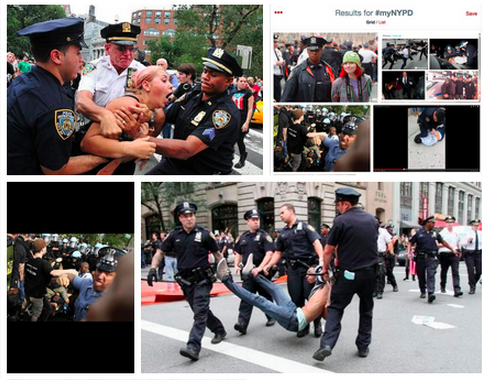
#myNYPD

What was on April’s Blog Menu, you ask? A flurry of posts covering everything from issues in ethnicity, crime stat validity, police social media involvement and ongoing Ukraine and surveillance coverage, of course! Continue reading

Standard
Dossiers

Ethnic Profiling as a Societal Institution in the Netherlands

The editors of Anthropoliteia would like to welcome this special “Dossier” from our own Paul Mutsaers

Psychologism and profiling ‘the other’

It is common knowledge in the sociology of police that law enforcers do not merely apply legal maxims but ‘employ discretion in invoking the law’, as Egon Bittner already put it in 1970 in The Functions of the Police in Modern Society. There is often not much consistency in the application of the law as beat officers have a large leeway when they operate in the blind spot of their desk superiors, that is, on the street. While on the beat, policing may be turned into a mechanism of social ordering that has the potential to significantly alter the life prospects of those who are encountered. When roaming in the districts, containing a demonstration, responding to an emergency call, mediating a conflict, investigating a homicide, or containing a riot, the police are actually (re)producing social hierarchies and differences in the settings in which they operate. Continue reading

Standard
DragNet

DragNet, March 2014

♫ Duh duh duh duh ♫  The editors of Anthropoliteia would like to introduce yet another new regular feature: DragNet.  An addition to our “Round Ups” series, DragNet will offer monthly highlights of the English-language academic blogosphere for topics related to policing, security, crime and punishment around the world.  We’re thrilled to have Kristin Castner serving as the Section Editor and lead author for the feature. ♫ Duh duh duh duh DUH ♫

dragnet-monthly-web-round-up.jpeg

Continue reading

Standard
In the Journals

In the Journals, Winter 2014

Image

Welcome to In the Journals, a (roughly) quarterly digest of the latest publications dealing critically with issues of crime, security, punishment, surveillance and law & order. 2014 has already seen a number of articles and whole issues grappling with these problems, the following is a selection for you to peruse at your reading leisure.

Continue reading

Standard
Commentary & Forums

Reflections on Police Violence at Berkeley

I’ve been meaning to provoke a bit more discussion regarding the confrontation between police and protesters at UC Berkeley a couple of weeks ago (although I did post something on the matter before the Nov 20th occupation), but the demands of teaching and preparing for AAA’s have been forestalling my best intentions.  On top of that, to be honest, i’m not sure what I think about it.  I’m left, mostly, with a bunch of half-articulated questions.  Aaron Bady, a graduate student in English at Berkeley has some reflections along that line over at The Chronicle of Higher Education:

Some sort of administration response to the occupation was inevitable, of course. But why was it necessary to direct police violence against the students outside Wheeler Hall? (In fact, the university has called for an independent investigation of police actions and the university’s own decisions that resulted in the police being called onto the campus.) The more the riot police surrounded Wheeler, the more students came out to watch. But the police treated that assembly of peaceful spectators like a clear and present danger, pushing and shoving back students whose crime seemed to be their very presence on their own campus. I cannot overstate how pointless and stupid it was. The police had marked off a perimeter around the building with crime-scene tape, and I have yet to hear the allegation that a single student ever tried to cross it. But when the police began to set up metal barricades, they ordered students to move back as they smashed the barricades into the front row of students. Students who didn’t respond instantly were beaten with batons; students who touched the barricades had their hands pounded with force enough to break bones.

via Making Sense of Senseless Violence at Berkeley – The Chronicle Review – The Chronicle of Higher Education.

In response to these questions Bady makes some gestures towards both Althusser and Weber and, while I think both are important routes to traverse, I think the tone in the passage above is probably the most appropriate–simultaneously critical and perplexed.  How can we proceed and maintain its tenor?

Standard