DragNet

DragNet: April 6 – 19, 2015

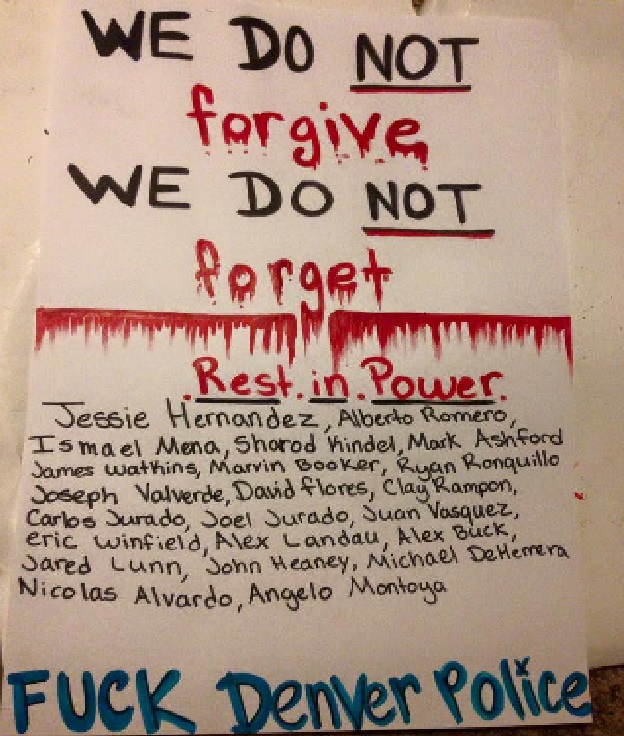
In an unusual demonstration against Denver police, supporters of Jessie Hernandez have allegedly been expressing their discontent by stealing cars. Hernandez was fatally shot by police in January.

In an unusual demonstration against Denver police, supporters of Jessie Hernandez have allegedly been expressing their discontent by stealing cars. Hernandez was fatally shot by police in January.

The police-involved killing of Walter Scott dominates policing news by far this month. Video footage, shot with the cell phone of a bystander who witnessed the event, seems to offer key (and yet incomplete) evidence of how the shooting evolved. Scott had apparently been stopped during a “routine traffic stop” for a broken tail-light. Although the video recording did not capture the full nature of the altercation, it did capture the officer proceeding to shoot Scott in the back while he was running more than 20 feet away from the officer.

Edward Bryant II, head of North Charleston’s NAACP chapter was among those interviewed about the incident by Martin Kaste on NPR’s Morning Edition. While addressing the moment of the film that captured the officer “dropping something” -perhaps the very Taser Scott was charged with stealing- Bryant says that it “reflects something very distasteful…like it’s already been practiced. It’s been already done.” Among organizations taking a stance against the continuation of racialized police violence is the American Anthropological Association, who’s post we shared via Jeff Martin. Stay tuned for their specific initiatives regarding policing culture, which are to be listed soon.

All Things Considered also joined the law enforcement culture conversation, with Audie Cornish’s interview with Seth Stoughton. Stoughton is an assistant professor at the University of South Carolina’s School of Law. He suggests the paradign of policing in American is is need of a major makeover; suggesting the current “warrior mindset” should be exchanged for one that is conducive to a “guardian” role.
A 73-year-old undercover Tulsa reserve deputy sheriff who fatally shot an unarmed black man during an undercover operation gone wrong turned himself in on Tuesday last week. He allegedly mistook his gun for his taser; fatally wounding the unarmed man. Robert Bates has been charged with second degree manslaughter involving culpable negligence. He was released on $25,000 bail and is awaiting trial, according to Lindsey Bever and Sarah Larimer of the Washington Post.
In an unusual demonstration against the Denver police, supporters of Jessie Hernandez have allegedly been expressing their discontent by stealing cars. As reported by Michael Roberts for Westword, Hernandez was fatally shot by police back in January after two officers responded to a call about a suspicious vehicle. According to one source, 126 vehicles have been stolen in the area since the beginning of the year, which is nearly double the amount recorded for the same period last year.

Did I miss something? No worries- it does happen on occasion. If you have any suggestions for DragNet, or if you want to call attention to a specific blog or article, send an email to anthropoliteia@gmail.com with the words “DragNet” in the subject header and I’ll get on it!

Standard
DragNet

DragNet: March 23 – April 5, 2015

chicago gangs

“What would it take for today’s gang members to bring peace to the neighborhood?” writes Laurence Ralph in his post for Anthropoliteia last month. Ralph recounts the story of his friendship with an elderly member of one of Chicago’s most notorious gangs, The Divine Knights. But the story reveals the little known history of the gang, as well as a strikingly “tender” side of the group previously known only among local community members.

To record, or not to record; that is the question! Last month, we shared Carlos Miller’s post for Photography is Not a Crime. According to legislators in Texas, members of the general public should not be allowed to film or record officers by law. But a policy being proposed by a political duo in Colorado begs to differ. Joe Salazar and Daneya Esgar have teamed up to co-sponsor a bill that would award up to $15,000 (plus attorney fees) to citizens who have cameras or recording devices confiscated by officers without a warrant. You can read a copy of the proposed bill here and decide for yourself.

The small town of Madison, Wisconsin is putting a whole new spin on the meaning of “officer next door” in an attempt to foster peaceful interactions between police and local community members. Melissa Block hosts this episode of All Thing Considered for NPR and details how officers and neighborhood residents have reacted to the police department literally moving in next store to high crime areas. The key to the community initiative’s success apparently lies in its exposure of officers and citizens to one another in everyday contexts- both good and bad.

If you, like me, have been amazed to discover how very impossible it is to obtain even the slightest estimates about lethal use of force by police for any given year, you’ve got to read Tom McCarthy’s post for The Guardian ASAP. Finally, we learn why there are no reliable estimates about police-related homicides: it was too difficult, so “we just gave up”. (Yeah, I’m not buying it either!) Although the Bureau of Justice Statistics arguably places a number on all kinds of similar measures, they’re reporting difficulties assessing lethal use of force nation-wide. Among other stumbling blocks are incomplete or never-filed reports (from departments such as NYPD) and inconsistent reporting. Now it’s time to play the waiting game to see if Obama’s newly created Policing Task Force will follow through with his request for “more” (or any?) data…

“What would it take for today’s gang members to bring peace to the neighborhood?” writes Laurence Ralph in his post for Anthropoliteia last month. Not that we need to remind you, but the newest Tip of the Cap feature is up and hungry for your feedback. Ralph recounts the story of his friendship with an elderly member of one of Chicago’s most notorious gangs, The Divine Knights. But the story reveals the little known history of the gang, as well as a strikingly “tender” side of the group previously known only among local community members. Laurence Ralph is an Assistant Professor of African and African American Studies as well as Anthropology at Harvard University. If you leave the post wanting more, be sure to check out his book, “Renegade Dreams: Living Through Injury in Gangland Chicago“.

To end on a fun note (and just because I’m feeling random), treat yourself to browsing through Radio Free Europe Radio Liberty’s eclectic collection of bizarre Soviet Police posters from back in the day. Among my own personal favorites are, “concerned looking smoking guy” and “Gee! My facial angle looks great in this lighting!“. If you’re also the kind of person that likes a healthy amount of “crazy crap” on your walls, you’ll thank me for including a link that can hook you up with your next police-inspired addition.

Did I miss something? No worries- it does happen on occasion. If you have any suggestions for DragNet, or if you want to call attention to a specific blog or article, send an email to anthropoliteia@gmail.com with the words “DragNet” in the subject header and I’ll get on it!

Standard
DragNet

DragNet: February 9 – 22, 2015

Is America ready for an NYPD cop show with a Muslim twist? In my favorite post of the month, Wajahat Ali recounts the inspiration, hilarity and first steps of writing the pilot script of MJ for HBO.

Is America ready for an NYPD cop show with a Muslim twist? In my favorite post of the month, Wajahat Ali recounts the inspiration, hilarity and first steps of writing the pilot script of MJ for HBO.

What do women bring to police command positions? Decentralized leadership, partnership and transparency, according to Lieutenant Colonel Nadia Rodrigues Silveira Gerhard. We shared Professor Lenin Pires’ interview with Gerhard earlier this month as she is the first woman to take on a leadership position in Rio Grande do Sul’s military police. Pires works as an anthropologist with the Public Safety Department of Fluminense Federal University. Be sure to catch more articles in Cultural Anthropology‘s Protesting Democracy in Brazil series here.

When there’s something strange about an officer’s demeanor, who you gonna call? This is precisely the dilemma Lisa Mahon faced. Don’t miss her interview with This American Life’s Ira Glass, titled “Cops See it Differently“. You can view the video footage (recorded by Joseph Ivy, who was also in the car during the confrontation) referenced during the interview here.

In shocking news, Republicans and Democrats appear to agree on one thing lately: reducing federal prison costs. In an effort to lower recidivism, the crime rate AND federal prison system costs, H.R. 759 is quickly gaining bipartisan support. Also known as the Recidivism Reduction Act, the evidence-based measure would serve to connect eligible inmates with recidivism reduction programs. There, inmates could earn credits toward “alternative custody arrangements” to lower the amount of dollars otherwise being spent to house them within the federal system.

It’s no wonder the script for the first half of MJ has generated such an overwhelming internet response. The co-creation of Al Jazeera‘s Wajahat Ali and author Dave Eggers, MJ isn’t your typical cop show…it’s a cop show with a Muslim twist. In my favorite post of the month, Ali recounts the inspiration, hilarity and first steps of writing the pilot script for HBO. The only bummer comes toward the end, when you realize MJ hasn’t yet made it to TV (why, we ask, WHY?!). Feel free to peruse the piece, available here, and freer to clamor for Hollywood to make this show happen (Ali even entertains the idea of revamping it Walking Dead style if all else fails…)

In the aftermath of Michael Brown and Eric Garner, I’ve been surprised to hear several officers insist that citizen education about how to interact with officers would reduce such tragic encounters. Perhaps more surprising is the fact that at least one city has recently made baby steps in this direction. This month we shared ML Schultze’s post, which covers Akron’s first-of-its-kind “crib sheet”; detailing the do’s and don’ts of officer-citizen interactions. The sheet was created by high school students with assistance from the city’s police department. The question is, will other departments follow suit?

Did I miss something? No worries- it does happen on occasion. If you have any suggestions for DragNet, or if you want to call attention to a specific blog or article, send an email to anthropoliteia@gmail.com with the words “DragNet” in the subject header and I’ll get on it!

Standard
DragNet

DragNet: January 26 – February 8, 2015

"I see how challenging the tour is to my class…they describe their discomfort of being the observers in what many liken to a human zoo," writes Ieva Jusionyte in my favorite post of the month.

“I see how challenging the tour is to my class…they describe their discomfort of being the observers in what many liken to a human zoo,” writes Ieva Jusionyte in my favorite post of the month.

It might be time for New York City’s Bill de Blasio to compare policing notes with Rafael Correa, writes Greg Grandin for The Nation. Ecuador’s president not only faced similar police-related challenges back in 2010, but managed to come out stronger than ever. Stay tuned to Anthropoliteia’s twitter feed for ongoing coverage of the NYPD-de Blasio fiasco.

What’s in a case study? The possibility that it is just that- a single set of potential results. Although police departments across the US are quickly adopting body-worn cameras, the results obtained by Rialto, CA’s pilot study are coming under scrutiny. New questions of interest include whether the verbal warnings (“You’re being recorded”) given by officers are the source of reduced citations, and whether any observed reductions in offenses will fade over time.

“I see how challenging the tour is to my class…they describe their discomfort of being the observers in what many liken to a human zoo,” writes Ieva Jusionyte in my favorite post of the month. Jusionyte demonstrates how the often “bland” classroom topics of theory and the criminal justice system take on new meanings when studied in the up-close-and-personal context of Florida State Prison. Jusionyte is an Assistant Professor of Anthropology at the University of Florida.

Our loyal readers will recognize this familiar question posed by Dylan Kerrigan: Do police agencies need anthropologists? Kerrigan discussed issues raised by Anthropoliteia’s Jennie Simpson in his post for The Guardian Trinidad & Tobago last month. Perhaps a new question to ask is whether or not police agencies are ready to face “the cultural dynamics obstructing their innovation”.

Anthropoliteia was pleased to feature a “rebuttal” to the police-anthropologist question. Professor Wilson Pena-Pinzon’s post, “A Response to ‘Do Police Departments Need Anthropologists?'”, examines the flip-side of the police-anthropology coin by approaching it from a cross-cultural perspective. Pena-Pinzon is a professor and researcher for the Department of Anthropology at the Universidad Nacional de Colombia and the Escuela Colombiana de Carreras Industriales.

Finally, be sure to check out Anthropoliteia’s YouTube channel for new episodes in our interview series. Dr. A. Lynn Bolles sits with us to discuss police racism, violence and the actions of the 2014 AAA Meetings. Dr. Bolles is an affiliate faculty in the University of Maryland’s Anthropology, African American Studies, American Studies, Comparative Literature AND Latin American Studies departments (phew!).

Did I miss something? No worries- it does happen on occasion. If you have any suggestions for DragNet, or if you want to call attention to a specific blog or article, send an email to anthropoliteia@gmail.com with the words “DragNet” in the subject header and I’ll get on it!

Standard
DragNet

DragNet: November 18 – December 1, 2014

Although we here at Anthropoliteia don't have any “existential answers" about how to process the recent events in Ferguson, we hope to provide a safe space for readers to reflect about and share their reactions.

Although we here at Anthropoliteia don’t have any “existential answers” about how to process the recent events in Ferguson, we hope to provide a safe space for readers to reflect about and share their reactions.

Continue reading

Standard
DragNet

DragNet November 4 – 17, 2014

Don't let the cute face fool you: Dale Lately of The Baffler reports how an increasing number of police officers are joining Facebook in trolling internet pages for "pre crime" in the making.

Don’t let the cute face fool you: Dale Lately of The Baffler reports how an increasing number of police officers are joining Facebook in trolling internet pages for “pre-crime” in the making.

Continue reading

Standard
Announcements, Conferences

Anthropoliteia @ #AAA2014

As long time readers may know, we like to offer a run down of the sessions, papers and events at the Annual Meetings of the American Anthropological Association that may be of interest for readers of this blog.  This has been made considerably easier the last couple of years by AAA’s personal scheduler function, which allows for the creation of sharable schedules.  You can see a full* list of these papers and sessions via our shared Google Calendar, here.  If you’re also a user of Google Calendar, you can easily copy individual events to your own schedule there.

In particular, though, I’d like to highlight a few events that are either directly sponsored or otherwise associated with Anthropoliteia.net.  Perhaps the most important of these is the first ever Anthropoliteia “Tweet-Up.”  Based on the previous success of similar events hosted by Savage Minds (among others), our Editorial Board has decided to extend an invitation to anyone interested to come meet with us–along with a select group of our various Section Editors and Contributors–to discuss, imbibe, and otherwise commiserate.  You can find** us Thursday, December 4th from 6-8pm at Murphy’s Irish Pub, around the corner from the conference hotel [UPDATE: Harry’s Pub, in the Wardman Park Marriott].

Besides the tweet-up, there are a few official sessions that come out of collaborations on Anthropoliteia and the CFP we circulated earlier this year:

On Wednesday, December 3rd from 4-5:45pm in Washington Room 3 of the Marriott Wardman Park will be the panel “Thinking Through Police, Producing Anthropological Theory: police ethnography as a tool for critical thought,” organized by and featuring yours truly, along with Avram Bornstein (John Jay-CUNY), Mirco Gopfert (U Konstanz), Beatrice Jauregui (U Toronto), Matthew Wolf-Meyer (UC Santa Cruz) and Matthew Hull (U Michigan).

On Friday, December 5th from 6:30-8:15pm in the Diplomat Ballroom of the Omni Shoreham will be a roundtable on “Critical Potentialities of the Anthropology of Policing.  Accounts of Police, Power and Politics on Public Display?” organized by our own Paul Mutsaers (Tilburg U) and featuring Beatrice Jauregui (U Toronto), Eilat Maoz (U Chicago), Simanti Dasgupta (U Dayton), Daniel Silva (Unicamp), Michelle L Stewart (U Regina), and Craig William Schuetze (UC, Santa Cruz).

Finally, on Saturday, December 6th from 9-10:15am, again in the Diplomat Ballroom of the Omni Shoreham, will be the panel “Violence and Ethics in Ethnographies of Security in Latin America,” organized by Stephanie Savell (Brown U), guest editor of this summer’s Forum “Security in Brazil: World Cup 2014 and Beyond“, and featuring Erika Robb Larkins (U Oklahoma), Aldo Civico (Rutgers U), Stephanie Savell (Brown U), Kristen Drybread (University São Paulo/ NEV) and Danial M. Goldstein (Rutgers U).

We hope to see you all there!

* As always, if you notice any oversights or would like to suggest additions send an email to anthropoliteia@google.com
** If you’re not sure who to look for, I basically look like this, possibly with shaggier hair.  Also, I’ll try to be attentive to twitter–@anthropoliteia and @kevinkarpiak–especially towards the beginning


Standard
DragNet

DragNet: October 21 – November 3, 2014

It is often the data that is not there that reveals what is most important. I was reminded of this fact again by Scott Vollum's post, The Ghost of the Condemned: What the Death Penalty Leaves Behind, Captured in a Snapshot

It is often the data that is not there that reveals what is most important. I was reminded of this fact again by Scott Vollum’s post, The Ghost of the Condemned: What the Death Penalty Leaves Behind, Captured in a Snapshot

Continue reading

Standard
DragNet

DragNet: Sept 22 – Oct 5, 2014

The city's where the crime's at, right? Think again. Nic Groombridge covers how rural criminology is becoming a growing problem.

The city’s where the crime’s at, right? Think again. Nic Groombridge reflects about the growing role of rural criminology.

Continue reading

Standard