DragNet

DragNet August 1 – 24, 2014

Whether you rely on Twitter, Facebook, Washington Post or Reddit for updates, chances are your August feed has been dominated by discussions surrounding the death of Michael Brown.

Whether you rely on Twitter, Facebook, Washington Post or Reddit for updates, chances are your August feed has been dominated by discussions surrounding the death of Michael Brown.

Whether you rely on Twitter, Facebook, Washington Post or Reddit for updates, chances are your August feed has been dominated by discussions surrounding the death of Michael Brown. Matt Thompson of Savage Minds touched upon the conflicting coverage of recent events in Ferguson (as well as the implications highlighted by news entities like The Washington Post and New York Times) in his entry, “What is a rioter?” Likewise, the short (and terrifyingly poignant) comic featured in Medium’s August 14th post expands upon the reality of modern police militarization. Among other problems, it emphasizes the role of basic training (or lack thereof) in the police use of military-issued equipment.

If militarization is of particular interest, be sure to check out Taylor Wofford’s piece in Newsweek. Although many associate the growing police use of military grade gear and weaponry with Ferguson protests, Wofford details how departments have been “silently preparing officers for battle” as far back as the early ‘90s.

The Economist’s post Cops or Soldiers? is also relevant to concerns about police militarization. More intriguing is the fact that the article was originally featured back in March (preceding the events in Ferguson). Although SWAT teams are implied as representing an important tool of departments, when and where such teams should be deployed remain key (unanswered) questions.

Of course, Anthropoliteia staff have not been silent bystanders to Ferguson discussions. Meg Stalcup offered insight about the series of events, providing the seldom-addressed topic of officer perceptions. Although the dynamic of officer-civilian relations remains mostly hostile, Stalcup posits that with officer’s “under threat perception, it’s not surprising, although unprofessional and deplorable, that officers menace the protestors they are supposed to protect.” Lastly, don’t miss Anthropoliteia’s second Ferguson post Blue on black violence and original crime: view from Oakland, California. Our developing forum featured Brad Erickson on August 21st. In his post, Erickson uses his own experiences researching the people and police of Oakland, CA to comment on the racial and militaristic implications of Michael Brown’s shooting.

Standard
#Ferguson & Elsewhere, Commentary & Forums

Notes on Ferguson: Some factors in the policing of protests

 
Ferguson Missouri protests

Ferguson, MO – Protests Day 4 –August 14th 2014
By Loavesofbread (Own work) [CC-BY-SA-4.0 ] via Wikimedia Commons

A friend sent me an article which quoted a police officer in Ferguson, MO snarling to a crowd, “Bring it. You fucking animals, bring it.” She asked for my thoughts. I’d seen the article earlier, part of the news reporting and blogosphere discussion of people of color killed by on-duty officers and the accompanying demonstrations against police violence. I think that coverage has correctly pointed to 1) entrenched racism, such that black faces are reflexively perceived as suspicious and dangerous, 2) and militarization of the police. But even with these explanations there seems to remain something incomprehensible, and I think that comes from just how differently the police tend to understand what they do.

Continue reading

Standard
Dossiers, From the Field

Economies of Security and Care in Catalonia, Spain

The editors of Anthropoliteia welcome Johanna Römer with a Dossier in our From the Field section.

Police Marcha Dignidad

Police presence at the Marcha por la Dignidad. Photo courtesy of Lee Douglas.


“The history of prisons in Spain?” a Catalan prison guard asked me, a man in his mid-forties, his hands resting on a heavy leather belt. “Everything has already been written. Our vocabulary, our forms of punishment – even the word cell itself, all come from Catholic and monastic practices.”

He turned to face the thick glass wall of the bunker.

“I spent years teaching…in law enforcement, in the private sector, and now I just want to be here, with these guys [inmates], where I can have peace and quiet,” he said, nodding towards a small group of men talking softly around a checked tablecloth whose color was imperceptible through the glass.

“Look at that. No one makes problems.”

While monitoring the inmates through the glass, the guard narrated other stories of prison work; but his last seemingly unremarkable comment, “no one makes problems,” stayed with me.

Continue reading

Standard
DragNet

DragNet: June 1 – 15, 2014

"The challenge of on-officer cameras is the tension between their potential to invade privacy and their strong benefit in promoting police accountability," ~ACLU

“The challenge of on-officer cameras is the tension between their potential to invade privacy and their strong benefit in promoting police accountability,” ~ACLU

June kicked off with a post by Scott Shafer of NPRNews regarding the drastic increase in California parole rates. Where previous years saw less than a 10% release rate for “lifers”, 2013 recorded a near doubling of this statistic. California governor Jerry Brown has reiterated that crime type is no longer as much of a determining factor for parole as is the level of threat an inmate poses to the community.  For more about the parole increase, check out Matt Levin’s article about lifers freed from prisons as well as his timeline cataloging the history of California parole trends.

“To the radicalized youth who demonstrated in 14 Brazilian state capitals on May 15, the World Cup represents a fundamental flaw in the Workers’ Party (PT) project,” writes Rodrigo Nunes in a news post from Aljazeera. While your friends are busy blowing up your Facebook feed about the soccer of World Cup, Brazilians continue to show outrage that the event has brought their country few winners, but many losers. For more about the political implications of the World Cup, check out Werner Krauss’ article on the Huffington Post.  Here, he dissects the event from a structural-ritual perspective. Anthropoliteia also featured a post from Meg Stalcup in our continuing coverage of the World Cup.

It’s not just police getting virtual these days- so are crime scenes. In a personal favorite post by Kashmir Hill of Forbes, Hill recounts the Internet trail left behind by Santa Barbara Shooter Elliot Rodger. The troubled youth produced several YouTube videos documenting his gradual decline into criminal violence.

What would Jeremy Bentham and Michel Foucault have to say about Lebanese prison systems? Yazan al-Saadi’s post on Al-Akhbar evokes this and other questions about surveillance and control. The original panopticon envisioned a top-down power structure wielded by authority figures over non-authority figures.  In the context of Lebanese prisons, however, this concept is turned on its head as it is the prisoner who seemingly wields ultimate control.  Also in surveillance, the wife of ex-IRA prisoner Anthony McIntyre has requested a formal investigation by the US state department after sensitive information from a phone call with the US embassy appeared in a popular tabloid a few days later.

An unlikely economical analysis of police body mounted cameras appeared in The Motley Fool’s investing section.  Ryan Lowery reflects on the potential profitability of the leading police tech companies (including TASER and L-3 Communications) that produce the majority of the equipment.

Issues of excessive force, surveillance and militarization come to a head in Kent Paterson’s post on CounterPunch. Using recent examples of militaristic responses by members of the Albuquerque police department, Paterson builds up to a broader discussion about the impact of police technologies on aggressive responses and use of force by US police departments.

Juvenile detention centers in California will be receiving $80 billion in coming months to rejuvenate current facilities. Several proposals for amenities and new features reinforce a community-based emphasis.  Officials hope the restructuring will help to solidify rehabilitation as a prevailing theme.

Tina Dupuy authored an engaging piece about casual vs. institutionalized racism in AlterNet this month. Why does the US rally more readily against casual comments than it does to institutionalized forms of racism (such as the prison system)? And further, does/can one form of racism lead to the other?

“Ban them, ban them all with a carve out for hunting weapons,” says Scott Martelle from LA Times Opinion. Referring to his admittedly minority stance on gun control in America, Martelle proposes the next steps for eliminating gun violence in America.

Standard
Commentary & Forums, Security in Brazil: World Cup 2014 and Beyond

A Conflicted Brazil on the Eve of the World Cup

The editors of Anthropoliteia welcome Meg Stalcup with the latest entry in our forum, Security in Brazil: World Cup 2014 and Beyond.
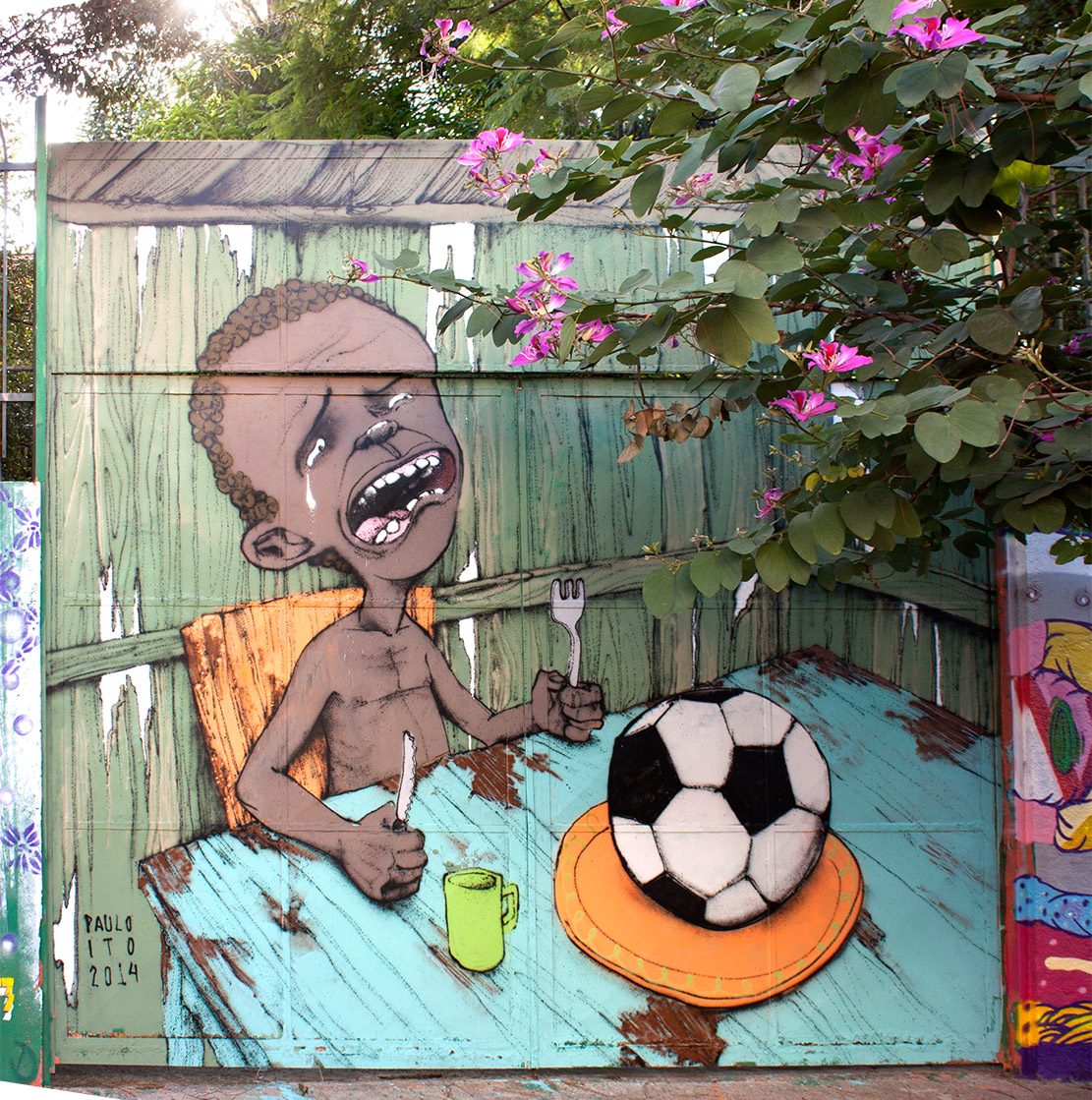
“evento da pompéia 2014.” Paulo Ito. Courtesy of the artist CC BY-NC-ND 2.0

“evento da pompéia 2014.” Paulo Ito. Courtesy of the artist CC BY-NC-ND 2.0

News and social media around the world are carrying stories about the tear-gassed transportation strikers in São Paulo, violence and conflict with the police in Rio’s favelas, and – witty but no less serious – John Oliver’s scathing explanation of the problems with the Fédération Internationale de Football Association (FIFA), which drew on major media reports about the organization’s well-known illegal cash-for-contracts corruption, and also its scandalously legal pillaging of World Cup host countries.

For those who have been following the preparations for the World Cup in international reporting, or this forum, strikes, protests and corruption are no surprise. Continue reading

Standard
DragNet

DragNet, April 2014

#myNYPD

What was on April’s Blog Menu, you ask? A flurry of posts covering everything from issues in ethnicity, crime stat validity, police social media involvement and ongoing Ukraine and surveillance coverage, of course! Continue reading

Standard
What's going on in Ukraine?

Police violence and ideas of the state in Ukrainian ‘Euromaidan’

The editors of Anthropoliteia would like to welcome Taras Fedirko with the latest entry in our developing Forum What’s Going on in Ukraine?

Violence as other; other as the authorities

In their responses to police violence during the ‘Euromaidan’in Ukraine, protesters and engaged commentators often located the source of brutality in some sort of unofficial, ‘other’realm within the state. Narratives of police brutality became narratives of the state as the riot police came to be imagined as commanded directly by the president Yanuokovych; authorities were thought to conspire against the Maidan; and snipers shooting at protesters on February 18-20 were said to be ‘Russian-trained.’

My interest here is in how protesters and sympathetic media represented the standoff between Maidan and ‘Berkut’ riot police not so much in terms of the enforcement of public order or contestations over what such order is/should be, but in terms of a confrontation between protesters and the authorities (rather than the police). The term for the ‘authorities’in Ukrainian is vlada, which simultaneously means abstract ‘power’and ‘people in/holding power’. Although it has an official usage (e.g. orhany vlady—state institutions, literally ‘organs of power’), it is crucial that in Ukrainian there is no word for ‘authority’and, I would add, no pragmatic difference between power and authority. The ‘realist’term vlada therefore maps the lack of emic differentiation between the official and unofficial power. I suggest that the displacement of the source of police agency to vlada was premised on understandings of vlada as the source of both official/formal and informal power in the society. Continue reading

Standard
Dossiers

Views of Venezuelan Protests, Pt. 3: Who is Policing the Protests? A Perspective from Venezuela’s National Bolivarian Police

The editors of Anthropoliteia would like to welcome a special guest post, the third in a series from Rebecca Hanson on recent political developments in Venezuela. 
Embed from Getty Images

“It is better to think of the police as providing support to the National Guard in the protests [as opposed to the other way around].  The National Guard has more experience and more training…and they aren’t restricted [in their use of force] like us…We can’t even defend ourselves.”  –National Police officer-in-training

Continue reading

Standard
What's going on in Ukraine?

Ukraine Roundtable

Ukraine memorial

Memorials for the dead along Institutka St. © Jennifer Carroll

Both Allegra and Anthropoliteia have been busy covering the political developments in Ukraine and Crimea, so we decided to “collaborate” on our coverage by bringing together the various contributors to pause and reflect on the question: “What has struck you the most, or been most noteworthy, about the developments in Ukraine—from EuroMaidan to Crimea—so far?” Continue reading

Standard