Commentary & Forums, Security in Brazil: World Cup 2014 and Beyond

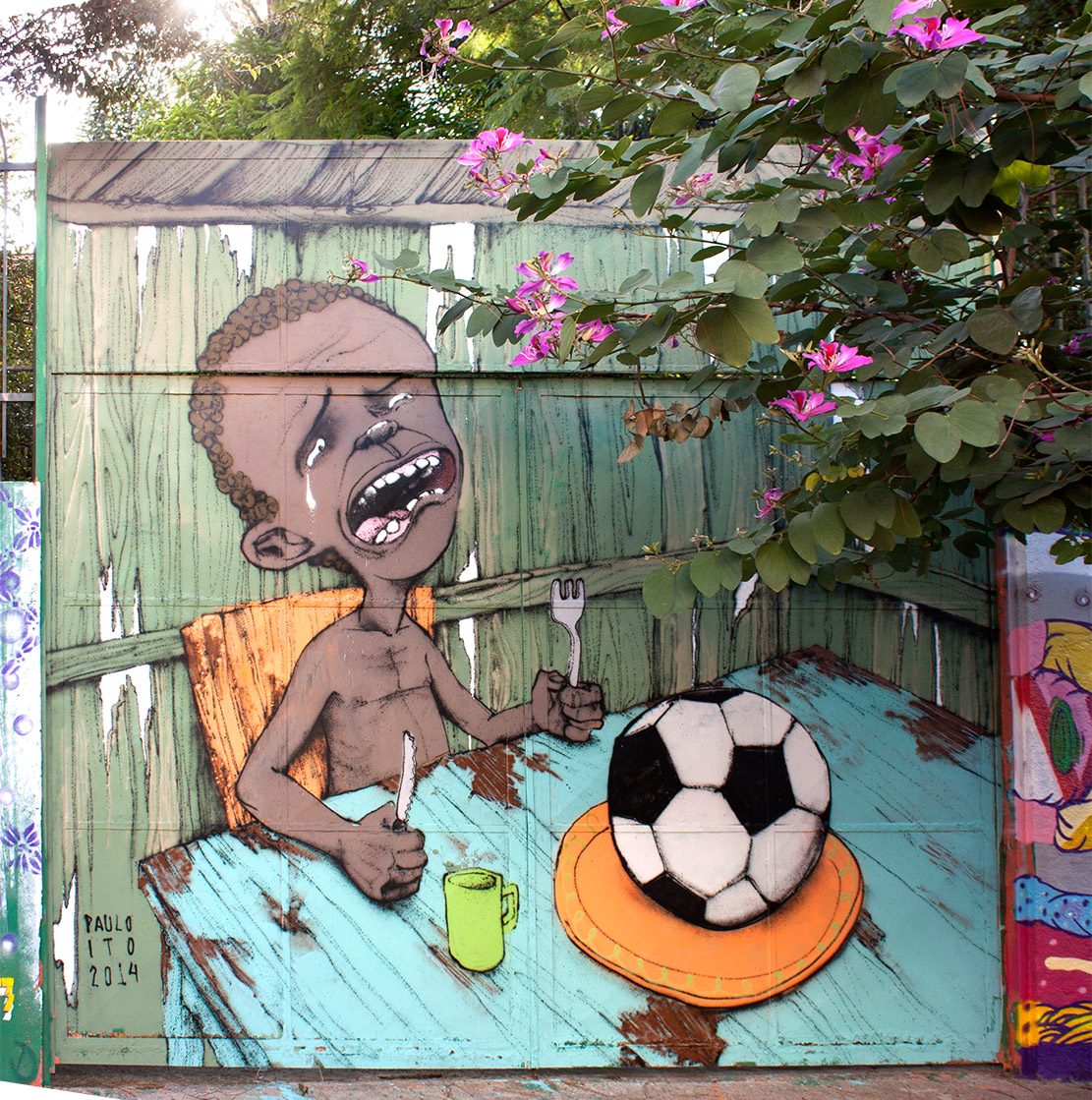
A Conflicted Brazil on the Eve of the World Cup

The editors of Anthropoliteia welcome Meg Stalcup with the latest entry in our forum, Security in Brazil: World Cup 2014 and Beyond.
“evento da pompéia 2014.” Paulo Ito. Courtesy of the artist CC BY-NC-ND 2.0

“evento da pompéia 2014.” Paulo Ito. Courtesy of the artist CC BY-NC-ND 2.0

News and social media around the world are carrying stories about the tear-gassed transportation strikers in São Paulo, violence and conflict with the police in Rio’s favelas, and – witty but no less serious – John Oliver’s scathing explanation of the problems with the Fédération Internationale de Football Association (FIFA), which drew on major media reports about the organization’s well-known illegal cash-for-contracts corruption, and also its scandalously legal pillaging of World Cup host countries.

For those who have been following the preparations for the World Cup in international reporting, or this forum, strikes, protests and corruption are no surprise. Continue reading

Standard
Security in Brazil: World Cup 2014 and Beyond

Pacifying Rio’s Favelas: innovation, adaptation or continuity?

Photo: SEASDH - Secretaria de Assistência Social e Direitos Humanos, Rio de Janeiro

Photo: SEASDH – Secretaria de Assistência Social e Direitos Humanos, Rio de Janeiro

The editors of Anthropoliteia would like to welcome Ben Penglase with the latest entry in our developing forum, Security in Brazil: World Cup 2014 and Beyond.

Brazil’s favela “pacification” policy, implemented by the state government of Rio de Janeiro beginning in 2008, is the most recent example of efforts by the Brazilian authorities to produce security. Coming before Brazil hosts the 2014 World Cup this June, and before Rio hosts the Olympics in 2016, and tackling that most visible and now internationally-renowned symbol of urban chaos – the city’s hillside favelas – the policy has attracted widespread attention. The Rio authorities have lost no opportunity to dramatize the supposed “take-over” of favelas by the army and police – often planting the Brazilian flag in neighborhoods “rescued” from drug traffickers – and the UPP (Unidade de Polícia Pacificadora, or Police Pacifying Unit) policy has become symbolic of a wider attempt by Brazilian authorities to create a safe urban landscape. Yet events in the past two years have called the UPP’s success into question. Shoot-outs between drug-dealers and police in several favelas where UPP units are in place, and a massive protest by residents of the favelas of Pavão-Pavãozinho and Cantagalo after the suspicious death of Douglas “DG” Pereira, have brought media attention to those who question the policy’s effectiveness.

In the midst of all this visibility and scrutiny of the UPP policy, several fundamental assumptions about the “pacification” policy often go unexamined. Drawing upon my own history of observing changes and continuities in policing in Brazil, and especially in Rio, for over twenty years, I would like to problematize these guiding assumptions which have often framed depictions of the pacification policy by both the media and Rio’s policy-makers. Continue reading

Standard
DragNet

DragNet, March 2014

♫ Duh duh duh duh ♫  The editors of Anthropoliteia would like to introduce yet another new regular feature: DragNet.  An addition to our “Round Ups” series, DragNet will offer monthly highlights of the English-language academic blogosphere for topics related to policing, security, crime and punishment around the world.  We’re thrilled to have Kristin Castner serving as the Section Editor and lead author for the feature. ♫ Duh duh duh duh DUH ♫

dragnet-monthly-web-round-up.jpeg

Continue reading

Standard
In the Journals

In the Journals, Winter 2014

Image

Welcome to In the Journals, a (roughly) quarterly digest of the latest publications dealing critically with issues of crime, security, punishment, surveillance and law & order. 2014 has already seen a number of articles and whole issues grappling with these problems, the following is a selection for you to peruse at your reading leisure.

Continue reading

Standard
Announcements, Call for papers

CFP Anthropoliteia-sponsored panel at the 2014 AAA Meetings

Long-time readers of Anthropoliteia may remember that some of the first “extra-curricular” iterations of the blog were at panels at the 2009 and 2010 Annual Meetings of the American Anthropological Association.  In my own humble estimation, these were extremely productive conversations, and not only because they resulted in an edited volume that was published by Palgrave Macmillan last year, of which we’re all extremely proud.

In that vein, and to broaden the conversation, we’ve decided to try sponsoring a panel on anthropoliteia-related issues this year.  If the experiment is successful, it may even become an annual thing.  Please read through the following CFP and consider offering an abstract.  Also, please pass this announcement on to anyone else that may be interested.

Call for Papers: Thinking through police, producing anthropological theory

For a session to be submitted to the 2014 Annual Meetings of the American Anthropological Association (Washington DC, December 3–7, 2014).  Dr. Kevin Karpiak (Eastern Michigan University), organizer.

Continue reading

Standard
What's going on in Ukraine?

Some thoughts on Ukraine

The editors of Anthropoliteia would like to welcome a special guest post from Michael Bobick as part of our developing Forum What’s Going on in Ukraine?

Much of what has been fascinating in Ukraine has been how perceptions of public order have framed interpretations of this conflict. The Maidan protesters certainly wrote another chapter in the ‘how to topple a corrupt government’ handbook that is, from the Russian perspective, far more dangerous than any particular nationalist regime might be. If unrest rises in Russia and a viable protest movement emerges (think motorcycle helmets and molotovs, not signs and chants), they will look to the experience of Maidan. The escalation of the conflict was, from the Russian perspective, something that should never have had to happen. Like in Kazakhstan (google Zhanaozen ) or Uzbekistan (Andijan), autocrats tend to stomp open dissent out before it can morph into something autonomous like Maidan. These suppressions as a rule occur off the books and without further inquiry. Yet it is precisely this idea of accountability that drove Yanukovch from Ukraine (that, along with an awkward telephone call from Putin). 

Continue reading

Standard
Dossiers

The Anthropology of “Robocop:” Finding New Audiences in Popular Media

The editors of Anthropoliteia would like to welcome a special guest post from Nolan Kline

Spoiler alert! This post reveals details about the new Robocop film.

As a kid, I loved the 1987 Robocop (even though I can’t recall how my parents allowed me to see it given its R rating and violent scenes).  Having grown up in the Detroit area and as a PhD candidate with research interests that all hinge on social inequality, it isn’t hard for me to understand now what I found so fascinating as a child about a film featuring a dystopian capitalist future. When I learned about the 2014 Robocop, admittedly I was excited to see it and interested in discovering whether the new film retained some of its social commentary roots. I was surprised to notice that the new film, more than the original, cut to the core of my current research interests around policing and health. The overlap with my scholarly interests led me to consider how I and other anthropologists might use popular media as a way to discuss anthropology with non-academic audiences.

Continue reading

Standard
Commentary & Forums

Some thoughts on the London “riots”: Foucault’s genealogy of neoliberalism and “police as a public service”

I have to say I resisted writing this post.  I have a visceral distaste for academic discursive hermeneutics performed from afar–this is partly why I’m an ethnographer, after all– and, that’s even more the case when trying to write au courant journalistically

However, despite having absolutely no ethnographic expertise among British police and only a concerned collaborator’s familiarity with the issues on the ground there, I’m going to just get over it–tempered still, hopefully, by a degree of humility and a recognition of our responsibility to ignorance.  The reason I’ve made this decision is to emphasize an ethnographic fact that I think is important for this blog: so much of what makes police a salient issue in broader terms are in fact riots and, conversely, so many riots, uprisings and rebellions are in fact about police.

All that was a way of putting a large preliminary asterisk on certain observations I’ve made following the news coverage via my own personal extended network of interwebs (BBC, CNN, NPR, Jeff Martin’s twitter feed…).  I’ve noticed a narrative dynamic emerging that I find a bit frustrating: on the one hand, news coverage presents the familiar “these are criminals/hoodlums without a politics,” with all its logical absurdities (is criminality innate and apolitical? If so, if these are innate tendencies and not the result of social conditions, how has London and then other cities in the UK suddenly–within the last several days– sprouted so many of this type? What would be the litmus test for whether determining this is a political act, by the way?).

On the other hand, often in an effort to show “the other side” or to emphasize some diversity of opinion on the events, news coverage includes another narrative which risks being equally tired and absurd, the “this is an expression of political-economic disenfranchisement” argument (with it’s equally non-falsifiable claims–what, again, are the criteria for deciding that this is political, and when where these events put to that criteria? what factors and/or data were considered? what would apolitical events look like? If at least one of these criteria should be statements of such from the protesters themselves, it does not seem to meet the definition…)

Even within stories framed in such a manner, however, I’ve noticed an interesting set of dissonances; some contradictions that, if properly attended to, don’t quite fit the dominant framing:

  • Generational conflict.  The “this is political” camp insists that the events are the result of the UK’s disinvestiture in social programs while experiencing wideing gaps in real wealth, but within that analysis there’s a type of inter-generational awkwardness, especially between what I think of as the Stuart Hall generation, associated with the Tottenham riots of the early 1980’s, and the present generation of protesters.  What’s interesting is to watch the older leftists struggle with understanding and/or translating the events; I’m thinking of some of the interviews with the MP from Tottenham and others, such as Darcus Howe, who seem to be attempting to work out some space for understanding them within a framework of social dis-investiture in the absence of an actually articulated voice of such a grievance.  The terms, or even the very language, seems to have moved somehow in the last 30 years.
  • Policing is a social program.  On the other hand, the “these are hoodlums” camp–set up as critics of the protesters (and thus anti-anti-dis-investiture)–emphasizes the affected business people and residents, often pointing to their calls for more police presence and in fact outrage at the lack of protection.  The contradiction here, of course, is that policing is a social program financed through government.  If anything, this is the voice criticizing dis-investiture.  What to make of that?

I think a less contradictory framing is possible if we make use of Foucault’s geneaology of liberalism (which I’ve written a bit on before), itself formulated during a crisis-point in global capitalism, which identifies neoliberal efforts to “reduce government” as one strategy, within a longer history of liberal political thought, which attempts to find external principles of limitation on government.  Part of why Foucault spends so much time on this is that it offers a prescient insight into so much of the nature of policing, security & surveillance today: namely that it springs from the same concern and theory of government.  Although often misread, I think, Foucault’s point is that the policing techniques of surveillance (much used in Britain) which skeev many of us out are not efforts to achieve a tightly controlled police state, but the opposite: it’s a strategy of governance which, for many reasons, sees such totalitarian aspirations as ineffectual and unnatural.  In this sense, security strategies of surveillance are attempts to provide a “policed” state (in the older sense of “happy, well -ordered and thriving”) with minimal police (in the sense of a specialized political organ claiming the monopoly of legitimate violence) interventon; police without policing.

In this sense, the policing strategies so heavily relied upon by Britain over the last several years are both part and parcel of a political rationality that also focused on finding more “economical” forms of government.  The same rationality which leads to a dis-investiture of the social programs targeted by “austerity measures.”  The two sides of the framing in the popular news-framing, then, are certainly not contradictory, nor is the one an effect of the other: they are two sides of the very same political rationality; one that more and more seems diseased.  What will be the alternative? I’m not sure, but finding a useful answer, I think, depends on understanding the political logic in which we find ourselves.
Standard
Announcements, Conferences

Anthropoliteia at the American Anthropological Association Meetings (2010, NOLA version)

Since people seemed to find it helpful last year, I’ve decided to try and make A@AAA an annual feature.  So here you go, my annual round-up of police, crime and security events at this year’s American Anthropological Association Annual Meetings.  As always, if you know about a session or paper that I’ve missed, let me know in the comments section and I’ll add it to the list.

Wednesday, Nov. 17th

1:15pm

2:15pm

2:30pm

9:00-9:15pm

Thursday, Nov. 18th

8:00-9:45am

10:15am-12:00pm

1:45-3:30pm

4:30pm

5:05pm

Friday, Nov. 19th

8:00am

2:30-3:00pm

2:45pm

3:45pm

4:30pm

Saturday, Nov. 20th

10:15-10:30am

1:45-3:30

Sunday, Nov. 21st

8:00-9:45am

8:15am

8:30am

Standard
Announcements, Conferences

Panels on Policing & Security at the 2009 American Anthropoligical Association Annual Meetings

I’ve compiled a list of panels and individual papers on security and policing-related issues at the upcoming AAA meetings.  You can see them below.

I’d like to give a special shout-out to the panel THE END/S OF POLICING: ETHNOGRAPHIC PERSPECTIVES ON POLICE POWER (Fri., 8:00-9:45 AM in rm 406) organized by the newest anthropolitician, William Garriott of James Madison University, also featuring myself, Michelle Stewart, Thom Chivens, Eva Harmon and Mindie Lazarus-Black of Temple University.  It should be good times.

Other than that, the following look interesting (panels are in bold):

Continue reading

Standard