Today at the American Anthropological Association Annual Meeting, there was a Special Session on Ferguson and police brutality hosted. At the session, there was a voiced a general desire for a forum through which to discuss and move forward on the issue, as anthropologists. Out of that meeting there were a series of actions, whose planning is in motion, but the Editors of Anthropoliteia would like to offer this space as a general forum open for discussion of the issue. We invite you to share your ideas below in the comments section
Tag Archives: American Anthropological Association
DragNet: November 18 – December 1, 2014

Although we here at Anthropoliteia don’t have any “existential answers” about how to process the recent events in Ferguson, we hope to provide a safe space for readers to reflect about and share their reactions.
DragNet November 4 – 17, 2014

Don’t let the cute face fool you: Dale Lately of The Baffler reports how an increasing number of police officers are joining Facebook in trolling internet pages for “pre-crime” in the making.
Anthropoliteia @ #AAA2014

As long time readers may know, we like to offer a run down of the sessions, papers and events at the Annual Meetings of the American Anthropological Association that may be of interest for readers of this blog. This has been made considerably easier the last couple of years by AAA’s personal scheduler function, which allows for the creation of sharable schedules. You can see a full* list of these papers and sessions via our shared Google Calendar, here. If you’re also a user of Google Calendar, you can easily copy individual events to your own schedule there.
In particular, though, I’d like to highlight a few events that are either directly sponsored or otherwise associated with Anthropoliteia.net. Perhaps the most important of these is the first ever Anthropoliteia “Tweet-Up.” Based on the previous success of similar events hosted by Savage Minds (among others), our Editorial Board has decided to extend an invitation to anyone interested to come meet with us–along with a select group of our various Section Editors and Contributors–to discuss, imbibe, and otherwise commiserate. You can find** us Thursday, December 4th from 6-8pm at Murphy’s Irish Pub, around the corner from the conference hotel [UPDATE: Harry’s Pub, in the Wardman Park Marriott].
Besides the tweet-up, there are a few official sessions that come out of collaborations on Anthropoliteia and the CFP we circulated earlier this year:
On Wednesday, December 3rd from 4-5:45pm in Washington Room 3 of the Marriott Wardman Park will be the panel “Thinking Through Police, Producing Anthropological Theory: police ethnography as a tool for critical thought,” organized by and featuring yours truly, along with Avram Bornstein (John Jay-CUNY), Mirco Gopfert (U Konstanz), Beatrice Jauregui (U Toronto), Matthew Wolf-Meyer (UC Santa Cruz) and Matthew Hull (U Michigan).
On Friday, December 5th from 6:30-8:15pm in the Diplomat Ballroom of the Omni Shoreham will be a roundtable on “Critical Potentialities of the Anthropology of Policing. Accounts of Police, Power and Politics on Public Display?” organized by our own Paul Mutsaers (Tilburg U) and featuring Beatrice Jauregui (U Toronto), Eilat Maoz (U Chicago), Simanti Dasgupta (U Dayton), Daniel Silva (Unicamp), Michelle L Stewart (U Regina), and Craig William Schuetze (UC, Santa Cruz).
Finally, on Saturday, December 6th from 9-10:15am, again in the Diplomat Ballroom of the Omni Shoreham, will be the panel “Violence and Ethics in Ethnographies of Security in Latin America,” organized by Stephanie Savell (Brown U), guest editor of this summer’s Forum “Security in Brazil: World Cup 2014 and Beyond“, and featuring Erika Robb Larkins (U Oklahoma), Aldo Civico (Rutgers U), Stephanie Savell (Brown U), Kristen Drybread (University São Paulo/ NEV) and Danial M. Goldstein (Rutgers U).
We hope to see you all there!
* As always, if you notice any oversights or would like to suggest additions send an email to anthropoliteia@google.com ** If you’re not sure who to look for, I basically look like this, possibly with shaggier hair. Also, I’ll try to be attentive to twitter–@anthropoliteia and @kevinkarpiak–especially towards the beginning
CFP: Anthropologists at the Intersections of Applied Anthropology and Criminal Justice
In March 2015, the Society for Applied Anthropology will hold its annual meeting in Pittsburg, PA. The following Call for Proposals might be of interest to some of our Anthropoliteia readers. Please direct questions to the organizers at their email addresses below.
 Seeking contributions to the panel “Anthropologists at the Intersections of Applied Anthropology and Criminal Justice” at the Society for the Applied Anthropology Meeting in Pittsburg (March 24-28, 2015)
Patricia San Antonio (CRS, Inc), Jennie M. Simpson (American Anthropological Association) and Scott Catey (National Council on Crime and Delinquency)
Anthropology has a long history of scholarship on crime, security, law, and justice, including significant work by major figures in the discipline, such as Malinowski, Nader, and the Comaroffs, among others. Yet, work by applied and practicing anthropologists in criminal justice settings and on criminal justice systems, including policing, courts, corrections, and policy, has been notably missing from discussions of crime, security, law and justice in academic scholarship. In this session, we seek to bring together practicing and applied anthropologists working in criminal justice fields to highlight the contributions made by these anthropologists to scholarship, policy, direct services and other areas of applied practice, as well as the potential of this work to inform theoretical practice. Proposals are welcome that highlight anthropological research, policy and/or direct service work in criminal justice. Topical and geographic areas are open.
Please, send your abstracts to Patricia San Antonio (psananton1@gmail.com), Jennie Simpson (jenmsimpson@gmail.com) and Scott Catey (catey.scott@gmail.com) by October 6th. Selected session participants will be notified by Friday, October 10h. Please note that session participants must register and pay for the conference before the abstract deadline on October 15th.
DragNet: July 15 – 31, 2014

With facial recognition technology growing in popularity (think Facebook), companies like CV Dazzle are responding with creative solutions aimed at protecting privacy (and, for that matter, your face).
CFP Anthropoliteia-sponsored panel at the 2014 AAA Meetings
Long-time readers of Anthropoliteia may remember that some of the first “extra-curricular” iterations of the blog were at panels at the 2009 and 2010 Annual Meetings of the American Anthropological Association. In my own humble estimation, these were extremely productive conversations, and not only because they resulted in an edited volume that was published by Palgrave Macmillan last year, of which we’re all extremely proud.
In that vein, and to broaden the conversation, we’ve decided to try sponsoring a panel on anthropoliteia-related issues this year. If the experiment is successful, it may even become an annual thing. Please read through the following CFP and consider offering an abstract. Also, please pass this announcement on to anyone else that may be interested.
Call for Papers: Thinking through police, producing anthropological theory
For a session to be submitted to the 2014 Annual Meetings of the American Anthropological Association (Washington DC, December 3–7, 2014). Dr. Kevin Karpiak (Eastern Michigan University), organizer.
Special Issue of Anthropology News features two articles on Police
Although there’s been quite a bit of rumbling over the AAA’s “open access” policies over the last several years, one positive development IMHO has been to move the association’s newsletter, Anthropology News, to an online and OA format.
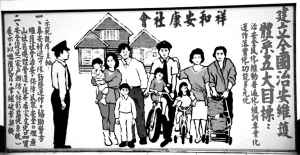
Police propaganda billboard advertising goals for building a “Peaceful and Healthy Society.” This photograph was taken in Taiwan in the early 2000s. Photo courtesy Jeffrey T Martin
And now readers of this blog can benefit. The most recent issue features several articles on the Anthropology of Law in its “In Focus” section, including two articles on the anthropology of policing: one from Anthropoliteia’s own Jeff Martin, entitled “How the Law Matters to the Taiwanese Police” and another by Jennie Simpson, a recent PhD from American University, “Building the Anthropology of Policing” (the latter featuring a short–and unexpected cameo from yours truly).
Personally, I’m super-psyched that the anthropology of policing is beginning to carve out a space in the larger world of anthropology. Not only am I currently brainstorming how to incorporate these blog posts into my course on Policing in Society, but I’m secretly formulating a response to Jeff arguing that his use of my beloved Max Weber is all wrong!
Anthropoliteia at the American Anthropological Association Meetings (2010, NOLA version)
Since people seemed to find it helpful last year, I’ve decided to try and make A@AAA an annual feature. So here you go, my annual round-up of police, crime and security events at this year’s American Anthropological Association Annual Meetings. As always, if you know about a session or paper that I’ve missed, let me know in the comments section and I’ll add it to the list.
Wednesday, Nov. 17th
1:15pm
- STEFAN LE COURANT — Names Written on the Wall: Understanding Graffiti in Alien Detention Places in France as part of the panel MIGRATORY SPACES OF INCLUSION AND EXCLUSION, Studio 3, Second Floor, Marriott
2:15pm
- DANIEL MAHER — Trash Talkin’ and Resurrectin’ Lawmen in Hell on the Border: African American Identity, Performance, and Representation in Fort Smith, Arkansas as part of the panel COUNTER-MEMORIES, Salon H, Third Floor, Marriott
2:30pm
- MEGAN CALLAGHAN (Bard College) — “Bricking the Peelers”: Children’s Challenges to the Police in Northern Ireland as part of the panel CIRCULATIONS OF CHILDREN AND FAMILY, Southdown, Fourth Floor, Sheraton
9:00-9:15pm
- JONATHAN PADWE (Yale University) — Remaking Ethnic Attachments by Fleeing the Police in Cambodia: Rethinking the Place of Jarai in Cambodia After the Refugees Have Moved On, as part of the panel ETHNIC LANDSCAPES AND LANDED ETHNICITIES: ATTACHMENTS, STOPPAGES AND CIRCULATIONS. (Salon H, Third Floor, Marriott)
Thursday, Nov. 18th
8:00-9:45am
- BETWEEN GOVERNMENTALITY AND STATE COERCION: GOVERNING BODIES IN SPACE, Organized by YASSER MUNIF
- ILGIN ERDEM — Dis-Ordering the Urban Space: The Case of May Day Protests in Turkey
- YASSER MUNIF — Disciplinary Spaces and “Lawless Zones” in a French Suburb
- SWATI BIRLA — Revisiting Public and Private Space- Prostitution Regulation in Gujarat
- ERIKA MARQUEZ — Social Movements in the Security State: Territorial Struggles in Valle Del Cauca, Colombia
- PANAYIOTIS MANOLAKOS (Sanhati) — Primary Accumulation qua Developmental Terrorism: Meditations on Political Strategy
10:15am-12:00pm
- INTERROGATING POLICE, Organized by ERIKA ROBB LARKINS (University of Wisconsin-Madison) & R BRIAN FERGUSON (Rutgers the State University of New Jersey-Newark) , Balcony M, Fourth Floor, Marriott
- R BRIAN FERGUSON (Rutgers the State University of New Jersey-Newark) — Killing Bill: Politics, Policing and Street Violence in the Gangs of New York Era
- AVRAM BORNSTEIN (John Jay College, City University of New York) — Policing, Race and “Color-Blindness” in the US
- ALDO CIVICO (Columbia University) — Policing as Cleansing: Gangs, Militias, and Death Squads in Medellin.
- ERIKA ROBB LARKINS (University of Wisconsin-Madison) — Men in Black and the Golden Gun: Maintaining Disorder in Rio’s Hyper Favela
- RIC CURTIS & TRAVIS WENDEL — Call the Policed: The Evolution of Police Tactics as Seen Through the Experience of Drug Distributors and Drug Users in New York City
- DISCUSSANT: NEIL WHITEHEAD (University of Wisconsin-Madison)
1:45-3:30pm
- COPS & CANONS: WHAT IS THE ANTHROPOLOGY OF POLICING AND WHAT IS IT GOOD FOR?, Organized by KEVIN KARPIAK (Eastern Michigan University) & WILLIAM GARRIOTT (James Madison University), La Galerie 1, Second Floor, Marriott
- MICHELLE STEWART (University of California-Davis) — “Don’t Dare Me”: A Consideration of Interdisciplinarity and Reflexivity in Policing Practice
- JEFFREY MARTIN (University of Hong Kong) — The Culture of Policing
- BEATRICE JAUREGUI (University of Cambridge) — Police Postings as Cultural Politics: Forces and Relations of State Authority in Northern India
- MEG STALCUP (University of California-Berkeley) — The Battle of Algiers on Main Street: Anthropology and the Policing of Terrorism
- WILLIAM GARRIOTT (James Madison University) — Ethical Failure or Ethical Imperative?: “Lumping It” as Method in the Anthropology of Police
4:30pm
- JULIA HORNBERGER — From Free Health Care to the Care of the Criminal Self as part of the panel SHIFTING SOVEREIGNTIES: CIRCUITS AND COUNTER-CIRCUITS OF KNOWLEDGE,La Galerie 4, Second Floor, Marriott
5:05pm
- KARINA BIONDI (Universidad Federal de São Carlos) — The Political Model of a Collective of Prisoners in São Paulo, Brazil as part of the panel NEW DIRECTIONS IN POLITICAL THEORY, Studio 3, Second Floor, Marriott
Friday, Nov. 19th
8:00am
- JENNIFER AENGST (University of California-Davis) — The Movements of Adolescents: Youth Policing and Secret Dating in Ladakh, India as part of the panel SEXUALITIES IN ‘OUT-OF-THE-WAY’ PLACES: TRACING INTIMACIES ACROSS BOUNDARIES, Salon 817 & 821, Eighth Floor, Sheraton
2:30-3:00pm
- BRIAN LANDE (University of California-Berkeley) & KEVIN KARPIAK (Eastern Michigan University) — ‘Taking the Field’: Thinking ‘Police’ Through the Social Sciences, Thinking ‘Society’ Through Policingas part of the panel BUSINESS ENCOUNTERS: FIELDWORK CONVERSATIONSOrganized by TIMOTHY DE WAAL MALEFYT (BBDO & Parsons, The New School for Design), BRIAN MOERAN (Copenhagen Business School), Balcony N, Fourth Floor, Marriott
2:45pm
- BJORN BERTELSEN — Chamboco, Lynchings, Death Squads and Prisons. Social Ontologies of Violence, Sovereignty and Conflict in Chimoio, Mozambique as part of the panel CONFLICTS ON THE MOVE,Balcony L, Fourth Floor, Marriott
3:45pm
- ROBERT A RUBINSTEIN (Maxwell School, Syracuse University) — Back to the Future?: Peacekeeping and Imperial Policingas part of the panel CONFLICTS ON THE MOVE,Balcony L, Fourth Floor, Marriott
4:30pm
- JENNIFER GOETT (Michigan State University) — Afro-Descendants and Counternarcotics Policing in Multicultural Nicaragua as part of the panel AFRO-LATINO POLITICS: REASSESSING THE MULTICULTURAL TURN TWO DECADES AFTER REFORM, (Studio 1, Second Floor, Marriott)
Saturday, Nov. 20th
10:15-10:30am
- KEVIN KARPIAK (Eastern Michigan University) — Use and Abuse of the Police in French Theory: Or, Uncanny Encounters With Foucault, Bourdieu and Many Others Among the Police Nationale as part of the panelFOUCAULT ET AL. FROM PARIS TO CALIFORNIA AND BACK AGAIN: THE CREOLISATION OF ‘FRENCH THEORY’organized by STEPHANIE LLOYD (McGill University), BAPTISTE MOUTAUD (INSERM), & LIVIA VELPRY (Cesames, University of Paris-Descartes), Grand Couteau, Fifth Floor, Sheraton
1:45-3:30
- THE ANTHROPOLOGY OF MASS INCARCERATION: GLOBAL ETHNOGRAPHIC PERSPECTIVES ON PRISONS AND POLICING organized byANDREA MORRELL (City University of New York-Graduate Center), & STEPHANIE CAMPOS,Oak Alley, Fourth Floor, Sheraton
- KAREN WILLIAMS (City University of New York-Graduate Center) — From Social Control to “Caring”?: Imagining a ‘Kinder Gentler’ Prison System Under Neoliberalism
- STEPHANIE CAMPOS — Las Burriers: Incarceration & Gendered Work in Illicit Economies
- HOLLIS MOORE (University of Toronto) — The Permeable Prison and the Production of (Un)relatedness: Household Responses to Imprisonment in Northeast Brazil
- ANDREA MORRELL (City University of New York-Graduate Center) — “A Label Tightly Sewn on the Community”: Race, Justice, and the Making of a Prison Town
- LILIAN NYAMPONG — Micro Interactional Processes State/Human Rights Interventions: Ethnography of Everyday Experiences in Correctional Institutions
- DISCUSSANT: PEM BUCK (Elizabethtown Community and Technical College)
Sunday, Nov. 21st
8:00-9:45am
- CIRCULATING TECHNIQUES OF GOVERNANCE: CRIME, INSECURITY, AND DELINQUENCY IN THE AMERICAS organized by CONNIE MCGUIRE (University of California-Irvine), Salon H, Third Floor, Marriott
- TIM GODDARD (University of California-Irvine) — Managing ‘Risky’ Populations: Crime Control Through Public-Private Partnerships
- CONNIE MCGUIRE (University of California-Irvine) — Transnationalizing Gangs in the Americas: From Local Problems to Regional Solutions
- VIRGINIA RAYMOND (Texas After Violence Project) — Lethal, Legal and Premeditated: U.S. State Homicide and Its Reverberations Throughout the Americas
- NINA SIULC (University of Massachusetts-Amherst) — U.S. Crimmigration Policies, Transnational Insecurities, and ? “Retraining”? Deportees
- WENDY REYES & ANGELA SANGUINETTI — Addressing the Limits of Orthodox Language
- MARIANA MORA — The Effects of Mexican State Security Policies: New Expressions of State Violence, Human Rights and the Production of Subjectivities in the State of Guerrero
- DISCUSSANT: ELANA ZILBERG (University of California-San Diego)
8:15am
- SANTIAGO GUERRA (University of Texas-Austin) — Los Mafiosos Y La Chota: Drug Trafficking and Policing in the South Texas-Mexico Borderlands
as part of the panel CIRCULATING MILITARISM, CIRCULATING SUBJECTS,Salon 829, Eighth Floor, Sheraton
8:30am
- TOM HALL (Cardiff University) & ROBIN SMITH — Local Motion, Local Knowledge: Research ‘On the Move’ With Urban Patrols as part of the panel OBSERVERS ON THE MOVE: REVISITING TRADITIONS AND EXPLORING INNOVATIONS IN PARTICIPANT OBSERVATION, Bayside B, Fourth Floor, Sheraton
CFP – THE CULTURE CONCEPT IN CONTEMPORARY CIRCULATION
(This CFP seems relevant to this dialogue about the utility of theorizing policing around a concept of culture)
Call For Papers — Proposed Session for AAA 2010
THE CULTURE CONCEPT IN CONTEMPORARY CIRCULATION
Does the culture concept have a place in anthropological understandings of a world increasingly defined and shaped by global circulations? Or, as decades of critique would wish it, can a concept of distinctive logics organizing human relations no longer hold water as the boundaries between the contexts and spaces in which those relations are negotiated become increasingly porous? This panel will consider, in light of both the history of its critiques, and recent ethnographic work from diverse locations and positions, the continuing relevance of a concept of culture — taken as a distinctive logic organizing social relations, moral and political projects, collective histories and imagined futures — as anthropology responds to the apparent dissolution of spatio-temporal, social and communicative boundaries. To what extent does the culture concept rely on our capacity to identify bounded collectivities, or on the isolation of those collectivities from each other, their ignorance of a world outside their “own” world, or on the difficulty of people associating with more than one of them or moving between them? (To put it another way: must “cultural” context always be relatively presupposed, rather than entailed?) What do prior theorizations of culture qua both difference and structure bring to our understanding of contemporary negotiations of the semiotic fields in which identity, alterity, and other sorts of projects come (or fail to come) into being? As it proliferates as a form in circulation beyond anthropological discourse, what force does culture retain or accrue as context or pretext, social text or hypertext? What pressure does the appearance of culture as a form in circulation place on our uses of culture as analytic frame?
Rather than seeing contemporary difficulties with deploying the concept of cultures as objects coterminous with geographically bounded social entities as an occasion for despair we see it as an opportunity for a productive untangling: Is difference (especially difference marked by a boundary) essential to the culture concept or simply the context in which it was first noticed? Need cultural “logics” be largely or partly unconscious to be powerful or is this a misguided analogy with linguistics? Need people have only one culture? Are unit cultures but one historically specific way in which human semiotic life can be organized (as bands, empires, or states are historically specific ways of organizing human political life)? Such untangling might let us continue to understand culture as the ground on which both alterity and alliance are negotiated regardless of the size and boundedness of the units involved, a use we see as faithful to its intellectual and political history, as well as one with a promising future on both fronts. As a platform for — and as a form accompanying— people and projects in circulation, the analytic concept of culture may in fact be of greater importance than ever.
Please address inquiries and submissions, in the form of an abstract of no more than 250 words, as e-mail text or attachment, to session organizers: Amy McLachlan (University of Chicago) amclachlan@uchicago.edu, or Daniel Rosenblatt (Carleton University) daniel.rosenblatt@gmail.com, by Friday, March 26th. In addition to an abstract, please also include your full name, contact information and institutional affiliation.
Feel free to circulate this announcement widely!
 Anthropoliteia