#Ferguson & Elsewhere, Commentary & Forums

Blue on black violence and original crime: a view from Oakland, California

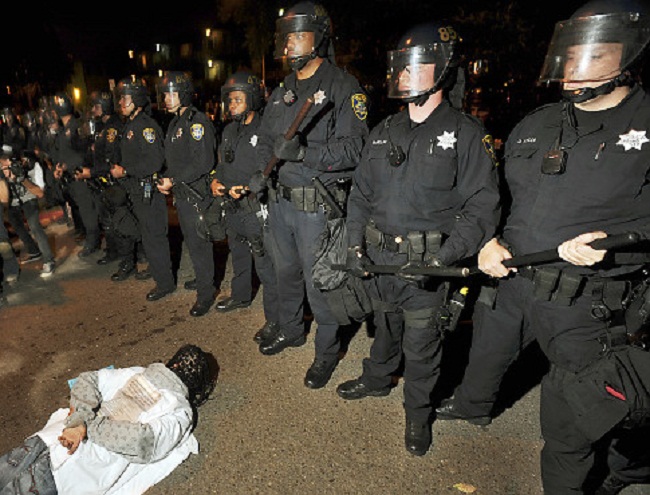
Oakland protest against murder of Oscar Grant. Image courtesy of Voice of Detroit


The editors of Anthropoliteia would like to welcome Brad Erickson with the latest entry in our developing Forum #Ferguson & Elsewhere

 The police killing of an unarmed, 18-year old African American, Michael Brown, and the hyper-militarized response to public protest in Ferguson, Missouri, has prompted wide-ranging national discourse following several threads. The first, exemplified by the #BlackTwitter phenomenon, emphasizes the pattern of extrajudicial killings of black people by police, security guards and self-appointed vigilantes as the continuing exercise of racial domination in the United States. The second is the attempt to cast Michael Brown and other black victims as threatening criminals in order to justify their killings and deny the salience of racism. A third major theme is the militarization of police, a growing trend since the introduction of SWAT teams in the 1970s, now pushed into high gear through the federal distribution of idle war materiel including armored vehicles, grenade launchers, and machine guns. This militarization is often linked to a decline in civil liberties and violations of due process. Some commentators locate these trends in the contexts of the rise of a surveillance state, the crisis of inequality and the demise of democracy orchestrated by wealthy elites.

I would like to reflect on these trends via the perspectives of people deeply impacted by them. In 2013, I carried out an evaluation of Oakland’s community policing program, and also tracked the effectiveness of family support services in Oakland’s lowest performing middle schools. For the first project I interviewed Oakland police personnel including captains, sergeants, lieutenants, problem solving officers (PSOs—assigned to work with specific neighborhoods), and crime reduction team officers (CRTs—largely focused on gang activity). For the second project, I observed and interviewed parents and children, teachers, principals, school counselors, and a variety of school-based service providers including nurses, counselors, mental health professionals, legal advisors, food bank and community gardens personnel, and Teach for America volunteers.

Continue reading

Standard
Interrogations

Interrogations: Heath Cabot and William Garriot on Policing and Contemporary Governance

Palgrave MacMillan (2013)

Policing and Contemporary Governance: the anthropology of police in practice. William Garriott, editor (Palgrave MacMillan 2013).

The editors of Anthropoliteia would like to introduce yet another in our series of new features: Interrogations, an interview series with authors and other people of potential interest to our readers.  The term ‘interrogation’ comes  the Latin inter “between” and rogare “question”.  It thus originally meant something like “to question between” (as opposed, for example, to examiner “to test, try, torture”).  Our plans for the series, which will edited by Kristen Drybread & Johanna Romer, are aimed at exploring this sense of the term.
We are happy to present to you the first in this series,  a conversation between Heath Cabot & William Garriott focused on Garriott’s edited volume Policing and Contemporary Governance: The Anthropology of Police in Practice (2013).
 

Continue reading

Standard
Dossiers

Views of Venezuelan Protests, Pt. 4: Looking at The “Collaboration” Between the Police and the Collectives

The editors of Anthropoliteia would like to welcome a special guest post, the fourth in a series from Rebecca Hanson on recent political developments in Venezuela. 


A water tower in Catia with Hugo Chávez's face on one side and the face of Lina Ron (founder of the Venezuelan Popular Union party and symbol of La Piedrita, another well known collective) on the other © Richard Snyder 2014

A water tower in Catia with Hugo Chávez’s face on one side and the face of Lina Ron (founder of the Venezuelan Popular Union party and symbol of La Piedrita, another well known collective) on the other © Richard Snyder 2014

In my last post I looked at the security force that is playing the most active role in policing the protests: the National Guard. While police officers overwhelmingly support the National Guard’s participation, there is second group that the police identify as “policing the protests” whose presence they do not condone: the collectives.

The collectives’ relationship to the state and state security forces has garnered much attention in the press since the protests began.  Providing little evidence, recent news reports (the Wall Street Journal , the BBC, and AlJazeera to name a few) have suggested that the police are working alongside and in collaboration with the collectives to repress protestors.  And this past week Human Rights Watch, though avoiding the term “collective,” published a report suggesting that the police and “armed pro-government groups” were in collusion with one another.

But National Bolivarian Police (PNB) officers describe this relationship quite differently, reporting that they must compete with the collectives for territorial control, access to arms, and even state protection.  For them, their relationship to the collectives is one structured by competition, not collaboration. In fact, since the Metropolitan Police in Caracas sided with the opposition in the 2002 coup against Chávez, officers feel that the government trusts the collectives–ideologically aligned with the Bolivarian Revolution–more than the police to work the protests. Though the police as an institution is often defined by its ability to legitimately deploy force in order to protect the state’s interests, officers perceive the collectives as primarily designated by the state to fulfill this function.

In this post, I provide a brief summary of the collectives’ history and then describe how police officers talk about their relationship to the collectives. Continue reading

Standard
Dispatches

An encounter with “Sky Watch” on a block in Bedford-Stuyvesant, Brooklyn

The editors of Anthropoliteia would like to welcome a special guest post from Orisanmi Burton as part of our series of anthropological reports From the Field
Figure 1: Surveillance Cameras on Gates Avenue

Figure 1: Surveillance Cameras on Gates Avenue

The first thing I noticed when I reached the corner of Gates Avenue and Lewis Avenue in the Bedford-Stuyvesant neighborhood of Brooklyn, NY was the pair of surveillance cameras perched conspicuously overhead (Figure 1). Each was approximately 15 inches long and five inches wide. Their white color contrasted sharply against the red brick of the building next to me, as if they were designed to be noticed. But their gaze was not trained on me. Instead, they were pointed toward opposite ends of the street corner. I then noticed a second pair of cameras about 300 feet from the first. One of them pointed directly at me. The other had an altogether different design, a sphere suspended in the air. I imagined a camera inside of it that could rotate 360 degrees. Thick black cables sprouted from the back of the devices, extending across the length of the building like arteries. Continue reading

Standard
What's going on in Ukraine?

Former Anthropoliteia contributor, and member of our Ukraine Roundtable, Michael Bobick has a new piece published over at the Council for European StudiesReviews & Critical Commentary site.  Here’s a taste:

On April 6th, pro-Russian protestors stormed and occupied the Donetsk Oblast Regional Administrative building, along with the local SBU (Ukrainians security services) headquarters. Overnight, barricades of tires, barbed wire, and professionally produced banners were hoisted over this building; the Ukrainian flag was replaced with a Russian one. On April 7th, the People’s Republic of Donetsk declared its independence and immediately appealed to President Putin to send Russian ‘peacekeepers’. A referendum on whether Donetsk ‘should join the Russian Federation’ was to occur sometime before May 11th, 2014. Similar events have occurred in the southern and eastern parts of Ukraine, in Lugansk, Kharkiv, Dnepropetrovsk, Zaporizhia, Kherson, Mykolaiv, and Odessa, regions referred to both in Western and Russian media as Russian or Russian-speaking. Though this conflation of language, identity, and ethnicity is far removed from the reality of everyday life in Ukraine, it remains an essential concept for understanding how separatism occurs in the former Soviet Union. Each can become a pretext for discrimination, marginalization, and threat at the hands of the de jure state that can only be remedied by Russian intervention.

In this article, I seek to answer three questions: Who are the separatist forces currently operating in Ukraine, and what is their goal? Secondly, what can Transnistria, a de facto state in Moldova that has existed for more than two decades, offer to an understanding of events in Ukraine? Finally, I am interested in how the new political technologies and practices deployed by Russia in Ukraine are changing the nature of war and humanitarian intervention in the twenty-first century.

via Active Measures: Separatism and Self-Determination in Russia’s Near Abroad | Reviews & Critical Commentary.

Link
Announcements, Book Reviews

New Feature: Book Reviews

Over the last couple of months we’ve already introduced two new suites of features: the first being a series of periodic digests from academic journals, around the web (which we call DragNet) and in the news that we’re collectively calling “Round Ups” and the second being the collection of original contributions from researchers From the Field, which we’ve further broken down into impressionistic Dispatches and more fully-developed Dossiers.

Now the editors of Anthropoliteia are happy to announce the first in a third “suite” of features which we’re collectively calling “Bibliographemes”.  The neologism is a a play on Roland Barthes’ term “biographeme,” of which Richard Elliott, drawing on Seán Burke, writes: Continue reading

Standard
What's going on in Ukraine?

Police violence and ideas of the state in Ukrainian ‘Euromaidan’

The editors of Anthropoliteia would like to welcome Taras Fedirko with the latest entry in our developing Forum What’s Going on in Ukraine?

Violence as other; other as the authorities

In their responses to police violence during the ‘Euromaidan’in Ukraine, protesters and engaged commentators often located the source of brutality in some sort of unofficial, ‘other’realm within the state. Narratives of police brutality became narratives of the state as the riot police came to be imagined as commanded directly by the president Yanuokovych; authorities were thought to conspire against the Maidan; and snipers shooting at protesters on February 18-20 were said to be ‘Russian-trained.’

My interest here is in how protesters and sympathetic media represented the standoff between Maidan and ‘Berkut’ riot police not so much in terms of the enforcement of public order or contestations over what such order is/should be, but in terms of a confrontation between protesters and the authorities (rather than the police). The term for the ‘authorities’in Ukrainian is vlada, which simultaneously means abstract ‘power’and ‘people in/holding power’. Although it has an official usage (e.g. orhany vlady—state institutions, literally ‘organs of power’), it is crucial that in Ukrainian there is no word for ‘authority’and, I would add, no pragmatic difference between power and authority. The ‘realist’term vlada therefore maps the lack of emic differentiation between the official and unofficial power. I suggest that the displacement of the source of police agency to vlada was premised on understandings of vlada as the source of both official/formal and informal power in the society. Continue reading

Standard
Dossiers

Views of Venezuelan Protests, Pt. 3: Who is Policing the Protests? A Perspective from Venezuela’s National Bolivarian Police

The editors of Anthropoliteia would like to welcome a special guest post, the third in a series from Rebecca Hanson on recent political developments in Venezuela. 
Embed from Getty Images

“It is better to think of the police as providing support to the National Guard in the protests [as opposed to the other way around].  The National Guard has more experience and more training…and they aren’t restricted [in their use of force] like us…We can’t even defend ourselves.”  –National Police officer-in-training

Continue reading

Standard
Dossiers

Order by the Books: Suicide crime scene investigations in southern Mexico

The editors of Anthropoliteia would like to welcome a special guest post from Beatriz Reyes-Foster as part of our series of anthropological reports From the Field

Abstract

The complex and contested relationship between representatives of a Mexican law enforcement agency and the citizenry it claims to protect is visible in the documents it produces. Ethnographic material further deepens our understanding of the ways in which law enforcement agents and common citizens form relationships based on negotiation and distrust.

Continue reading

Standard
What's going on in Ukraine?

Ukraine Roundtable, pt. 2: Simulacrum Crimea

Yesterday, as part of our ongoing collaboration on Ukraine coverage, Allegra published a timeline summarizing the main ‘events’ of the Ukrainian crisis. Today, Judith Beyer, who already published an article on Ukraine with Allegra, continues our conversation and answers the question that was asked in the first part of our joint virtual roundtable: “What has struck you the most, or been most noteworthy, about the developments in Ukraine—from EuroMaidan to Crimea—so far?”

Embed from Getty Images Continue reading

Standard