Announcements

Welcome to the new Anthropoliteia.net !

© The estate of Edward Wolfe

P.C. 77 by Edward Wolfe c.1927

We are happy to continue announcing the exciting changes that are rolling out here at Anthropoliteia. You’ve already heard about our new snazzy design and two of our new features, “Dispatches” and “In the Journals“.  In the meantime we’ve also snuck in our very own domain name: anthropoliteia.net  For most of you this should make very little difference, in any.  Your browser and rss reader should automatically redirect you from our old WordPress address to the new one, but this change affords us a greater deal of flexibility with the site design going forward. Continue reading

Standard
Dossiers

Views of Venezuelan Protests Part II: La Desconfianza and the Venezuelan Opposition

The editors of Anthropoliteia would like to welcome a special guest post, the second in a series from Rebecca Hanson on recent political developments in Venezuela. A version of this piece originally appeared on the blog Venezuela Politics and Human Rights as “La Desconfianza: The View from Western Caracas II
Mural from a wall in Catia © Rebecca Hanson

Mural from a wall in Catia. The literal translation is “knee on the ground” but the term originally arose from the military to refer to the position of a shooter with one knee on the ground to take a shot. Chavistas use it metaphorically to mean that they are prepared for battle or to do whatever it takes to protect the Bolivarian Revolution. © Rebecca Hanson

“It makes no sense! You go into a Chavista’s house and Chávez and Maduro’s faces are everywhere but you open their fridge and it is empty!  Empty!” This was the passionate reaction I received from an acquaintance I was chatting with yesterday when I commented that protests in Caracas have not seemed to receive support from popular sectors in the city.

Continue reading

Standard
Podcasts, What's going on in Ukraine?

Crimea: Skirmishes and Signals in a (mostly) Bloodless War

The editors of Anthropoliteia would again like to welcome the latest in a series of special guest posts from Monica Eppinger as part of our developing Forum What’s Going on in Ukraine?

It is a rare war where the local population and defending army speak the language of the invader so well.  Clearly, shared language facilitated talking through tense stand-offs and other encounters that could have otherwise easily devolved into bloodshed during the invasion of Crimea.  In my first blog post, I identified discourse as a significant feature in Ukrainians’ responses to the invaders.  (Some examples of subsequent encounters made it into my earlier posts here, here, and here.)  In place of the post-Soviet aphasia Sergei Oushakine found 20 years ago, there’s been an explosion of discourse.  That in itself is worth analyzing.  For now, I’m just taking note.  Forget Stratego, Battleship, or other games of traditional tactical maneuver as heuristic; forget tank counts or brigade movements as the only, or even primary, means of understanding and assessing.  This war has consisted of verbal performance to an extent that  invites interaction analysis as a method for apprehending its tactics.  This post shares some of the last military engagements of the invasion.

Continue reading

Standard
Dossiers

Policing an Occupied Legislature, Part Three: Throwing Police Under the Bus.

[Updated 2014/03/25]

Propaganda from a Taiwanese protest camp

Fig. 1. Propaganda from the protest camp regarding last night’s police action: “You go to sleep. When you awake, Taiwan is not the same”

“Police friends,” said the student with a microphone, speaking over the heads of people facing him to the riot troops massing in the street behind them, “We have a chance to make history tonight! Join with us! Show the autocratic Ma government that the people and police are united!”

Continue reading

Standard
Dossiers

Views of Venezuelan Protests Part I: Where are the Poor Protestors?

The editors of Anthropoliteia would like to welcome the first in a series of special guest posts from Rebecca Hanson on recent political developments in Venezuela.   This piece originally appeared on the blog Venezuela Politics and Human Rights as “Venezuelan Protests from the View of Western Caracas

Images of burning tires, masked youth, and clashes between citizens and state security forces have accompanied almost all news coverage of Venezuela for the past few weeks.  And these well-documented protests and the government response to them have, as blogger Francisco Toro wrote, changed the political game in Venezuela for the foreseeable future.

To fully appreciate these changes, however, we need to also appreciate the geographical limits of the opposition protests. Taking into account where protests are not occurring, and why, is important in understanding what they represent for residents who do not live in the zones where protests have erupted.

Continue reading

Standard
In the Journals

In the Journals, Winter 2014

Image

Welcome to In the Journals, a (roughly) quarterly digest of the latest publications dealing critically with issues of crime, security, punishment, surveillance and law & order. 2014 has already seen a number of articles and whole issues grappling with these problems, the following is a selection for you to peruse at your reading leisure.

Continue reading

Standard
Announcements, In the Journals

New Feature: In the Journals

The editors of Anthropoliteia are pleased to announce yet another in a planned series of new features that will be appearing here on the blog over the coming month.  We’re calling this new feature, which will be part of the “Round Ups” suite of regular features, “In the Journals” and it will  digest anthropoliteia-related articles and special issues appearing in academic journals, on a quarterly basis (for now). 

In addition I’m happy to introduce one of our new “Section Editors,” David Thompson.  David is currently a PhD candidate in Anthropology at the University of California, Berkeley, having earned a B.A. from the University of Sydney. His work focuses on prisons in Rio de Janeiro as institutions that subvert as much as they reinforce the established social and political order of the city; hosting different legal, political, humanitarian, evangelical, community and narcotic projects that then bleed out into the urban fabric of a city saturated with discourses on crime and justice.  We’re super happy to have him on board.

If you have any suggestions for journals we should be keeping tabs on for this feature, or if you want to call our attention to a specific issue or article, send an email to anthropoliteia@gmail.com with the words “In the Journals” in the subject header.

Standard
Dossiers

Policing an Occupied Legislature (part 2).

(Continued from part one)

IMG_2914

Fig. 1 A note reading “Everyone, police, thank you for your struggle” hangs on a barbed wire barricade.

An emphasis on unity between the police and the people has emerged as a core element in the struggle by Taiwanese protestors to control representations of their movement. Where the Presidential Office has sought to describe them as a “Violent Mob,” they have successfully asserted the peaceful qualities inherent in the sympathetic bond that stretches across the barricades, uniting them with the rank and file policemen called up to contain them.

Continue reading

Standard
Dossiers

Policing an Occupied Legislature (or “Institutional memory will get you through a time of no constitution better than a constitution will get you through a time of no institutional memory”).

Image

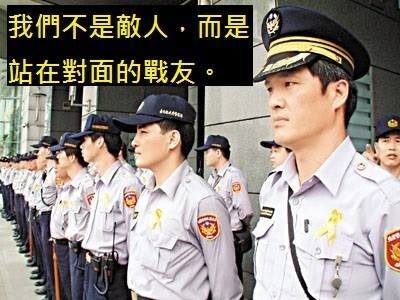
“We are not enemies. We are allies that stand facing one another” (caption to a picture that is purportedly an expression of police attitudes towards the recent occupation of Taiwan’s legislature)

In the context of a loving relationship between consenting adults, it’s normal for police to get screwed from both sides. Taiwanese democracy is sometimes a strained marriage, however. Tensions are introduced to any enterprise of collective self-determination when the great power next door insists your state does not exist. The existential tensions of Taiwanese democracy are currently being expressed in a constitutional crisis.  Last Tuesday night, the unpopular president’s ham-fisted attempt to fudge the procedures involved in his party’s pursuit of economic integration with China blew up in his face. Dissident students (later joined by their professors, constitutional law scholars and, increasingly, the general public) occupied the legislative assembly to physically prevent the conclusion of a process that would have endowed an agreement concluded between legislatively unqualified bodies with the force of statutory law.

Continue reading

Standard
Dossiers

Policing and “Safety in Numbers” in a Post-Panoptic Age

The editors of Anthropoliteia are pleased to welcome a special commentary from our own Kristin Castner.

Let’s face it: Americans are living in an age of extreme surveillance.  The government is listening to our phone calls, capable of controlling our computer cameras remotely and (perhaps) reading our Facebook messages.

Continue reading

Standard