DragNet

DragNet: May 1 – 15, 2014

Use of force by Border Patrol OfficersA study conducted through a collaboration of biostaticians and lawyers attracted attention this month, with the duo evaluating the overall success rate of the criminal justice system. Using death penalty cases as a “control group” of sorts, they argue against the claim that “99.973%” of US Court cases are processed accurately. They also found that ~36% of death row inmates are reassigned to life in prison if question about their guilt remains, fueling discussions of whether there is, in fact, an “acceptable” error rate.

The ACLU called for a reconsideration of Border Patrol Officer discretionary power with respect to the use of deadly force. Does throwing a rock at an officer warrant a lethal response? John Burnett of NPR also tackled the question (somewhat unsuccessfully), while NBC Nightly News covered a DOJ report that also exposes a pattern of excessive force by officers in New Mexico.

Use of force gave way to topics in police technology, with attention being paid to the use of “shooting simulators” by some courts in Texas. The technology allows jurors to experience a simulation of a crime before it is heard in court. Praised by some for its ability to “put the juror in the shoes of the defendant or officer”, some insist it is a pro-law enforcement ploy to justify officer use of deadly force. Also in technology, a crowd-sourcing tool known as LEEDIR was used by the LAPD last month during investigations of a widespread riot. Officers praised its ability to quickly process digital evidence, while others point to its potential to subject innocent bystanders in public areas to police surveillance. Anthropoliteia author Orisanmi Burton also reflected on police technology in a post about Sky Watch stations in Brooklyn. Is this form of surveillance technology yet another chapter in the Domain Awareness initiative?

…just when you thought you knew everything Anthropoliteia has to offer, we throw a new feature at you! Guest author Stephanie Savell talks about the hidden side of police and security in Brazil. Fill in the gaps of World Cup media coverage with Savell’s holistic historical analysis.

Anthropoliteia was pleased to see former contributor Michael Bobick publish a piece through the Council for European Studies Reviews & Critical Commentary’s site. In it, he targets and addresses 3 questions about the separatist forces operating in Ukraine.

According to the National Institute of Mental Health, about 1 in 4 adult in the US suffers from a diagnosable mental disorder. Perhaps stats like these are behind the growth of Crisis Intervention Teams. Read how one police department in Fairfield, CT invested (and benefits) from enrolling 20% of its officers in mental health response training. The role of mental health and policing lend to issues in homelessness, with Anthropology News featuring a thesis overview by Maegen Miller about the slow evolution of homelessness into a prosecutable crime.

Lastly, don’t miss 2014 Society of Cultural Anthropology conference materials that were presented on May 9th and 10th. Anthropoliteia’s own Kevin Karpiak and Michelle Stewart attended to present papers on the work of police. View the SCA 2014 agenda here.

Standard
Security in Brazil: World Cup 2014 and Beyond

Pacifying Rio’s Favelas: innovation, adaptation or continuity?

Photo: SEASDH - Secretaria de Assistência Social e Direitos Humanos, Rio de Janeiro

Photo: SEASDH – Secretaria de Assistência Social e Direitos Humanos, Rio de Janeiro

The editors of Anthropoliteia would like to welcome Ben Penglase with the latest entry in our developing forum, Security in Brazil: World Cup 2014 and Beyond.

Brazil’s favela “pacification” policy, implemented by the state government of Rio de Janeiro beginning in 2008, is the most recent example of efforts by the Brazilian authorities to produce security. Coming before Brazil hosts the 2014 World Cup this June, and before Rio hosts the Olympics in 2016, and tackling that most visible and now internationally-renowned symbol of urban chaos – the city’s hillside favelas – the policy has attracted widespread attention. The Rio authorities have lost no opportunity to dramatize the supposed “take-over” of favelas by the army and police – often planting the Brazilian flag in neighborhoods “rescued” from drug traffickers – and the UPP (Unidade de Polícia Pacificadora, or Police Pacifying Unit) policy has become symbolic of a wider attempt by Brazilian authorities to create a safe urban landscape. Yet events in the past two years have called the UPP’s success into question. Shoot-outs between drug-dealers and police in several favelas where UPP units are in place, and a massive protest by residents of the favelas of Pavão-Pavãozinho and Cantagalo after the suspicious death of Douglas “DG” Pereira, have brought media attention to those who question the policy’s effectiveness.

In the midst of all this visibility and scrutiny of the UPP policy, several fundamental assumptions about the “pacification” policy often go unexamined. Drawing upon my own history of observing changes and continuities in policing in Brazil, and especially in Rio, for over twenty years, I would like to problematize these guiding assumptions which have often framed depictions of the pacification policy by both the media and Rio’s policy-makers. Continue reading

Standard
Dossiers

Views of Venezuelan Protests, Pt. 4: Looking at The “Collaboration” Between the Police and the Collectives

The editors of Anthropoliteia would like to welcome a special guest post, the fourth in a series from Rebecca Hanson on recent political developments in Venezuela. 


A water tower in Catia with Hugo Chávez's face on one side and the face of Lina Ron (founder of the Venezuelan Popular Union party and symbol of La Piedrita, another well known collective) on the other © Richard Snyder 2014

A water tower in Catia with Hugo Chávez’s face on one side and the face of Lina Ron (founder of the Venezuelan Popular Union party and symbol of La Piedrita, another well known collective) on the other © Richard Snyder 2014

In my last post I looked at the security force that is playing the most active role in policing the protests: the National Guard. While police officers overwhelmingly support the National Guard’s participation, there is second group that the police identify as “policing the protests” whose presence they do not condone: the collectives.

The collectives’ relationship to the state and state security forces has garnered much attention in the press since the protests began.  Providing little evidence, recent news reports (the Wall Street Journal , the BBC, and AlJazeera to name a few) have suggested that the police are working alongside and in collaboration with the collectives to repress protestors.  And this past week Human Rights Watch, though avoiding the term “collective,” published a report suggesting that the police and “armed pro-government groups” were in collusion with one another.

But National Bolivarian Police (PNB) officers describe this relationship quite differently, reporting that they must compete with the collectives for territorial control, access to arms, and even state protection.  For them, their relationship to the collectives is one structured by competition, not collaboration. In fact, since the Metropolitan Police in Caracas sided with the opposition in the 2002 coup against Chávez, officers feel that the government trusts the collectives–ideologically aligned with the Bolivarian Revolution–more than the police to work the protests. Though the police as an institution is often defined by its ability to legitimately deploy force in order to protect the state’s interests, officers perceive the collectives as primarily designated by the state to fulfill this function.

In this post, I provide a brief summary of the collectives’ history and then describe how police officers talk about their relationship to the collectives. Continue reading

Standard
Dispatches

An encounter with “Sky Watch” on a block in Bedford-Stuyvesant, Brooklyn

The editors of Anthropoliteia would like to welcome a special guest post from Orisanmi Burton as part of our series of anthropological reports From the Field
Figure 1: Surveillance Cameras on Gates Avenue

Figure 1: Surveillance Cameras on Gates Avenue

The first thing I noticed when I reached the corner of Gates Avenue and Lewis Avenue in the Bedford-Stuyvesant neighborhood of Brooklyn, NY was the pair of surveillance cameras perched conspicuously overhead (Figure 1). Each was approximately 15 inches long and five inches wide. Their white color contrasted sharply against the red brick of the building next to me, as if they were designed to be noticed. But their gaze was not trained on me. Instead, they were pointed toward opposite ends of the street corner. I then noticed a second pair of cameras about 300 feet from the first. One of them pointed directly at me. The other had an altogether different design, a sphere suspended in the air. I imagined a camera inside of it that could rotate 360 degrees. Thick black cables sprouted from the back of the devices, extending across the length of the building like arteries. Continue reading

Standard
What's going on in Ukraine?

Former Anthropoliteia contributor, and member of our Ukraine Roundtable, Michael Bobick has a new piece published over at the Council for European StudiesReviews & Critical Commentary site.  Here’s a taste:

On April 6th, pro-Russian protestors stormed and occupied the Donetsk Oblast Regional Administrative building, along with the local SBU (Ukrainians security services) headquarters. Overnight, barricades of tires, barbed wire, and professionally produced banners were hoisted over this building; the Ukrainian flag was replaced with a Russian one. On April 7th, the People’s Republic of Donetsk declared its independence and immediately appealed to President Putin to send Russian ‘peacekeepers’. A referendum on whether Donetsk ‘should join the Russian Federation’ was to occur sometime before May 11th, 2014. Similar events have occurred in the southern and eastern parts of Ukraine, in Lugansk, Kharkiv, Dnepropetrovsk, Zaporizhia, Kherson, Mykolaiv, and Odessa, regions referred to both in Western and Russian media as Russian or Russian-speaking. Though this conflation of language, identity, and ethnicity is far removed from the reality of everyday life in Ukraine, it remains an essential concept for understanding how separatism occurs in the former Soviet Union. Each can become a pretext for discrimination, marginalization, and threat at the hands of the de jure state that can only be remedied by Russian intervention.

In this article, I seek to answer three questions: Who are the separatist forces currently operating in Ukraine, and what is their goal? Secondly, what can Transnistria, a de facto state in Moldova that has existed for more than two decades, offer to an understanding of events in Ukraine? Finally, I am interested in how the new political technologies and practices deployed by Russia in Ukraine are changing the nature of war and humanitarian intervention in the twenty-first century.

via Active Measures: Separatism and Self-Determination in Russia’s Near Abroad | Reviews & Critical Commentary.

Link
Security in Brazil: World Cup 2014 and Beyond

Security in Brazil: World Cup 2014 and Beyond

Riot police gather in front of a mural of the mascot for the 2014 World Cup soccer tournament, called Fuleco, near the Maracana stadium ahead of the Confederations Cup soccer final between Brazil and Spain in Rio de Janeiro, Brazil, Sunday, June 30, 2013. (Source: AP Photo/Victor R. Caivano)

Riot police gather in front of a mural of the mascot for the 2014 World Cup soccer tournament, called Fuleco, near the Maracanã stadium ahead of the Confederations Cup soccer final between Brazil and Spain in Rio de Janeiro, Brazil, Sunday, June 30, 2013. (Source: AP Photo/Victor R. Caivano)

The Editors of Anthropoliteia would like to welcome Stephanie Savell as guest editor of an invited developing Forum on Security in Brazil: World Cup 2014 and Beyond

The media is full of stories about Brazil, particularly stories of urban violence, protest, and police repression. Many news stories make the link to the upcoming June 2014 World Cup and the 2016 Olympics in Rio de Janeiro, wondering more or less explicitly whether such violence will affect the games and visitors to Brazil. Brazilian activists and citizens have been protesting the massive spending on infrastructure and highly visible public security measures being taken in preparation for the global games, asking, among other things, “What happens in 2017?”

In Rio de Janeiro, much controversy revolves around the flagship program known as “pacification,” in which state security forces wrest territorial control of favelas from drug gangs and install police posts in these informal settlements. I just spent the past year living in the “pacified” Complexo do Alemão, a sprawling favela notorious for its crime-related street violence. Here residents perceive an ongoing battle for control between police and the still present but now slightly more covert gangs, and many believe the gangs are gaining ground. In recent months, escalating violence has many in Rio wondering whether the pacification program will collapse.

From an anthropological viewpoint, the significance of how security in urban Brazil has been developing reaches far beyond what the media portrays as preparation for the games. Current trends must be understood in the context of a history of both repressive policing and alternative community policing programs in Brazil. There are pressing questions to be asked about the deployment of the military in urban neighborhoods and the use of private security firms and personnel to fill gaps in state capacity. Additionally, there are multiple dimensions of a broader understanding of the term “security” that are obscured by the focus on public security in the context of the forthcoming global sporting events. For example, many Brazilians protest the economic and social costs of hosting the games, at a time when the government fails to meet the basic needs of citizens, and as many favela residents are displaced by infrastructure projects and real estate interests. Unemployment, racism, gender disparities, suppression of popular uprisings, lack of freedom of the press, environmental precariousness, and the enforcement of state regulations in informal settlements are just a few of the insecurities at stake in pre- and post-World Cup security practices.

Anthropologists like myself, and ethnographers in other disciplines, have in recent years been investigating ever more closely how security is experienced, understood, and contested in the everyday lives of urban Brazilians. Through historical and ethnographic fieldwork, such analyses seek to characterize the forms of governance through which security emerges. In a timely discussion leading up to the June 2014 World Cup, several of us will take the opportunity to share posts as part of a special invited forum on Anthropoliteia to discuss and reflect on some of the issues of the contemporary security moment in Brazil and shed light on what takes place behind the news.

Standard
DragNet

DragNet, April 2014

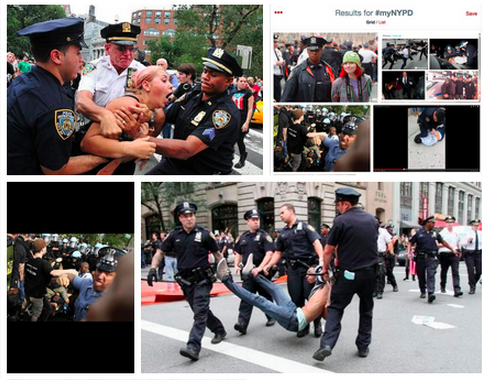
#myNYPD

What was on April’s Blog Menu, you ask? A flurry of posts covering everything from issues in ethnicity, crime stat validity, police social media involvement and ongoing Ukraine and surveillance coverage, of course! Continue reading

Standard
Dossiers

Ethnic Profiling as a Societal Institution in the Netherlands

The editors of Anthropoliteia would like to welcome this special “Dossier” from our own Paul Mutsaers

Psychologism and profiling ‘the other’

It is common knowledge in the sociology of police that law enforcers do not merely apply legal maxims but ‘employ discretion in invoking the law’, as Egon Bittner already put it in 1970 in The Functions of the Police in Modern Society. There is often not much consistency in the application of the law as beat officers have a large leeway when they operate in the blind spot of their desk superiors, that is, on the street. While on the beat, policing may be turned into a mechanism of social ordering that has the potential to significantly alter the life prospects of those who are encountered. When roaming in the districts, containing a demonstration, responding to an emergency call, mediating a conflict, investigating a homicide, or containing a riot, the police are actually (re)producing social hierarchies and differences in the settings in which they operate. Continue reading

Standard
Book Reviews

The Poetry of Barrio Libre

BL Cover2

Book Review: Gilberto Rosas, Barrio Libre: Criminalizing States and Delinquent Refusals (Duke University Press, 2012).
By Vino Avanesi, undergraduate student in Culture Studies, Faculty of Humanities (Tilburg University, the Netherlands)

The title of Rosas’ work suggests a balance between the concreteness of Mexican barrio’s and the abstraction found behind scholarly walls. One could say that ‘Barrio Libre’ did not disappoint, in fact, it surpassed expectation. In order to offer the reader a deep understanding of the phenomenon called Barrio Libre, Rosas theorizes in his work the multiple threads which come together in the phenomenon. According to Rosas these social, economic and political threads constitute the fabric of the problems underlying the emergence of Barrio Libre. Continue reading

Standard
Announcements, Book Reviews

New Feature: Book Reviews

Over the last couple of months we’ve already introduced two new suites of features: the first being a series of periodic digests from academic journals, around the web (which we call DragNet) and in the news that we’re collectively calling “Round Ups” and the second being the collection of original contributions from researchers From the Field, which we’ve further broken down into impressionistic Dispatches and more fully-developed Dossiers.

Now the editors of Anthropoliteia are happy to announce the first in a third “suite” of features which we’re collectively calling “Bibliographemes”.  The neologism is a a play on Roland Barthes’ term “biographeme,” of which Richard Elliott, drawing on Seán Burke, writes: Continue reading

Standard